
If you are looking for entry level compliance jobs, start by identifying the smallest real set of tasks you could perform competently, not by applying to every posting with “entry-level” in its title. Compliance work concerns checking whether activities meet applicable requirements and recording findings. An entry-level support position may organize evidence and track requests, whereas an officer may interpret rules, advise leaders or conduct assessments. Those responsibilities are not interchangeable. This guide compares starting compliance routes, shows how to prove careful work without inventing experience, and gives U.S. applicants a practical screen.
The BLS occupational profile describes established tasks and preparation for this field; it does not certify that a current opening exists.
Separate Entry Routes From Advanced Responsibilities
Start by sorting ads by the real work: document review, record keeping, monitoring, or reporting. Search for compliance assistant, audit support coordinator, policy documentation assistant and junior analyst roles that specify review and escalation arrangements. When a listing emphasizes positions independently deciding regulatory violations, providing legal advice, managing regulatory exams or owning enterprise compliance strategy, treat it as a different qualification tier rather than a failure to match a beginner job. A “compliance assistant” title is a clue, but some firms still expect industry or legal experience. Our guide “Entry-Level Event Coordinator Jobs” covers how to find realistic first roles.
Read the verbs. Words like “track,” “document,” and “escalate” suggest a supervised role; “approve,” “certify,” and “advise” suggest more responsibility.

| Possible job title | Work to verify | How to assess it |
|---|---|---|
| Compliance assistant | Track requests, evidence, dates and policy files | Verify whether tasks are administrative or analytical |
| Documentation coordinator | Organize controlled versions, logs and audit support | Good fit when record accuracy is central |
| Junior compliance analyst | Check assigned records against procedures and flag exceptions | Often needs degree or relevant industry exposure |
| Compliance officer | Assess obligations, policies and potential violations | Broader role with stronger preparation expectations |
Check Education, Training, and Supervision Before Applying
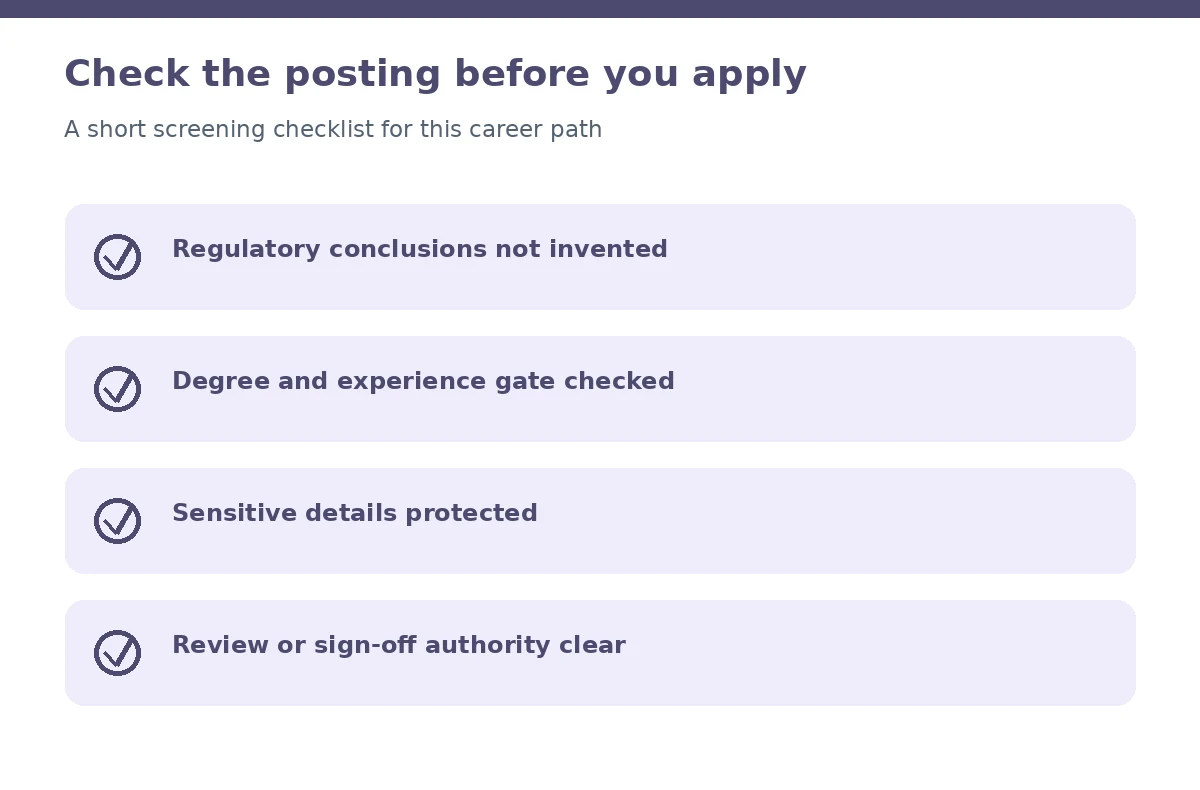
BLS says a bachelor’s degree is typical for compliance officers and that employers may seek industry experience. Entry support opportunities can have narrower tasks, but an employer’s use of “junior” or “entry-level” does not waive the skills in the posting. Read each required skill literally, such as a specific regulation area, then set preferences aside. For the fuller picture, see our guide “Entry-Level Automotive Technician Jobs”.
Make three columns: the requirement, the document or task that proves it, and what is still unclear. A course shows you know the rules exist; supervised tasks show practical use; neither gives you authority to sign off. Do not present a compliance course as professional review experience.
Build Evidence Around Real Work Tasks
The most useful evidence in compliance relates to maintaining an accurate request log, versioning approved documents, noting missing evidence, and escalating potential exceptions rather than declaring a definitive legal conclusion. Pick one small task, such as building a document checklist, explain your part, and share a file you are allowed to share. If you cannot quantify the result, say what you reviewed and what you learned.
Possible evidence includes a fictional policy-control tracker, an actual authorized records-management project, or a student case exercise that traces a procedural requirement to a documented check. A portfolio should never include real case files or personal data. Use public regulations and a made-up scenario instead. Label practice reviews as practice and coursework as coursework, separate from paid work.
Translate Experience Into a Targeted Resume
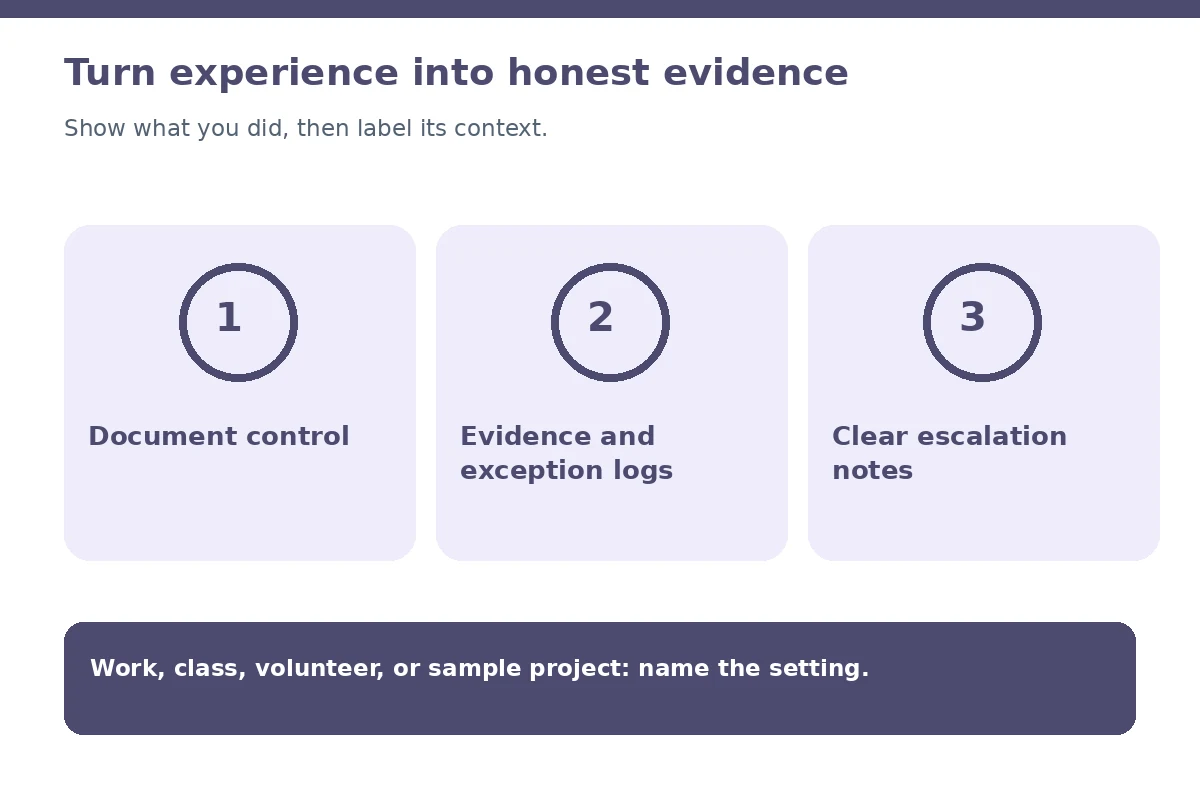
Start each résumé entry with the real setting, what you documented or reviewed, and how it was checked. For example, Hypothetical: A student prepared a mock policy version register, identified missing sign-off dates, and wrote a neutral escalation note. This shows documentation discipline, not regulatory authority or legal interpretation. Say whether you used a tracking or case system for real tasks or only in a class. Our guide “Entry-Level GIS Jobs” adds more detail on this.
If a job involves document control, demonstrate a completed related task. If it involves evidence and exception logs, state the evidence that supports your accuracy.
Ask Practical Questions During the Interview
Ask which rules apply to the unit, who interprets them, whether the role needs a degree or industry experience, how findings are escalated, and how sensitive records are stored. One useful question: “What does someone in this role handle alone in the first months, and what does a compliance officer review?” The answer shows how much support you would have.
Prepare one honest example about following a procedure, noticing a missing document, or raising a concern. Describe the situation, your task, your action, and the documented next step. If a question involves legal judgment beyond your training, say how you would get qualified guidance.
Screen Job Posts and Recruitment Messages for Risk
Before sharing personal details, confirm the job through the company’s own site. The FTC job-scam guidance warns that scammers advertise through many of the same channels as legitimate employers and may ask for money or personal data. Never pay to secure a job, and be wary of any “compliance check” that asks for your bank details.
Claiming to have “ensured legal compliance” after completing a classroom checklist overstates competence. Describe the record-review or documentation task, not an unproven legal result. Check the work site, schedule, and training before you accept.
Use a Seven-Day Application Workflow
On day one, collect a manageable list of real vacancies using titles such as compliance assistant, audit support coordinator, policy documentation assistant, junior compliance analyst. On day two, group compliance ads by tasks and minimum requirements. Then, on day three, pick an existing example or finish one labeled practice checklist. On day four, update the résumé with only true compliance claims. On day five, check each company’s official application page and prepare short questions.
Use the last two days to apply where you meet the essentials, and log the company, title, date, and follow-up.
How We Research Entry-Level Job Routes
We reviewed the occupational descriptions and first-role boundaries in the primary BLS source and O*NET on October 21, 2026.
Read our affiliate disclosure.
Related Job Search Guides
- Entry-Level Finance Jobs: Compare Billing, Operations, and Analyst Routes
- Entry-Level Bookkeeping Jobs: Choose Clerical Routes and Show Accuracy
- Entry-Level HR Jobs: Compare Assistant, Records, and Recruiting Support
- Entry-Level Sales Jobs: Compare Positions and Build Proof
- Entry-Level Public Relations Jobs: Choose Writing and Media Support Roles
There are support and junior roles, but requirements differ. The broader compliance officer occupation typically calls for a bachelor’s degree and may value relevant experience.
No. Assistants may organize evidence or track requests; officers can have responsibility for interpreting and implementing compliance procedures.
Yes, as a clearly hypothetical exercise that demonstrates organization and escalation, not proof of an actual regulatory finding.
No. Discuss what you documented and whom you would consult or notify within the role’s procedures.
Many do, but requirements depend on the industry, regulator, employer and job duties. Study the exact posting before applying.