
For a truck driver interview, prepare a small set of accurate examples that show how you make decisions in this role. Expect questions about safety checks, a delay or breakdown, dispatch communication, and the rules you cannot bend.
Start with the actual posting: route type, license class, and endorsements. For role duties, compare the posting with this official occupational reference; for example structure, see UMBC Career Center’s STAR guidance.
Understand What the Truck Driver Role Actually Covers
BLS describes heavy and tractor-trailer truck drivers as transporting goods, inspecting equipment, reporting problems and coordinating travel. Drivers of these vehicles generally need a commercial driver’s license. The applicable requirements depend on vehicle, route, cargo, license class, endorsements and other circumstances; do not assume that a non-CDL local delivery role has identical requirements.
A driver interview is not a request to recite legal limits from memory without context. It is a chance to explain that you check the current regulations, employer procedures, dispatch instructions and vehicle documentation. FMCSA’s Safety Planner describes the expectation to verify safe operating condition before operating applicable commercial vehicles. State what you actually did and what you would stop and escalate.
Match Interview Questions to the Work You Would Do
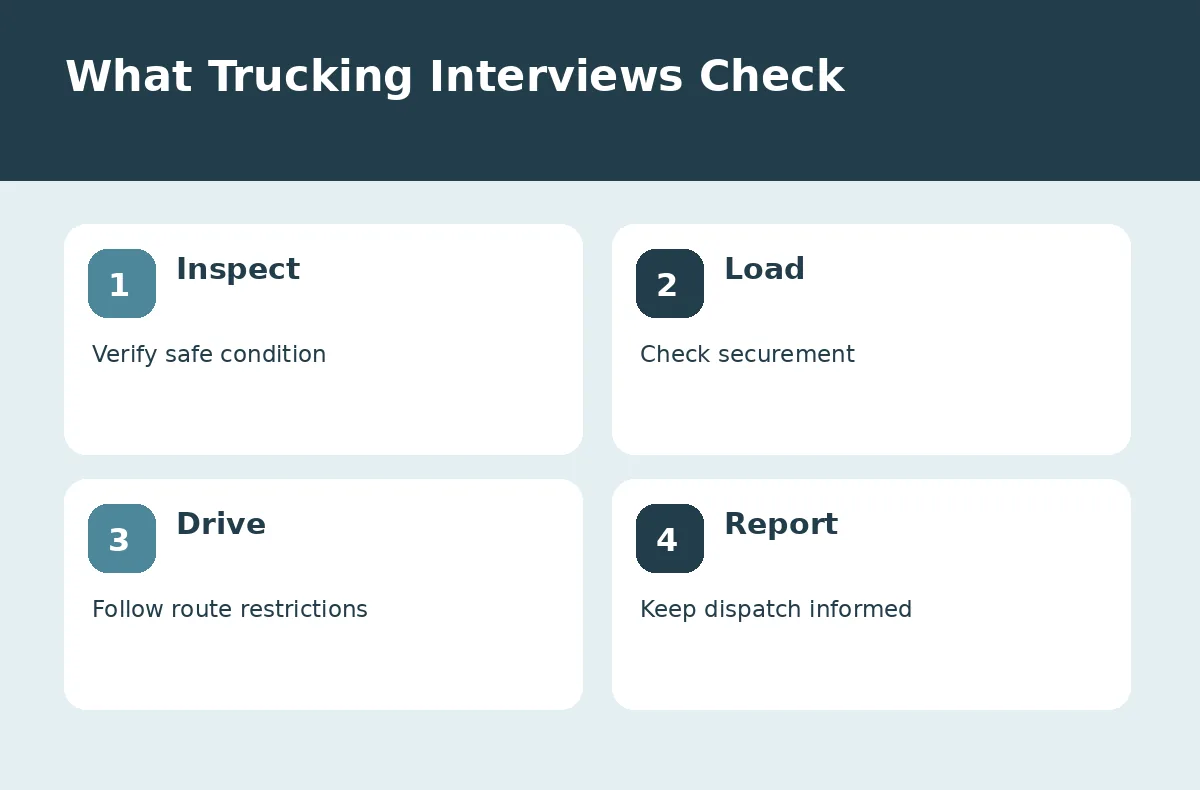
Rather than memorizing a generic list, map the posting to four recurring situations: vehicle checks, load and cargo, route disruption, and dispatch updates. Use the chart below to match your driving experience to each type of question. Without commercial driving experience, a labeled training-school or other driving example can work.
Six Questions With Answer Strategies and Honest Examples
1. How do you approach a pre-trip inspection? Discuss using the applicable inspection process, checking safety-critical conditions, consulting the last report when relevant and escalating a suspected defect. Avoid claiming an unchecked truck is safe.
Hypothetical practice answer: “I would follow the approved inspection sequence, review any noted defects and notify the responsible person before moving a vehicle with an unresolved safety concern.” Use the structure only if you can replace it with your own truthful actions and context.
2. What would you do if dispatch asks you to take an unsafe load? Emphasize verifying load information, securing requirements and safe operating limits with qualified personnel. Do not say that a schedule target overrides safety.
Hypothetical practice answer: “I would stop the departure decision, report what appears unsafe and obtain a verified correction before proceeding under the applicable process.” Use the structure only if you can replace it with your own truthful actions and context.
3. How do you respond when your route is blocked? Explain checking a safe alternative consistent with vehicle restrictions, schedules and driving-time obligations, and keeping dispatch informed.
Hypothetical practice answer: “I would pull over safely if needed, check approved route options for my vehicle and update dispatch with a realistic revised plan.” Use the structure only if you can replace it with your own truthful actions and context.
4. What should you do after identifying an equipment defect? Describe documenting the observed issue according to the applicable reporting process, communicating with the correct maintenance contact and not making unauthorized repairs.
Hypothetical practice answer: “I would record the defect through the carrier’s procedure, notify maintenance and wait for an appropriate safety decision instead of guessing.” Use the structure only if you can replace it with your own truthful actions and context.
5. How do you handle delivery delays? Show accurate updates, customer-facing professionalism where relevant, realistic estimates and attention to rest and operating requirements. Avoid offering unrealistic promises.
Hypothetical practice answer: “I would notify dispatch with the verified cause and available timing information, then follow the approved communication procedure for the customer.” Use the structure only if you can replace it with your own truthful actions and context.
6. How would you describe your driving qualifications? Give only your real license class, endorsements, training, vehicle types and applicable experience. Mention any restrictions accurately. Never claim certification or an accident-free record that cannot be established.
Hypothetical practice answer: “I would describe the class and endorsements shown on my license, the vehicles I have actually operated and the training I can document.” Use the structure only if you can replace it with your own truthful actions and context.
Use a Decision Path for an Unexpected Scenario
You identify an unresolved safety concern during inspection while dispatch is urging you to depart. An appropriate interview answer is to explain the observed condition, follow the carrier’s inspection and reporting process, seek a qualified determination and not operate a vehicle you cannot verify as safe. Do not supply fabricated legal details or imply that a dispatcher can waive requirements.
For a behavioral answer, set the scene briefly, spend most of the time on your actions on the road, then share the result. This is consistent with the STAR-based approach described by Penn Career Services. If the question is hypothetical, explain how you would put safety first; do not invent a past event.
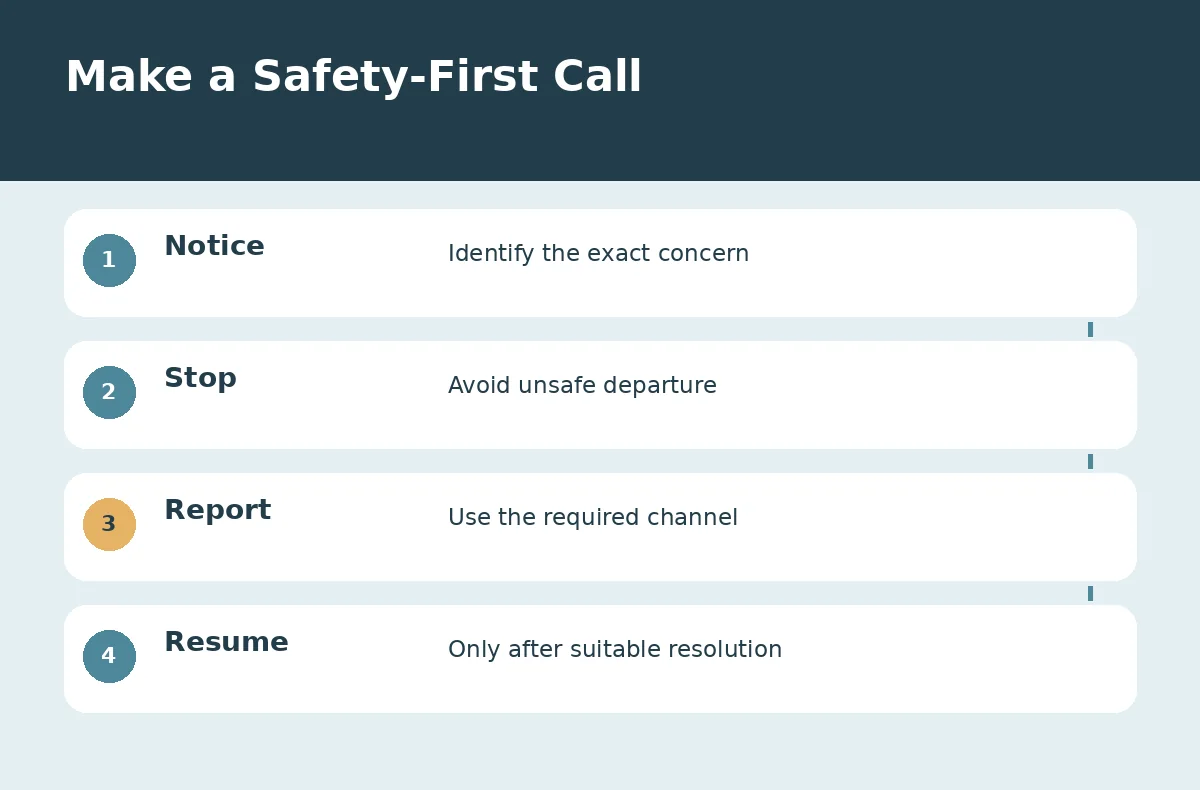
| Situation | Best next move | Evidence or result |
|---|---|---|
| Pre-trip concern | Verify and report the condition | A safety decision before movement |
| Cargo appears unsecured | Stop and use approved load process | Confirmed securing action |
| Traffic closes the route | Check safe vehicle-appropriate alternatives | An updated dispatch plan |
| Delivery will be late | Send a truthful status update | A documented revised handoff |
Build Evidence Even Without the Exact Job Title
Prepare a factual inventory of the vehicles you have driven, routes you have completed, training, licensing and any equipment you are competent to use. You can discuss a school driving exercise as training, not professional miles. If an employer asks for records or safety history, provide accurate information through the required process rather than inventing a clean record or confidential employer log.
Make a card for each story: the trip, your responsibility, what you did, and what you would improve. If dispatch or a mechanic solved the problem, say so. If you only rode along with another driver, say so.
Avoid Answers That Hide Important Uncertainty
Weak answers glorify speeding up deliveries, skipping checks or ignoring a defect to protect an on-time rate. Another weak answer quotes a rule without checking applicability. Strong responses establish the safe choice, accurate communications and next steps. Use current FMCSA resources and the job’s exact vehicle and operating context for regulatory questions. Our account manager interview questions guide goes into more detail.
If asked about equipment or a route type you have not handled, say so plainly. Explain similar experience you have, what training you would need, and who you would ask. Never share a previous employer’s customer or load details in your answers.

Rehearse a Practical Thirty-Minute Preparation Plan
Spend ten minutes marking the posting’s key driving duties and choosing two or three matching questions. Then spend ten minutes answering aloud and checking every detail is accurate. Use the last ten minutes on a scenario such as bad weather on your route: what you check, who you call, and how you log it. Our childcare worker interview questions guide adds more detail on this.
While practicing, note whether you answered directly and put safety ahead of speed. Prepare a short introduction about your driving record and experience. Then practice follow-ups like “What did you check first?” and “Who did you contact?” The aim is to show sound judgment on the road.
Ask Questions That Reveal the Employer’s Expectations
End with questions such as: What routes and schedules would I start on? How are loads assigned and communicated? Which problems go to dispatch or safety staff? How are inspections and logs reviewed? For more detail, our financial analyst interview questions guide looks at models and assumptions.
Do not ask for guaranteed miles or pay that the posting does not state. If pay, hours-of-service rules, or license requirements come up, ask for the written details and check official guidance. Our medical receptionist interview questions guide goes into more detail.
How We Research Truck Driver Interview Questions
All scenarios and answer samples are expressly hypothetical.
Sources, Limitations, and Affiliate Disclosure
References checked 2026-10-21: BLS; UMBC Career Center; Penn Career Services; FMCSA. This guide contains no affiliate links. See the JobAsk affiliate disclosure for the site’s policy.
More Interview Preparation Guides
- Electrician Interview Questions: Safety Judgment, Troubleshooting, and Training
- Warehouse Interview Questions: Safety, Inventory Accuracy and Teamwork
- Warehouse Worker Interview Questions: Safety, Accuracy, and Shifts
- Maintenance Technician Interview Questions: Safety and Work Orders
- Manager Interview Questions About Decisions, Teams and Accountability
It may. Explain the actual inspection procedure you know, safe-condition checks and reporting of defects under applicable rules.
Know the requirements relevant to your operation and check the current regulations; do not claim one schedule applies to every driver.
Yes, if clearly identified as training rather than paid driving experience, and qualifications are accurately stated.
Describe stopping the unsafe departure decision, notifying the right people and following verified securing procedures.
Ask about vehicle types, inspection process, dispatch communication, training support and which routes or endorsements the role requires.