
For a financial analyst interview, prepare a small set of accurate examples that show how you make decisions in this role. Expect questions about models, a forecast that missed, explaining numbers to others, and when you escalate a concern.
Start with the actual posting: reporting, modeling, and the tools listed. For role duties, compare the posting with this official occupational reference; for example structure, see UMBC Career Center’s STAR guidance.
Understand What the Financial Analyst Role Actually Covers
BLS describes financial analysts as interpreting financial data, forecasting trends and preparing reports or recommendations. Interviews can differ sharply among corporate financial planning, investment research and risk analysis. First classify the target position: a budgeting role may stress variance explanations; an investment role may require valuation; a risk role may focus on exposure and controls.
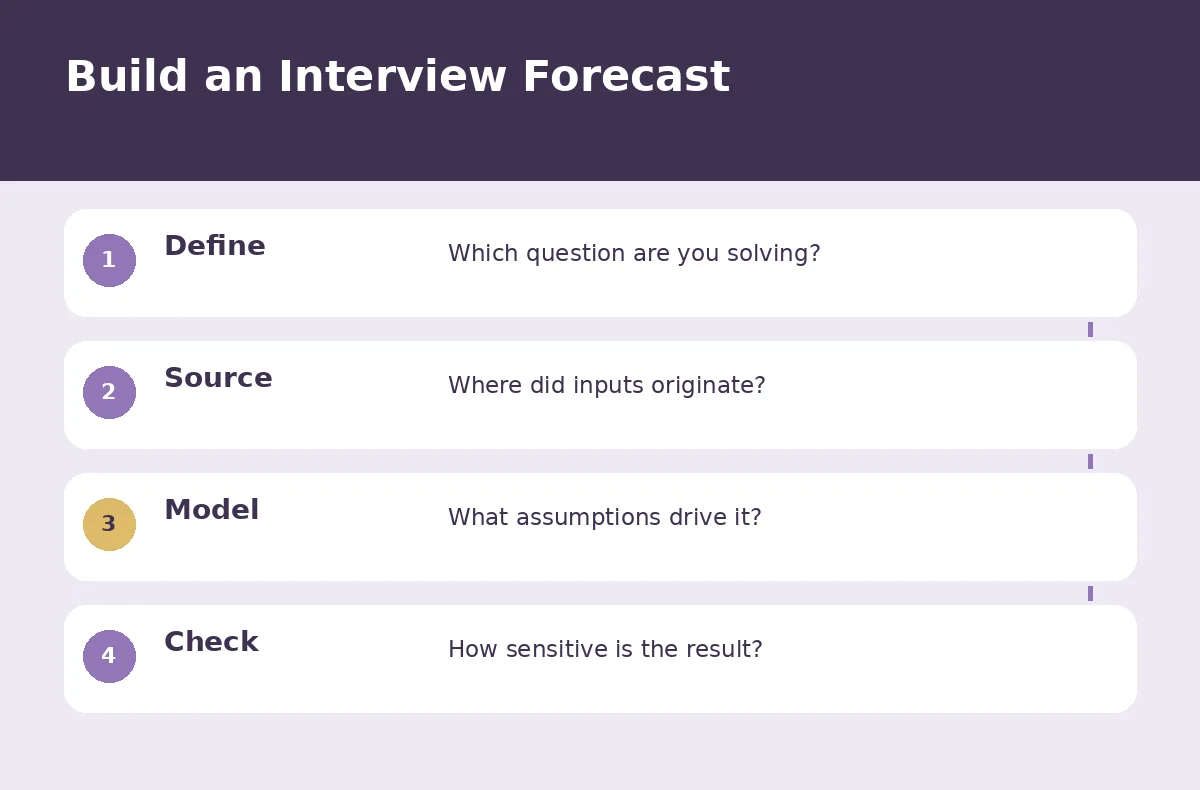
A spreadsheet is not the conclusion. A useful analyst explains the data source, what was assumed, how errors were checked, which variables could change the result and which decision the result can support. Interviewers may test both arithmetic accuracy and the limits of the analysis. Do not claim one universal modeling test.
Match Interview Questions to the Work You Would Do
Rather than memorizing a generic list, map the posting to four recurring situations: data quality, forecast drivers, sensitivity, and recommendation. Use the chart below to match your analysis work to each type of question. Without finance work experience, a labeled course model or case competition can work.

Six Questions With Answer Strategies and Honest Examples
1. How do you build an initial forecast? Begin with the business question, period and source data. Separate observed history from assumptions and decide what operating drivers plausibly explain movement.
Hypothetical practice answer: “I would check the historical series, document volume and price assumptions, calculate a base case, and show which inputs drive the forecast.” Use the structure only if you can replace it with your own truthful actions and context.
2. What do you check before trusting a financial model? Explain formula consistency, sign conventions, source reconciliation, time-period alignment and reasonableness checks. Name specific checks you know how to run rather than claiming every model is error-free.
Hypothetical practice answer: “I would trace totals to source figures, inspect formulas at category boundaries and test whether changing an input produces a plausible directional response.” Use the structure only if you can replace it with your own truthful actions and context.
3. How would you explain an unfavorable budget variance? Distinguish price, volume, timing and scope effects when evidence permits; verify the comparison baseline. Do not invent a business cause simply because it sounds strategic.
Hypothetical practice answer: “I would check whether the spending date shifted, compare actual units with the plan and tell the manager which causes remain unverified.” Use the structure only if you can replace it with your own truthful actions and context.
4. When would you run a sensitivity analysis? Use sensitivity when a recommendation depends materially on uncertain assumptions. Describe one input at a time or coordinated scenarios and show the decision implications, not just a chart.
Hypothetical practice answer: “I would test a range of plausible demand assumptions and identify where the proposed project no longer meets its stated target.” Use the structure only if you can replace it with your own truthful actions and context.
5. How do you present a technical result to a nonfinance colleague? Start with the decision and material uncertainty; use a small number of labeled figures and clarify what the analysis cannot determine. Invite questions about inputs.
Hypothetical practice answer: “I would lead with the cost drivers and decision threshold, then keep a detailed worksheet available for colleagues who need to inspect the formulas.” Use the structure only if you can replace it with your own truthful actions and context.
6. What if you discover a mistake after sending a report? Explain immediate verification, transparent correction through the right channel, documentation of affected conclusions and a preventive check. Concealment is not a defensible answer.
Hypothetical practice answer: “I would reproduce the error, notify the report owner, send a corrected version with the changed figures identified and add a specific review check.” Use the structure only if you can replace it with your own truthful actions and context.
Use a Decision Path for an Unexpected Scenario
Your forecast differs sharply from a colleague’s estimate. Before claiming either person is wrong, compare definitions, periods, source data and assumptions. Build a simple reconciliation of differences and explain which decisions change under each scenario. This is a stronger interview response than announcing that your Excel skills prove the forecast is correct. Our truck driver interview questions guide adds more detail on this.
For a behavioral answer, set the scene briefly, spend most of the time on your analysis, then share the result you can verify. This is consistent with the STAR-based approach described by Penn Career Services. If the question is hypothetical, explain how you would test the numbers; do not invent a past event.
| Situation | Best next move | Evidence or result |
|---|---|---|
| Numbers do not reconcile | Check source and period alignment | A documented correction or open issue |
| Forecast depends on demand | Test plausible driver assumptions | A range and decision threshold |
| Manager wants one recommendation | Present findings with caveats | A clear tradeoff and next step |
| Model contains an error | Verify and disclose promptly | A corrected analysis and control |
Build Evidence Even Without the Exact Job Title
For a portfolio, use publicly available data or a clearly labeled hypothetical dataset, document inputs and show working formulas. Never present confidential company information or fictional investment performance as real. An applicant without analyst employment may discuss a capstone project or a supervised budget exercise, explicitly naming its academic context.
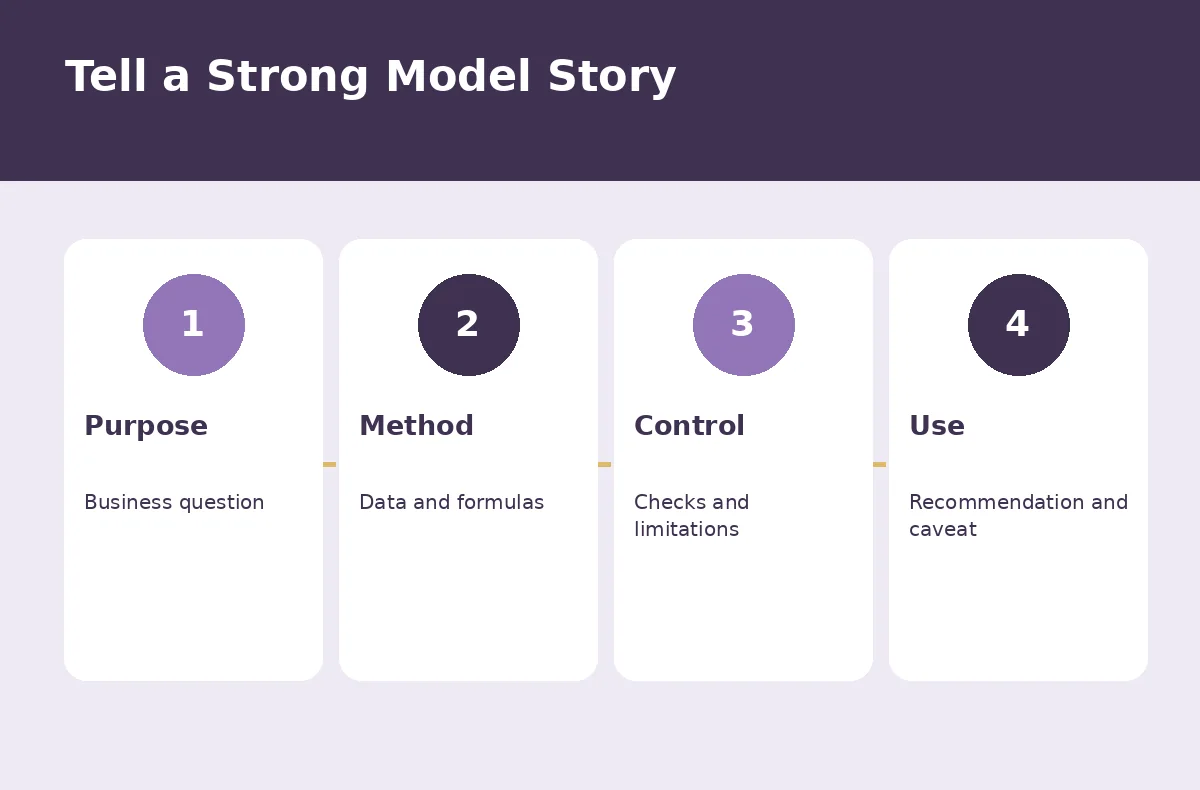
Make a card for each story: the business question, your analysis, your evidence, and what you would improve. If a team built the model, say which part was yours. If you only reviewed a colleague’s model, say so.
Avoid Answers That Hide Important Uncertainty
A memorized technical definition does not answer why a model is useful. Avoid giving a ratio without describing the financial question, period or source. Another common weakness is false precision: a forecast may be a disciplined estimate rather than a fact. Show assumptions, alternate cases and a bounded recommendation.
If asked about software or a valuation method you have not used, say so plainly. Explain a similar method you know, what you would study, and who you would ask to review your work. Never share confidential client figures or internal reports in your answers.
Rehearse a Practical Thirty-Minute Preparation Plan
Spend ten minutes marking the posting’s key analysis duties and choosing two or three matching questions. Then spend ten minutes answering aloud and checking every number is accurate. Use the last ten minutes on a scenario such as a figure that does not reconcile: what you check, who you tell, and how you document it. Our childcare worker interview questions guide goes into more detail.
While practicing, note whether you answered directly and explained your assumptions. Prepare a short introduction about your analysis experience. Then practice follow-ups like “What assumption mattered most?” and “What would you change?” The aim is to show sound judgment with numbers. For the fuller picture, see our medical receptionist interview questions guide.
Ask Questions That Reveal the Employer’s Expectations
End with questions such as: Which reports matter most in the first months? Which tools and data sources does the team use? Which issues go to the finance manager? How is model accuracy reviewed? Our account manager interview questions guide goes into more detail.
Do not ask for confidential financials or guaranteed bonuses. If pay, bonuses, or licensing come up, ask for the written details.
How We Research Financial Analyst Interview Questions
All scenarios and answer samples are expressly hypothetical.
Sources, Limitations, and Affiliate Disclosure
References checked 2026-10-21: BLS; UMBC Career Center; Penn Career Services. This guide contains no affiliate links. See the JobAsk affiliate disclosure for the site’s policy.
Related Guides
- Business Analyst Interview Questions: Requirements and Stakeholder Decisions
- Entry-Level Finance Jobs: Compare Billing, Operations, and Analyst Routes
- Financial Analyst Resume Summary: Show Your Methods and Decisions
- Accountant Interview Questions: Accuracy, Reconciliation, and Judgment
- Tell Me About Yourself in an Accounting Interview: Records and Judgment
Many include financial reasoning, spreadsheets or case discussions, but the depth depends on the specific analyst function.
Use an honest academic or personal project with public or hypothetical data, and explain the methods and limitations.
Know relevant concepts for the posting, but practice explaining what a metric measures and why its inputs matter.
State the decision, source data, assumptions, checks, sensitivity and any unresolved uncertainty.
Ask which reports the role owns, how models are reviewed, what sources are used and who makes final decisions.