
An artist CV should make a reader understand your creative practice and verify your exhibition record without searching through decorative design. Start with one complete master record, then select and order the sections required by the gallery, residency, grant program or academic committee. A long CV is not automatically the right document for every opportunity; follow the exact call for applications before choosing length and format.
The College Art Association (CAA) visual-artist CV guidelines distinguish a comprehensive record from shorter selections. Its artist résumé guidance describes an abbreviated, audience-specific presentation. These are professional conventions, not a guarantee of acceptance. Your images, statements, proposal and documentation may be equally important to the reviewer.
Decide Which Document the Opportunity Needs
Read the submission instructions before editing. An academic search may ask for a complete CV with teaching, research and professional activity; a gallery or open call may request a concise résumé emphasizing exhibits and selected recognition. When the instructions specify a page limit, format or section order, treat that as the actual rule rather than a generic template recommendation. Do not submit a long chronological archive merely because the document is called a CV. For the next step, our academic CV format guide explains how to organize Research, teaching, and publications.
Keep a master list with every verified exhibition, publication, grant, residency, commission and teaching activity. Create a separate submission copy that highlights relevant entries without deleting your source record. If you have a limited exhibition history, use honest sections such as Selected Projects, Education or Community Practice when applicable. Never change an unjuried open event into a juried exhibition or a group show into a solo exhibition for stronger optics.

Organize Your Header and Creative Record
Place your name, reliable contact information, city or region as appropriate, and a working portfolio link at the top. A website is most useful when a reviewer can reach the actual artwork quickly. The discipline or medium may be included if it clarifies your practice, but avoid an inflated artistic title. Use legible headings such as Exhibitions, Grants and Awards, Residencies, Commissions, Publications and Teaching. Omit sections with no truthful entries.
Within most dated sections, place recent work first and use one repeatable entry pattern. CAA recommends reverse chronology for many artist CV sections, with exceptions for some undated categories. If a call asks for selected activity only, select by relevance, quality of documentation and significance rather than listing every small event. Avoid graphics, portraits and elaborate typography inside the actual CV; save visual richness for the portfolio where it belongs.
| Requested document | Priority evidence | Decision rule |
|---|---|---|
| Academic or comprehensive CV | Complete verified professional activity | Use if a long CV is requested |
| Gallery or opportunity résumé | Selected exhibits, awards, practice | Follow the application page limit |
| Grant or residency application | Relevant practice, awards, exhibitions | Add requested proposal separately |
Write Exhibition and Grant Entries Precisely
For an exhibition, provide the year, show title when known, your participation type, venue and location, with enough details to distinguish a solo, two-person or group exhibition. If an event was virtual, identify it that way. A student show may be worth including, especially early in a career, but label it accurately. An application reviewer should not need to guess whether the artist curated, exhibited or simply attended an event.
For a grant or residency, record the award name, awarding organization, year and status. Separate grants actually received from applications still under review. An award for which you were only shortlisted should be marked as such, not added as a won grant. Hypothetical example: “2025 — Group Exhibition, Material Dialogues, Neighborhood Arts Center, Portland, OR” illustrates structure only; it is not a verified real exhibition.

Connect Your CV to Your Portfolio
A CV is a navigational record, not a substitute for documenting the art itself. If you mention a public commission, exhibition or performance, make sure a portfolio page or supporting evidence explains what the work was and what you contributed. Place a single stable portfolio URL in the header instead of scattering shortened links throughout the page. Check that the link works without a private sign-in and that images have informative captions and clear authorship.
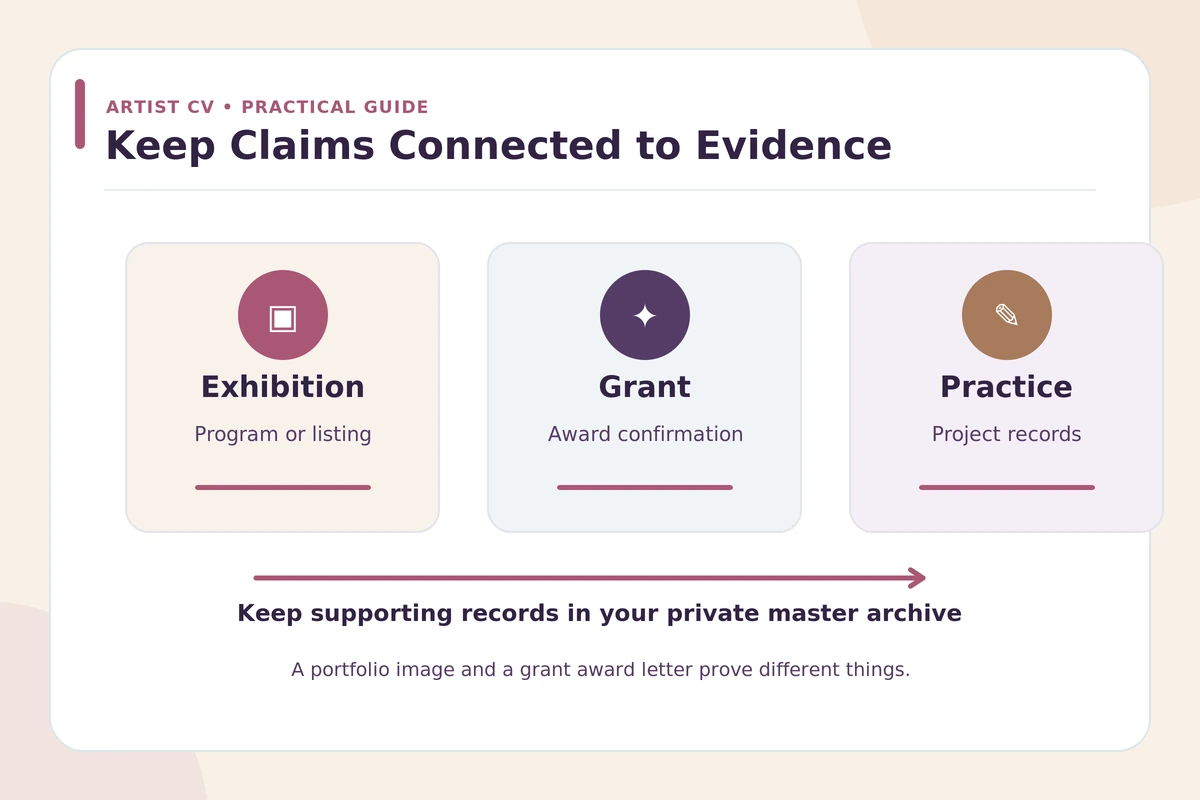
Do not create false cross-references. A portfolio image may show a piece, but it does not by itself prove that a grant was awarded or that a venue exhibited it. Keep the award letter, official program, catalog or other permissible record in your private master archive. You can then answer a factual follow-up without exposing private documents or adding unverifiable awards to your submitted CV. For the fuller picture, see our guide “Executive Resume Layout”.
Handle Emerging Practice Without Padding
Artists who are just starting may have coursework, community exhibitions, collaborative practice or self-directed projects rather than a long gallery record. Give those activities their truthful labels and dates. Self-organized events belong in the record if meaningful, but should be described as self-organized. If a collaboration matters, clarify your role without claiming sole authorship. A short, accurate résumé can be more useful than a long document with empty headings.
Personal statements and proposals serve different purposes from a CV. An artist statement describes the themes or approach of the work; a proposal outlines an intended project; the CV records what you have actually done. A grant application may require all three. Check where the organizer wants each element rather than inserting several paragraphs of artist-statement prose into the exhibitions section.
Audit Every Date, Credit, and Attachment
Before submission, compare each selected line with its original record. Confirm the spelling of institution and venue names, event dates, city and state, grant status, collaborator roles and live URLs. Where the official title differs from a casual shorthand, use the title documented by the organizer. A visually tidy format does not excuse a misleading record. Never publish a third party’s private contact details to substantiate an entry.
Export according to the application instructions and inspect the actual file after export. CAA favors straightforward, readable presentation; small decorative illustrations can reduce scanability. Keep a version named for the opportunity in your own workspace, but make sure its internal text contains only reader-facing information. Ask a colleague to proofread if possible and keep the complete master record unchanged for your next application.
Adapt the Order to the Reviewer
For a gallery, exhibitions and selected press might come before teaching. For a residency, prior projects and community practice might matter more. For an academic role, teaching, degrees and service may warrant prominent sections. These are editorial choices, not universal requirements. A useful test is whether the first half-page answers the opportunity’s actual selection criteria using claims you can defend. If that is your next decision, our guide “Academic CV Layout” explains how to order Research, teaching, publications, and service.
Maintain two versions only when they perform different jobs: one master record and one concise submission copy. You can also create a relevant selection within the same document when the organizer explicitly permits it. The goal is a clear record that complements your artwork, not a designed poster that forces reviewers to decode your career history.
How We Research These Resume Decisions
We reviewed the public professional and university sources linked in this guide on October 22, 2026: CAA guidance and CAA guidance. The visual decision aids and all writing examples are original editorial illustrations, not independent evidence that any candidate achieved a result. Source recommendations concern document conventions or eligibility context; they do not prove hiring success, software screening outcomes, or a specific personal claim.
Disclosure and limits: Every illustrative applicant or sample accomplishment in this article is hypothetical; replace it with your own verified record. No hiring outcome, employer endorsement, guaranteed screening performance, or affiliate relationship is claimed. Read the affiliate disclosure. Employers may impose different requirements; review those and your supporting documents before applying.
More Resume and Cover Letter Guides
- One-Page Resume Layout: What to Keep, Cut, and Check
- Architecture Resume Layout: Connect Project Roles to Portfolio Proof
- Two-Column Resume Layout: When to Use It and How to Check It
- Resume Formats Compared: Choose a Layout That Makes Your Experience Clear
- Resume Layout for a First Job: Put Education and Real Proof First
No. CAA distinguishes a comprehensive CV from a shorter, selective artist résumé. Follow the language and limits of the specific opportunity.
Yes, when relevant and accurately labeled as a student or group event. Do not imply a juried or solo status that did not exist.
Usually keep the CV text-focused and direct the reviewer to a separately requested portfolio; follow the organizer’s file instructions.
Omit those headings and emphasize actual exhibitions, projects, education or community practice without inventing recognition.
CAA generally recommends reverse chronology for dated entries, subject to limited exceptions and the application instructions.