
The STAR interview method is a simple way to answer a behavioral question with a real past example. STAR means Situation, Task, Action and Result. The method helps a listener understand the setting, your responsibility, the actions you personally took and what actually happened. It cannot compensate for a fabricated experience and it does not guarantee a job offer. This page focuses on shaping individual stories, rather than the broader JobAsk behavioral-interview-question collection. Every sample situation and speaker below is hypothetical.
Recognize when a question calls for STAR
Behavioral prompts ask for something that happened: “Tell me about a time you disagreed with a teammate,” “Describe how you handled a deadline change,” or “Give an example of learning from an error.” These invite specific episodes, not general beliefs. A question about a technical definition may need a direct explanation instead, and a hypothetical scenario may require reasoning about what you would do. STAR is helpful when a real event can demonstrate an ability, but not every interview question needs a four-part story. Start by identifying the behavior the interviewer wants to understand.
Pick an event you can describe faithfully, including what happened after you acted. You can use paid work, volunteer service, coursework or projects where relevant, clearly naming the setting. Choose a story whose details you still remember rather than forcing a perfect ending onto a vague memory. University of Washington’s STAR resource stresses that action should take the largest share of your explanation. Prepare several real examples for different skills instead of memorizing one universal script and applying it to unrelated questions.
Set the situation without overwhelming the listener
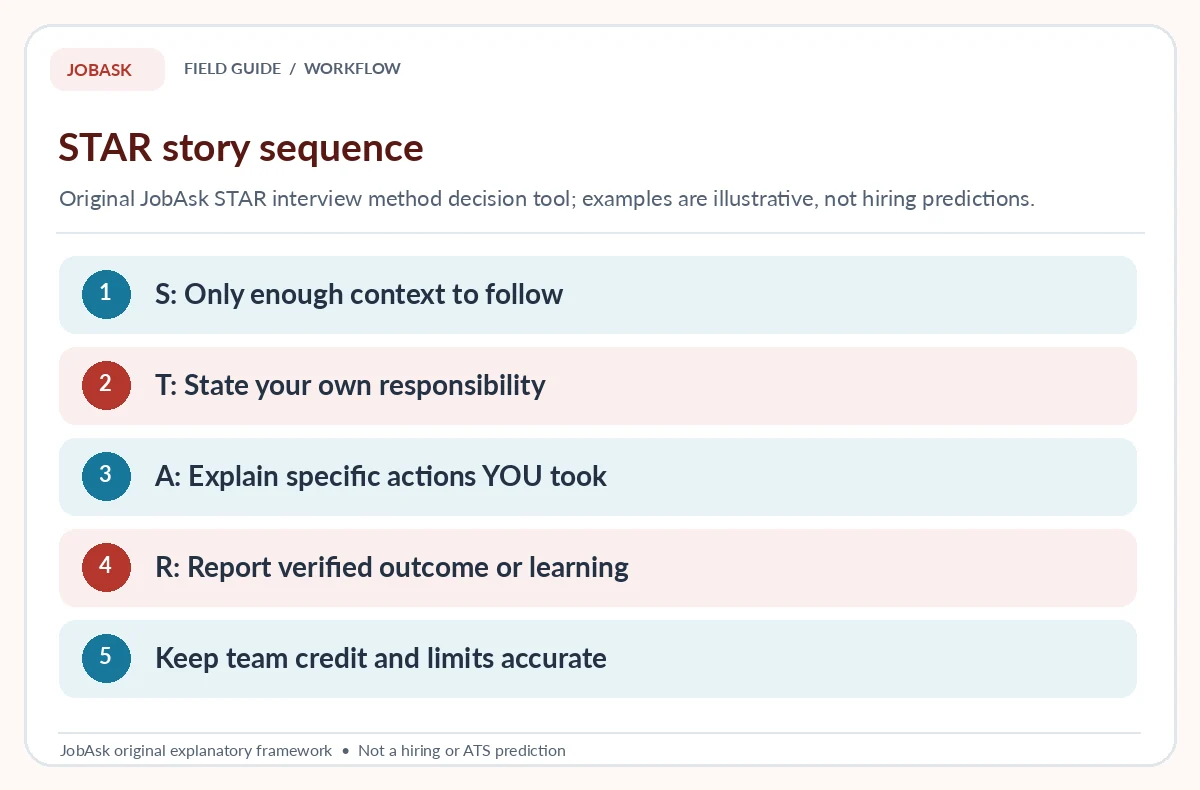
Situation gives enough context to understand why your action mattered. It might include the kind of project, the people involved and the immediate obstacle. Hypothetical opening: “During a volunteer event, our shared check-in sheet contained duplicate registrations shortly before guests arrived.” That is concrete enough to follow. It does not need a long history of the organization, the exact day or every participant. Too much setup takes the time you need to explain your decisions. Remove contextual details that have no bearing on the problem.
Be cautious with confidential stories. Generalize private details, avoid naming clients without permission and never fabricate a replacement event. If the story involves a mistake, acknowledge the problem accurately without exposing protected information. One sentence of scene-setting can work when the task is clear; a complex team project may need two or three. Your purpose is not to entertain but to give the interviewer the information necessary to evaluate your work. Stop adding context when the listener can already understand the challenge.
Clarify the task and your actual responsibility
Task answers: what was your role in that situation? A team goal is not necessarily your personal assignment. In the fictional check-in example, perhaps you were asked to compare two registration lists and prepare the corrected copy for review. Do not say you “led the event” if you only checked records. Make responsibility explicit: “I was responsible for identifying duplicate rows and bringing uncertain matches to the volunteer coordinator.” This communicates scope without overstating authority. STAR separates context from ownership so your contribution does not disappear behind “we.”
If no one formally assigned a task, describe the real responsibility you assumed and whether it was appropriate. For example, you noticed unclear signage and asked the organizer before changing it. That detail may reveal sound judgment. Avoid inventing unilateral decisions in a setting where approval was necessary. A good Task sentence prepares the listener for your Action: it states the obstacle and your responsibility in terms you can defend under follow-up questions. The task is not a boast, and it need not make you the most senior person present.
Give the action most of the useful detail
Action is where the answer becomes evidence. Explain a sequence of your decisions and behaviors: first you compared records, then marked possible duplicates, then consulted the coordinator before making changes. State what you personally did and why you chose that sequence. “We collaborated and solved everything” does not tell an interviewer much about you. University of Washington advises spending more attention on actions than on the opening context. This is guidance for clarity, not a strict stopwatch or scoring algorithm that every employer follows.
Include relevant judgment, such as documenting an unresolved issue rather than deleting a record based on a guess. If a colleague made a key change, credit that colleague. If you received direction from a supervisor, distinguish the instruction from your own execution. Interviewers may ask what you would change next time; specific action details make a thoughtful reflection possible. Avoid adding a software name you never used or a conflict that never happened just to make the story dramatic. Precision and credibility are more valuable than a cinematic ending.
| Component | Too vague | More specific and defensible |
|---|---|---|
| Situation | It was chaotic | The approved check-in sheet had duplicates |
| Task | We fixed it | I checked records for coordinator review |
| Action | I worked hard | I flagged matches and requested approval |
| Result | Everything improved | Corrected list was approved; impact unknown |

Report a result you can support
A Result may be a completed handoff, an accurately delivered item, relevant feedback or an unfinished outcome with a lesson. In the fictitious registration story, you might say: “I submitted the marked list for coordinator review before doors opened; they approved the corrections.” Do not add “cut wait times by 40 percent” without recorded evidence. Even a genuinely imperfect result can demonstrate learning if you explain what you observed and how you adjusted your practice. A result is not a claim that you controlled every subsequent team outcome.
Sometimes the project ends after your participation or the impact was not measured. Be straightforward: “I prepared the handoff notes; I did not track the final processing time.” That is preferable to estimating a number that sounds impressive. You can describe feedback only if you genuinely received it. If something failed, explain your decision, what happened and what you would change, without blaming colleagues or rewriting the story into a success. Specific reflection can be more informative than an unsupported claim of extraordinary results.
Practice two hypothetical stories and assess them
Fictional answer one, a changed deadline: “Situation: Our class project presentation was moved up one day. Task: I owned the outline and needed to help the group deliver a coherent version. Action: I drafted a shorter agenda, asked teammates which examples they could verify and revised the slides after their feedback. Result: We submitted the revised presentation on time, though we removed one planned example.” The answer states a limit and makes no fictitious grade or employer claim. It would be inappropriate for someone to present this story if it did not actually happen to them.
Fictional answer two, correcting an error: “Situation: I noticed an incorrect room number on a volunteer flyer. Task: My role was distributing approved materials. Action: I flagged the error to the organizer, checked the correct room against the event plan and distributed the updated version only after approval. Result: The revised flyer was used; I do not know how many people saw the earlier copy.” Compare these with “I have amazing attention to detail.” The stories describe action and truthful limits. Practice aloud, then ask whether the event answers the precise question rather than merely sounding polished. If that is your next decision, our guide “STAR Interview Answer Preparation” explains how to build real stories that fit the question.

How We Research and Limits of This Guide
We reviewed the University of Washington STAR method resource and behavioral interview examples, then differentiated this single-answer technique from JobAsk’s earlier Behavioral Interview Questions and Tell Me About Yourself topics. The two short stories, before/after rubric and action-attribution diagram were authored as hypothetical examples. No interview study, hiring guarantee or private employer evaluation is claimed.
Sources reviewed October 19, 2026: University of Washington defines STAR and emphasizes specific personal action in behavioral answers. University of Washington discusses applying Situation Task Action Result to real past-work examples. University of Washington includes examples of how context, actions and results can be structured in a response.
Affiliate disclosure: There is no affiliate interview-coaching promotion in this article; the guidance links are free editorial references. Read the JobAsk affiliate disclosure for the site-wide policy.
More Interview Preparation Guides
- Interview Strengths and Weaknesses: Give Specific, Honest Answers
- Tell Me About Yourself in an Interview: Build an Honest, Focused Answer
- Tell Me About Yourself in a Nursing Interview: Safe, Specific Answers
- Tell Me About Yourself in an IT Support Interview: Triage and Evidence
- Tell Me About Yourself in a Construction Interview: Safe Site Work
Situation, Task, Action and Result: context, responsibility, your actions and the actual outcome.
No. It is most useful for questions asking about past behavior; direct technical or factual questions may need a different structure.
Yes, when it is your real experience and you accurately identify the setting and your contribution.
Describe what occurred truthfully, what you learned and what you would do differently without fabricating a positive metric.
Keep enough detail to explain your action clearly; follow the interviewer’s cues rather than treating any timing formula as universal.