
When an interviewer asks “Tell me about yourself,” offer a short professional introduction rather than reciting your biography. A useful answer connects what you do now, one experience that demonstrates a relevant capability, and why this particular work interests you. There is no secret response that guarantees selection. This guide focuses only on the opening interview question; JobAsk’s broader interview-preparation and common-questions guides handle logistics and other prompts. All applicants and jobs in the examples are fictional.
Understand the actual purpose of this opening question
The interviewer needs a starting point for a conversation about your fit with the posted work. They may already have your resume, so a chronological reading of every job title rarely adds much. Select what helps a listener understand your relevant experience and direction. UW–Madison’s career guidance includes this question among common interview prompts and recommends a present, past, future frame. Treat that structure as a communication aid, not as a hiring algorithm or a fixed script that every employer follows.
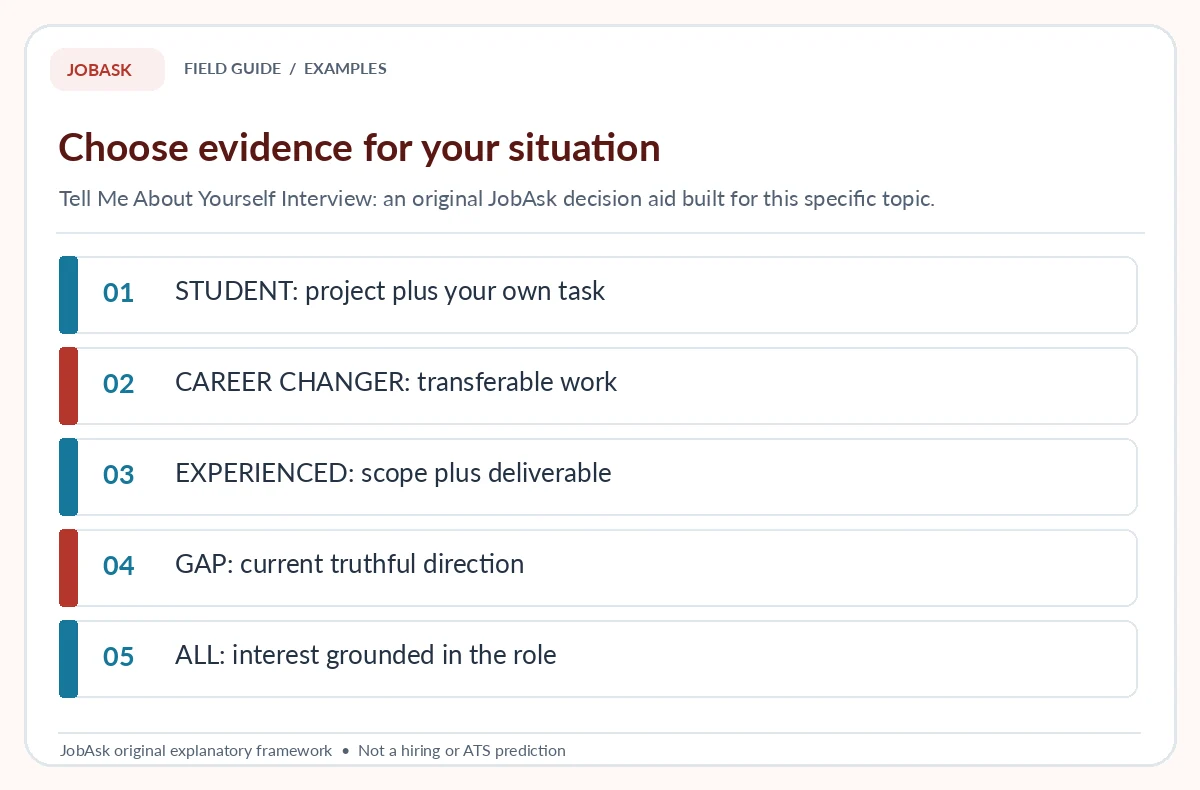
Before rehearsing, underline two responsibilities in the real job description that match things you have actually done. A student might choose a class project; a career changer might choose a service workflow; an experienced candidate might choose coordinating teams. Then ask whether the example is understandable without specialized internal jargon. The task is to make a short, truthful connection. Do not claim the interviewer’s intent can be read from their tone, facial expression, or the timing of the question.
Build a present past future outline before drafting sentences
For the present, state your current work, study, or professional focus and mention a relevant activity. For the past, give one concrete example explaining where a useful skill came from. As for the future, link that skill to the responsibilities of this role, using an employer detail you have actually checked. Brandeis describes this as present, past, future. The parts are a sequence of ideas, not three obligatory paragraphs or a universal sixty-second formula.
Use a three-box note card: NOW — what I do and what I handle; EVIDENCE — one true task and what came of it; NEXT — why the duties described in the posting are the kind of contribution I want to make. Draft each box in your own words without claiming a specific performance metric you cannot verify. If you need twice as long to explain your example as the question warrants, narrow the evidence. A concise answer can still feel warm and human; accuracy matters more than polish.

Try a fictional student example that names real kinds of tasks
Hypothetical student response: “I’m finishing a public-health degree and I help organize sign-ups for a campus volunteer program. Last term I consolidated event registrations into one shared worksheet and wrote instructions so other volunteers could update it. I’m interested in this program assistant role because scheduling and keeping information clear are central duties in the posting.” Every detail in this sample is invented. A real applicant must substitute their own degree, project, responsibilities, and genuinely relevant target role.
Notice what the sample deliberately avoids: no claim that the event produced an impressive percentage gain, no borrowed employer praise, and no suggestion that unpaid work was a full-time administrative job. If an applicant only observed the registration process, they should say they observed or assisted rather than led it. A listener can ask a follow-up about how the worksheet was maintained. That is a useful standard for choosing an example: could you describe the work accurately if invited to explain it?
Adapt the structure for career changers and experienced workers
Hypothetical career changer: “I currently work in retail operations, where I organize shift handovers and document customer requests. The part I most enjoy is improving instructions for people who pick up a task later. I’m now exploring office coordination roles because the posting includes recordkeeping and cross-team updates.” The transferable link is a specific action, not a declaration that retail experience automatically qualifies someone for every administrative position. A career change does not require hiding an accurate job title.
Hypothetical experienced applicant: “I coordinate logistics for a community-services team and regularly update shared schedules when priorities change. In an earlier role I built a straightforward checklist for handing over recurring tasks, which helped colleagues find the information they needed. This operations coordinator position appeals to me because it emphasizes clear cross-team coordination.” Again this is fiction, not evidence of results or a real vacancy. Edit for your own scope; do not imply leadership responsibility for a project you only supported.
| Part | Prompt | Evidence to verify |
|---|---|---|
| Present | What do I work on now? | Exact role, study or project |
| Past | Which task shows the skill? | Personal action, not team credit |
| Future | Why this posted work? | Real role duty or employer fact |
| Listen | Can a newcomer follow it? | Specific nouns, fewer acronyms |
Practise as a conversation rather than a memorized speech
Say the answer aloud with the job description closed, then listen to a recording only if you are comfortable doing so. Can someone outside your organization understand your role, the action you took, and the work you hope to do next? If not, substitute ordinary verbs for internal acronyms. Replace claims such as “I always exceed expectations” with one substantiated responsibility. UW–Madison also advises thinking through your skills, employer research, and what you want from a role; the opening should be consistent with those broader answers.
Time the response once to catch rambling, but do not chase a fake universal threshold. An interviewer may invite a brief overview or ask for more detail. Leave room for an interruption and be prepared to shorten or expand your answer. If you have employment gaps or a nontraditional route, lead with present capability and relevant evidence rather than volunteering sensitive private details. You can decide what personal information is appropriate to disclose. A confident answer is clear enough to start a real exchange.
Edit out common detours and unsupported claims
A weak opening often contains one of four detours: a complete life history, a list of unsupported personality adjectives, a detailed discussion of unrelated responsibilities, or exaggerated claims about the prospective employer. Mark any sentence that does not make the role connection clearer. If you say “expert,” “managed,” or “improved,” make sure you can define what you actually did. If you refer to the employer’s mission, confirm it through an official source instead of inventing a flattering detail from a copied example.
Replace an abstract line such as “I’m a natural leader who loves challenges” with a true task: “I facilitated weekly check-ins for our volunteer project and tracked follow-up items,” but only if that happened. Do not confuse this opening with behavioral STAR answers: a short evidence example is enough here, while an interviewer who asks for a full situation may need a longer story. Keep the question’s scope narrow to prevent cannibalization with JobAsk’s separate common-interview-questions guide. Our guide “Interview Strengths and Weaknesses” goes into more detail.
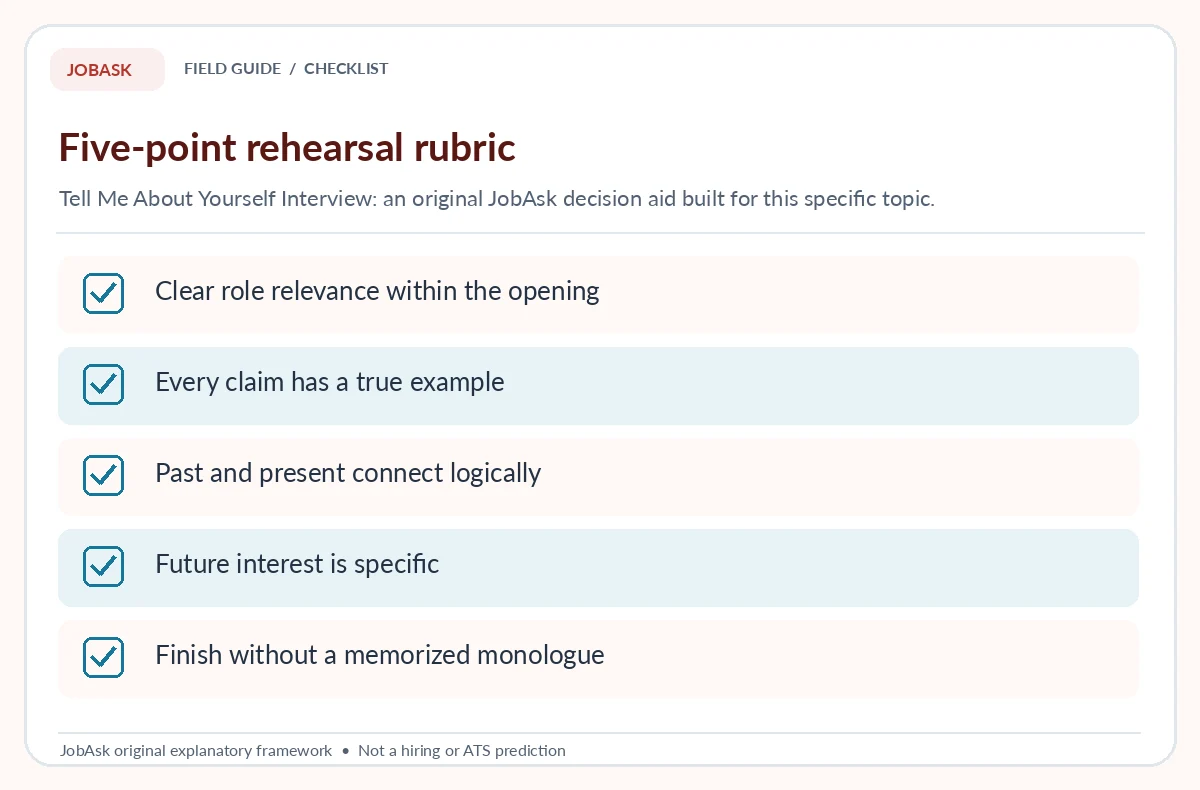
Use a final five-question self-check before the interview
Read the answer once and ask: is my current position described correctly; is the example accurate; can I explain my contribution; does the ending address the actual role; and can I say it in a natural voice? A truthful answer may not be perfect and need not copy a university example. If the target role changes, recheck the future sentence rather than pretending every employer offers the same duties. This is a practical rehearsal rubric, not a validated assessment that predicts interview success.
Ask a trusted person to listen without seeing your notes and summarize what kind of work they think you can do. If their summary misses the intended skill, adjust your example. If they hear a more senior title than you actually held, clarify the wording. Keep the final outline available before the interview but avoid reading from it word for word. This leaves space for relevant follow-up questions and ensures that the introduction represents you, rather than a template.
How We Research and Limits of This Guide
We compared UW–Madison interviewing guidance with the present-past-future descriptions hosted by Brandeis and Penn Career Services. Our student, career-transition, and experienced-worker introductions and five-point listening rubric were developed specifically for JobAsk; they do not reproduce a source sample or claim a validated hiring method. We checked the intent against JobAsk Interview Preparation and Common Interview Questions: this page treats only the opening professional introduction.
Sources reviewed October 19, 2026: UW–Madison offers the present-past-future model and encourages preparation grounded in the position. Brandeis describes present, past, future and warns against a full personal biography. Penn Career Services hosts a practical structured-answer discussion and examples.
Affiliate disclosure: The links below are educational career-center resources; we do not assert sponsorship, payment, or an approved affiliate arrangement. Read the JobAsk affiliate disclosure for the site-wide policy.
More Interview Preparation Guides
- Where Do You See Yourself in Five Years? Describe a Credible Path
- Tell Me About Yourself in an IT Support Interview: Triage and Evidence
- Tell Me About Yourself in 30 Seconds: Build a Focused Interview Pitch
- Tell Me About Yourself for Customer Service: A Calm, Evidence-Based Answer
- Tell Me About Yourself in a Phone Interview: A Clear First Answer
Make it concise enough to be conversational and relevant. Exact timing depends on context; practice reducing unnecessary details instead of chasing a guaranteed number of seconds.
You can choose what is appropriate, but you are not required to disclose unrelated private information. Start with skills and experience connected to the job.
Use genuine class projects, volunteering, student leadership, or other responsibilities, correctly described. Explain your own contribution rather than borrowing a team achievement.
Yes. Describe your current role honestly and connect tasks you actually performed to the new role; do not invent years of direct experience.
No. Rehearse the structure and supporting facts so you can respond naturally and adjust to a follow-up or shorter prompt.