
A phone interview puts most of the conversation into your words and voice; the interviewer cannot see your gestures or your notebook. Start by confirming when and how the call will happen, then practice a few accurate, role-specific answers. Georgia Tech and Stanford career resources emphasize quiet surroundings, reliable reception, accessible notes and careful listening. This guide addresses the phone format itself, not a general list of behavioral questions or the distinct logistics of a video call. The model conversations below are deliberately fictional and should never be described as actual recruiter interviews.
Confirm the time, caller and phone format
Check the exact date, time zone and expected call method in the invitation. Note whether you should call a number, use an audio link, or wait for an inbound call. Record the interviewer’s name only when provided reliably by the employer, and keep the original contact details available. If the email says the conversation is a short screen, that still requires preparation. Some calls explore availability and basic qualifications; others include examples and questions about the role. Avoid assuming a fixed duration or an identical sequence across all employers.
If a time or number is unclear, respond promptly and politely with a specific question instead of guessing. Hypothetical message: “Thank you for the invitation. Could you confirm whether the call is at 2 p.m. Eastern Time and whether I should dial the number provided?” Do not treat an unexpected generic text as a genuine interview confirmation. When a recruiter contacts you through an unfamiliar channel, verify the job through the employer’s independently accessed website. Save the confirmed arrangement in a calendar with a reminder that respects your normal travel and other commitments.
Make the call environment simple and reliable
Choose the quietest reasonably private place available, with dependable signal or stable audio connectivity. Charge the device, silence notifications and close unrelated apps. Place your resume, the employer’s job description, a pen and a short question list where you can find them without loud shuffling. These small actions reduce avoidable distractions but cannot guarantee a perfect connection. If you need an accessible interview arrangement, contact the employer through its established process rather than guessing what technology or format will be offered.
Check whether you can hear your own voice clearly using a trusted test call, especially with headphones or speakerphone. A phone interview is not the place to test an unfamiliar audio setup for the first time. Have a secondary number or email available if the employer provided one for coordination, but do not contact random numbers presented by a suspicious third party. If your chosen room unexpectedly becomes noisy, briefly explain the situation and request a moment to move if practical. Communication matters more than pretending an interruption did not happen.

Prepare brief answers using the actual job description
Read the core responsibilities and identify two or three genuine experiences that illustrate your fit. Questions may include “What interests you about this role?”, “What do you know about our organization?”, and “Can you describe relevant experience?” You do not need to memorize a performance. Prepare a short outline: the answer first, one supporting task and why it matters here. Your response should reflect things you actually did. If you are changing fields, make that transition clear without suggesting you held a related title you did not have.
For a hypothetical customer-support screen, a candidate might say, “I helped visitors navigate an event schedule and recorded questions for the coordinator. I learned to clarify the request before giving an answer.” This is a teaching example, not an account of a real employer or applicant. It is stronger than “I am a people person” because the task is identifiable. Practice saying it aloud and remove internal jargon an outsider would not understand. If a question asks about a skill you lack, acknowledge the gap honestly and discuss relevant learning where appropriate.
Listen, pause and speak at a useful pace
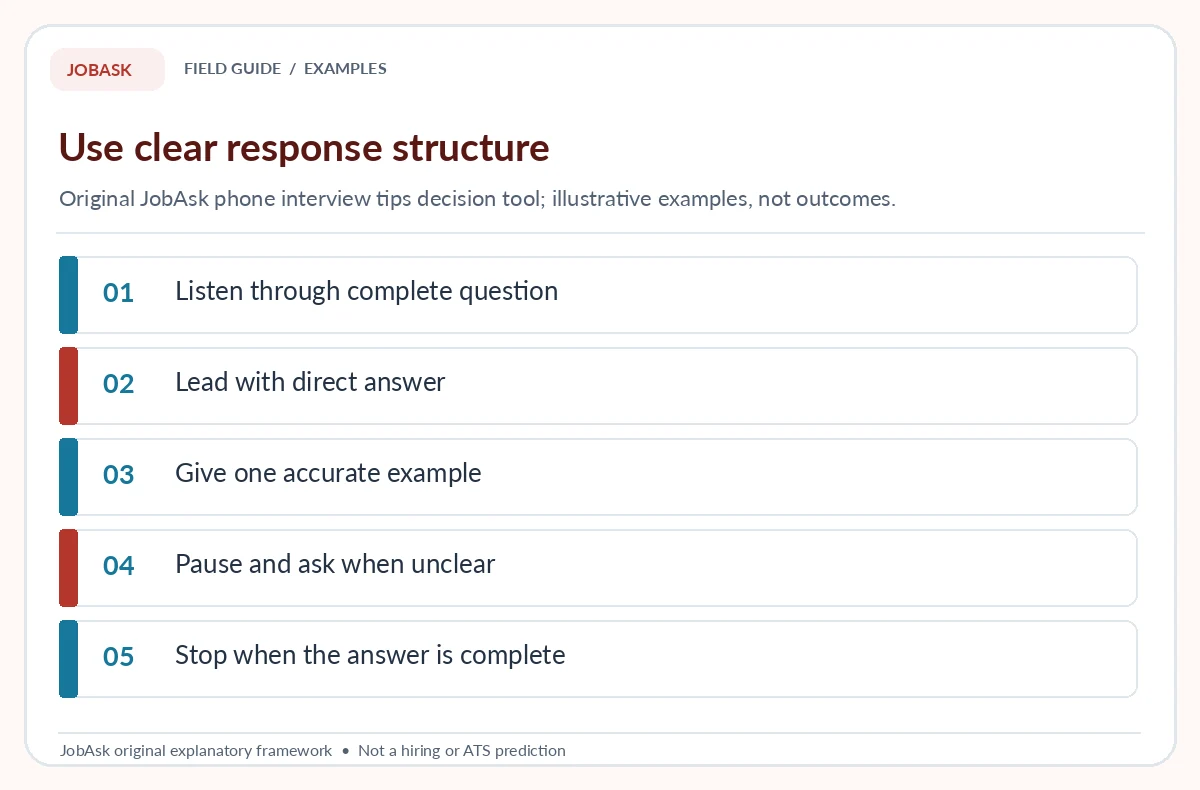
Without visual cues, it is easy to start answering before the interviewer has finished. Listen to the complete question; if there are two parts, jot down brief keywords so you address both. Give a direct opening sentence, then support it with one relevant example. A short pause is acceptable, and you can ask for clarification when the audio or the question is unclear. Georgia Tech specifically advises listening carefully and requesting repetition if necessary. Do not read long prepared paragraphs verbatim, because doing so makes it harder to respond naturally.
Keep the conversation collaborative. A fictional exchange might go: “What is your approach when a request is unclear?” “I confirm the intended outcome and deadline before acting. In a class project, I clarified conflicting instructions and documented the agreed version.” You can then stop and invite a follow-up. The situation, class and candidate are invented, and results should never be copied into a real interview. Listen for the interviewer’s answer too; their description of priorities can shape the questions you ask near the end.
| Situation | Reasonable response | Next record |
|---|---|---|
| Unexpected time-zone mismatch | Ask for corrected confirmed time | Calendar updated |
| Question unclear over audio | Request repetition calmly | Note the actual question |
| Call disconnected | Reconnect via verified invitation | Record attempt and next step |
Recover from a dropped call professionally
If the audio cuts out, first check whether the line disconnected or merely went silent. If there is an established number or link from the verified invitation, use that to reconnect. A brief, calm acknowledgement is enough: “I’m sorry, the connection dropped. I’m back now; would you please repeat the last part of the question?” Do not launch into an elaborate explanation or blame the interviewer. If repeated drops prevent a useful conversation, ask whether a rescheduled call or an approved alternate contact method is possible.
When you cannot reconnect, send one concise message to the confirmed recruiter contact: “Our call disconnected at about 10:15 a.m. I attempted to reconnect using the original number. Please let me know the best way to continue.” Adjust the facts to what actually happened. Avoid sending personal data to a new number that appears in an unverified text or asking someone else to impersonate you. Technical problems are not a signal to invent an answer or rush through required disclosures. Your task is to restore a clear, secure conversation if possible.
Finish with useful questions and next steps
Prepare two questions grounded in the role, such as “What would be most important to learn during the first month?” or “What is the next step in your hiring process?” Do not ask a question that the interviewer has just answered. When salary, hours or travel requirements matter to your decision, seek clear information through the employer’s process; no universal question order applies. Before ending the call, verify whether you should expect another interview, a skills task or an update. Record only what was actually stated, not a promised outcome the interviewer did not give.
Send a short thank-you note when appropriate using the employer’s verified contact channel. A fictional example is: “Thank you for discussing the coordinator role today. I appreciated learning about the team’s scheduling process and remain interested. Please let me know if I can clarify anything.” If the interviewer provided a timeline, use that rather than sending repeated follow-ups before it expires. A phone screen is one step in a process with different employer practices; thoughtful preparation may improve clarity, but it cannot guarantee a second interview or offer. Our guide “Phone Screen Interview Preparation” covers how to match your experience to the role.

How We Research and Limits of This Guide
Georgia Tech, Stanford and the University of Houston support phone-specific logistics, clear answers and professional follow-up. The sample questions and interruptions are authored hypothetical exercises.
Sources reviewed October 19, 2026: Georgia Tech career center provides phone-screen preparation and audio call guidance. Stanford communication program offers audio interviewing and preparation guidance. University of Houston career center reviews targeted preparation, clarity and follow-up for phone interviews.
Affiliate disclosure: No interview coaching package, calling service or practice tool has been represented as an approved affiliate. Read the JobAsk affiliate disclosure for the site-wide policy.
More Interview Preparation Guides
- First Job Interview Tips: Use School, Volunteer Work, and Honest Examples
- Tell Me About Yourself in a Phone Interview: A Clear First Answer
- Phone Interview Thank-You Email: Turn a Screening Call Into a Specific Note
- Video Interview Tips: Test Your Setup and Answer With Clarity
- Questions to Ask a Recruiter During a Phone Screen: Role and Process
Yes. Keeping a brief outline, resume and job description nearby can help; do not read long scripted answers instead of listening.
If practical, explain politely and ask to agree on a specific better time through verified employer contact details.
Choose the position that helps you speak clearly and stay focused. Reliable reception and a quiet space matter more than a universal posture rule.
Try the original verified contact method, acknowledge the interruption briefly, and ask to repeat the last question if necessary.
Follow a timeline the employer provided; otherwise one concise, professional check-in after a reasonable interval may be appropriate.