
To find part-time work, start with the hours you can reliably work, not with a list of attractive job titles. A role described as “flexible” may still need nights, weekends, short-notice coverage or a minimum number of shifts. This guide is for U.S. applicants searching for scheduled part-time employment, not gig-income projections or live vacancies. The original availability matrix below helps you reject impossible schedules before you spend time applying. All people, shift examples and companies mentioned in examples are hypothetical.
Start with a schedule that you can defend
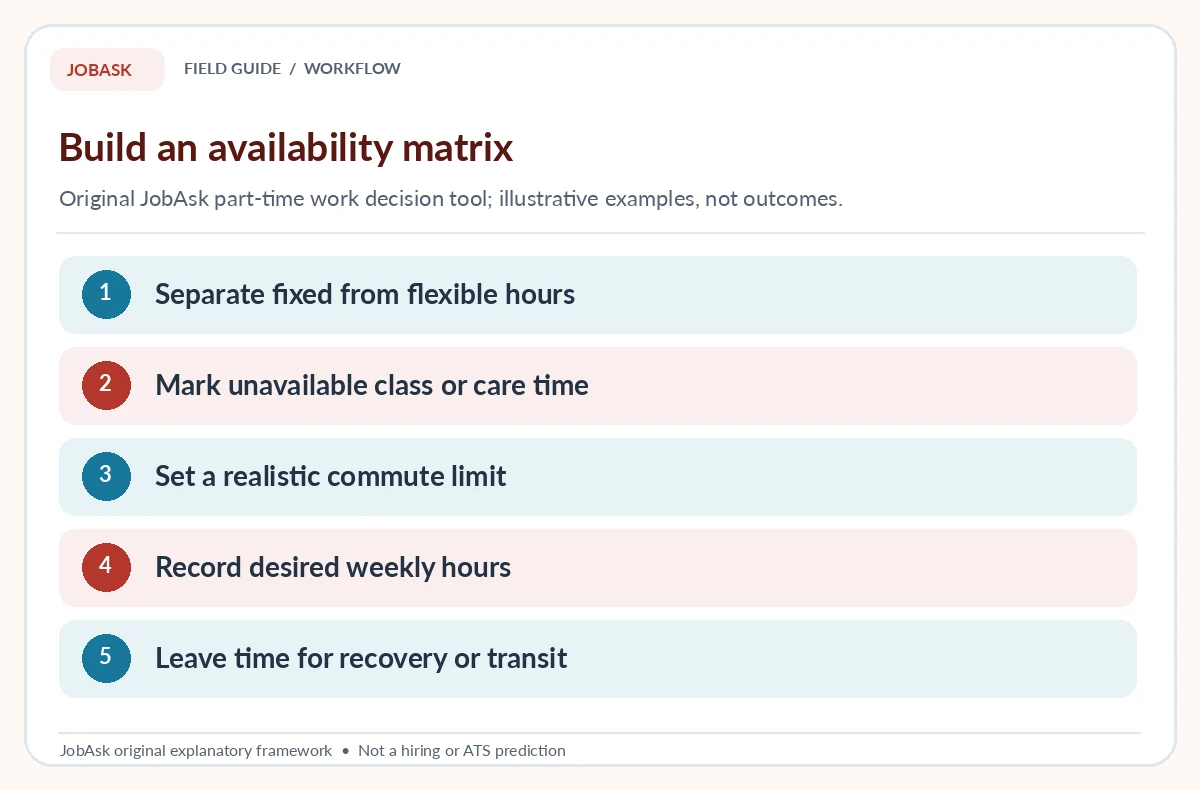
Write down the specific blocks of time you can commit to work for the next several weeks. Separate firm limits, such as recurring classes or caregiving, from preferences, such as wanting Sunday free. If you can only work Tuesday and Thursday evenings, saying “open availability” to attract more postings will create a problem later. Include travel and preparation time, not only the hours you would clock in. Work out a minimum and preferred weekly-hours range that fits your actual needs rather than assuming every part-time job offers a stable number of hours.
A useful worksheet has columns for day, earliest start, latest end, conflict, commute limit and flexibility. For a hypothetical applicant, Tuesday may be available 5–10 p.m. and Saturday 9 a.m.–3 p.m., while Wednesday remains unavailable. These are illustrations, not suggested universal work schedules. Add a line for how much advance notice you need if your availability can change. This simple exercise gives you a truthful, concise answer when an employer asks for shifts and reduces applications that would fail immediately on availability.
Search by shift and task instead of title alone
Part-time vacancies can appear under a wide range of functional titles: receptionist, customer support associate, event assistant, stock associate or administrative support, for example. These are search categories, not actual openings. Combine the tasks you can perform with location, shift and part-time filters. CareerOneStop explains that job banks allow searches by occupation, location and employer. But a filter labeled part-time does not prove the listing’s actual shift expectations; open the full description and confirm whether hours are fixed, rotating, seasonal or on call.
Keep a small search glossary based on work you can actually do. “Weekend,” “evening,” “20 hours,” and “limited schedule” may reveal different postings, but do not rely on a keyword appearing in the title. For each genuine listing, copy the employer, job title, official careers-page URL and description date into a private tracker. Search local employer websites directly when appropriate. Never confuse a syndicated advertisement with independent confirmation that the position is currently available. A listing that is months old or changes details between sites deserves an extra verification step.
Screen job descriptions for practical fit
Before applying, look for five concrete facts: duties, required skills, work location, shift pattern and how to submit an application. Note any credential or physical requirements described in the actual posting; do not assume a part-time label means entry-level or casual work. If a job requires rotating nights and you are only available mornings, the fit is poor even if your resume matches. If weekly hours are unspecified, mark the listing “ask” rather than inventing an estimate or treating the maximum as a promise.
Consider the total practical commitment. A four-hour shift may require more time after travel, onboarding and the employer’s stated arrival requirements. A hypothetical applicant with a 90-minute trip each way might decline short shifts that leave too little time for studies. Conversely, another applicant may prioritize a nearby predictable schedule over a somewhat higher listed rate. These are personal decisions, not claims about current pay or labor law. Keep legal questions about breaks, classifications, or overtime separate and verify them with an appropriate official source in your jurisdiction.
Verify employers and reject suspicious offers
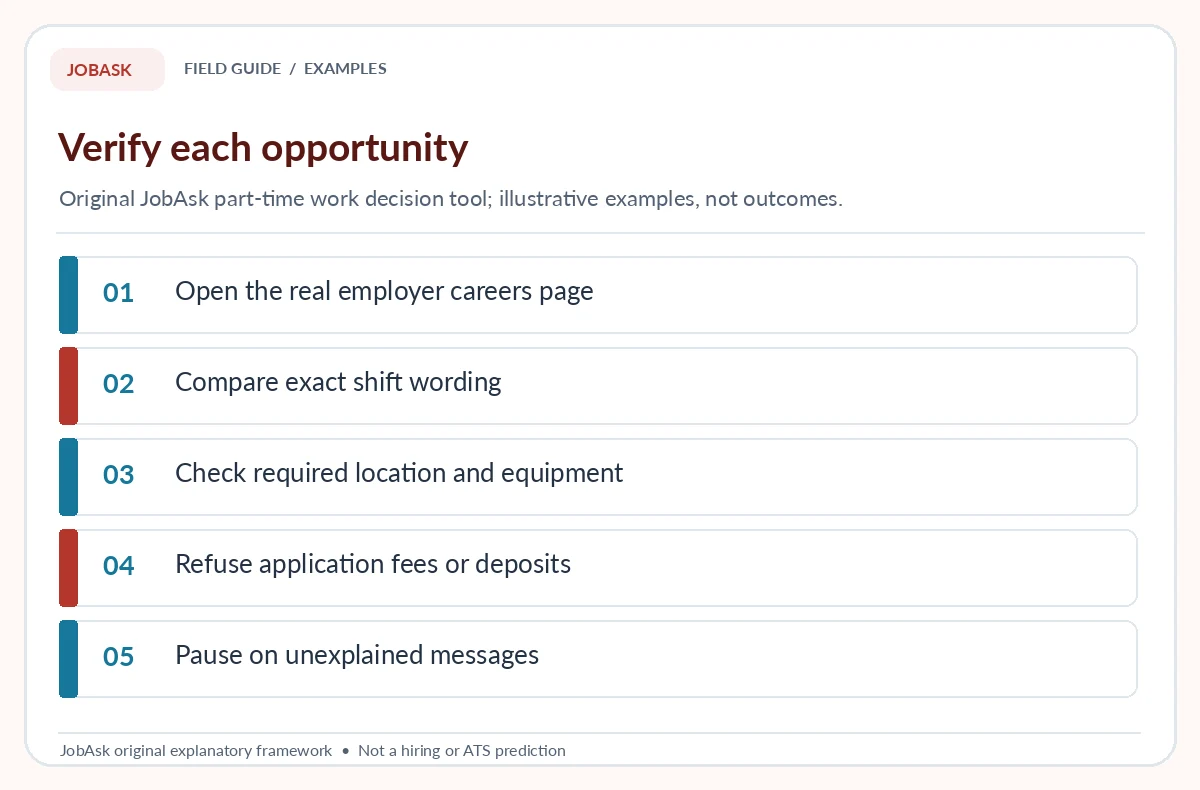
The FTC has warned about unsolicited text messages offering full-time or part-time positions to people who never applied. A message mentioning a reputable company is not proof that its sender works there. Type the company’s name and careers page independently instead of following an unsolicited link. Confirm that the exact role exists, and use contact information obtained from the real organization. Be cautious when a supposed recruiter moves the conversation immediately to a private chat app, requests banking details before genuine hiring, or refuses to explain the duties.
Do not pay a “registration,” “verification,” equipment or starter-kit fee for a promised position. The FTC also warns against fake checks and requests to send money back after depositing one. As a hypothetical comparison, a listing with specific in-person duties, an official company application and reasonable communication is worth evaluating further; a generic message promising substantial income for a few clicks, then demanding a deposit, is a reject. These checks reduce obvious risks but cannot authenticate every employer, so keep your own independent verification step before sharing sensitive information.
| Posting situation | What is known | Action |
|---|---|---|
| Evening desk support | Published shift fits; official site found | Apply after skill check |
| Weekend event support | Shift ends after final transit option | Skip or ask for alternative |
| Text-only task position | Unsolicited offer asks for deposit | Reject and report if appropriate |
Use an honest availability message when applying
If the application asks about availability, answer with concrete and accurate time windows. A fictional example: “I can consistently work Tuesday and Thursday evenings after 5 p.m. and Saturday from 9 a.m. to 3 p.m.; I am not available on Wednesdays.” This is clearer than “any time” or “very flexible.” If you have flexibility to swap a Saturday shift occasionally, say so as a separate qualification. Do not promise holidays or last-minute changes you cannot provide. Follow the actual application form’s required fields rather than pasting a prepared script into an unrelated section.
A short inquiry before applying can save time when a posting leaves the schedule unclear: “I am interested in the support associate role. Could you confirm whether the listed part-time schedule requires weekday mornings or rotating evenings?” Keep the note polite and focused on a genuine open question, without disclosing unnecessary personal circumstances. If the employer does not provide a verifiable way to ask, use the public application instructions or research further. The inquiry is not a substitute for checking the role, and receiving no reply does not prove a rejection.
Review a weekly application log and adjust
Track a few fields: employer, official source, role, required shift, verification status, application date, resume version, response and next action. Use statuses such as research, not a fit, applied, contacted and closed rather than assuming silence means rejection. Record why you skipped a posting; repeated mismatches may reveal that your search terms are too broad or your available hours too narrow. Avoid a made-up applications-per-offer target. One well-matched, verified application can be a better use of time than repeatedly applying to jobs whose hours are impossible.
At the end of each week, compare the listings you saved with your actual availability. If every viable posting needs weekends and weekends are impossible, revise the kind of work you search for rather than pretending the conflict disappeared. You may also identify a real skill or credential gap that warrants learning before applying. Recheck offers against the written shift requirements, location and any documented terms. This workflow supports sound decisions; it does not promise a particular wage, response rate, employer approval or number of open part-time jobs.

How We Research and Limits of This Guide
We compared search results about part-time schedules with JobAsk’s broad job-search, application tracker and upcoming remote-work seeds. CareerOneStop supports using legitimate job banks; the FTC supports the scam cautions. We created the availability matrix and fictional decision log independently.
Sources reviewed October 19, 2026: CareerOneStop explains job-bank search and application tools. FTC warns that unsolicited offers of full- or part-time work can be fraudulent. FTC describes fake flexible-work offers and upfront payment red flags.
Affiliate disclosure: This article does not recommend a particular recruiter or paid placement service and has no confirmed affiliate partnership. Read the JobAsk affiliate disclosure for the site-wide policy.
Related Job Search Guides
- Part-Time Jobs for Retirees: Find Sustainable Work That Fits Your Goals
- Part-Time Bookkeeping Jobs: Match Reconciliation Work to Your Hours
- Seasonal Part-Time Jobs: Verify the Work Period and Weekly Hours
- Part-Time Delivery Jobs: Routes, Vehicle Costs, and Work Arrangements
- Part-Time Warehouse Jobs: Compare Picking, Packing, and Shift Demands
Use recognized job banks and employers’ official career pages, filter by schedule and location, and independently verify the opening before applying.
Give the time windows you can reliably work and distinguish firm restrictions from occasional flexibility. Avoid claiming open availability if it is not true.
No. Part-time describes a reduced schedule; location, rotation, consistency and flexibility are separate conditions to confirm with each employer.
Watch for unsolicited recruiting messages, upfront fees, fake checks, requests for financial details and positions you cannot verify through real employer channels.
No universal guarantee can be assumed from that label. Check the posting and written offer, and seek qualified local guidance for questions about employment rights.