
The best questions for this interview are the ones that resolve genuine uncertainty about the role. This guide gives you a practical way to choose, adapt, and interpret questions without treating an interview as a scripted performance. The examples are hypothetical, not claims about any real employer. Start by reading the posting and noting what you still need to learn, then bring only the most important questions into the time available.
Ask Coworkers About the Work They Actually Do
Peer interviewers can often describe the rhythm of everyday work better than broad employer materials can. Start with a nonintrusive question: “What does a typical handoff look like between your role and this one?” This invites an example without asking for confidential account information. Do not assume every person on the panel has the same job responsibilities or insight into compensation and hiring policies.
A hypothetical teammate might describe a shared tracker and a quick handoff meeting. Your useful next question is how urgent work enters that system. That reveals a process, while “Are people friendly?” would produce a much less informative answer.
Make Invisible Handovers Visible
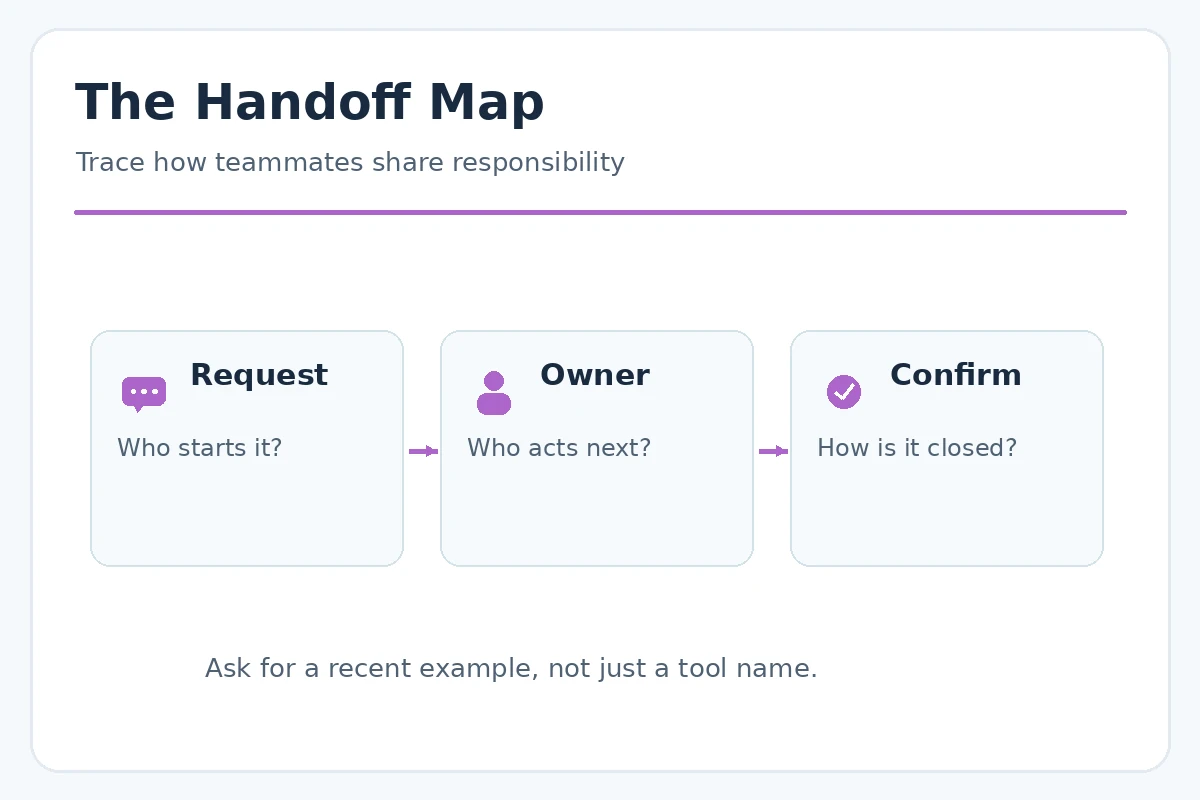
Many team frustrations come from unspoken assumptions about who owns a task once it leaves one desk. Ask where requests are recorded, how handoff completion is confirmed, and whom people notify when information is missing. This is particularly useful in service, health-adjacent administrative, operations, and software roles, although the specific tools differ. Do not ask an interviewer to reveal protected client or patient information.
Listen for a named ownership rule rather than a particular app. One employer may use a ticketing system; another may use documented meetings. What matters for your choice is whether someone can explain what happens when an issue crosses team boundaries.
Find Out How Work Changes When Plans Change
A great question for a prospective colleague is “When a priority suddenly changes, how does the team decide what stops?” It is more practical than asking whether the company is fast-paced. The reply may reveal decision-making roles, daily updates, or a manager-led reprioritization. You do not need a perfect schedule; you need to understand how people avoid competing urgent demands.
If an answer is “we all pitch in,” follow gently with “Could you describe a recent example?” Specifics such as notifying affected partners and updating a shared queue are useful; a slogan is a starting point, not proof of how the team always behaves.
Ask How New Employees Find Answers
Instead of requesting a promise of unlimited training, ask where coworkers look for accurate instructions and how they request help on unfamiliar tasks. A team may rely on documentation, paired work, office hours, or an assigned buddy. Each method has strengths and limitations. The question is whether a new hire can identify an appropriate next action when something is unclear.
A hypothetical new employee receives a question from a customer outside their authority. You could ask a peer “What is the usual escalation route in that situation?” The answer helps you evaluate support without implying that an employee should take on tasks beyond their permitted scope.

Explore Feedback and Disagreements Respectfully
Workplace culture becomes more concrete when you ask how people correct mistakes or discuss competing approaches. Try “How does the team give feedback when a handoff is incomplete?” or “What helps people resolve a disagreement about priorities?” Avoid asking for stories that identify or blame specific coworkers. You want to understand working norms, not office gossip.
Listen for facts such as private feedback, shared checklists, retrospectives, or manager involvement. One example cannot prove every future interaction. It can, however, tell you which follow-up questions would improve your understanding.
Compare Team Answers With Manager Expectations
If a manager describes monthly planning but coworkers describe daily unpredictable requests, both may be true: planning and interruptions can coexist. Ask for a clarification instead of treating the difference as deception. Note what each person is positioned to know. A manager may set targets, while teammates know where a process loses time or how tools work in practice.
After the interview, make a small table: stated process, colleague example, remaining question. This prevents one memorable anecdote from overshadowing a broader decision about the role and working arrangement. For the fuller picture, see our guide to questions to ask at the end of a technical interview about team practices.

Recognize When a Question Crosses a Boundary
Do not ask whether a particular colleague is difficult, why someone left, which employee is underperforming, or what private data sits in team systems. Questions about workload and support can be specific without violating confidentiality. Similarly, asking a peer to promise promotions or benefits often places them outside their authority. Direct policy questions to the correct HR contact. For the fuller picture, see our guide to questions to ask in an internship interview about learning and projects.
Rephrase a personal-sounding question into a workflow question: instead of “Who causes most delays?” ask “What is the usual approach when an approval is late?” The answer is more useful and respectful.
Turn the Interview Into a Practical Fit Check
Hypothetical scenario: two future coworkers describe a project team. You ask how assignments begin, how a blocker is raised, and what happens before a deliverable is considered complete. You note that each person describes the same handoff practice, but the escalation owner is still unclear. At the end you ask who would be able to clarify that part of the workflow.
The goal is not to uncover a secret “right” answer. It is to decide whether you understand how to collaborate and whether the routines fit the work you want to do. Thank every participant for sharing their perspective.
Prepare a Focused Question List Before You Go
To prepare, rewrite the sample questions so that they refer to the actual job description instead of a hypothetical organization. A short question works best when it has one subject and a concrete answer you can evaluate. These five starters cover the important unknowns for this scenario: “How does work move from one teammate to another?” “When priorities shift, how do you coordinate deadlines?” “Where does the team keep up-to-date instructions?” “How do new hires ask for help without blocking others?” “What is one recent way the team handled a disagreement?” Ask only what remains unanswered and do not read the full list aloud. For the fuller picture, see our guide to questions to ask a hiring manager about priorities and success.
After the discussion, note the question, the person who answered, what they actually said, and whether anything needs confirming. Separate a definite policy from a rough estimate, a personal opinion, or a hypothetical illustration. If the interviewer cannot answer, ask who is responsible for that information. This is more reliable than treating a pleasant conversation as proof that every aspect of the role is settled. If that is your next decision, our guide to questions to ask an interviewer explains how to choose by role, stage, and signal.
How We Research and What to Verify
This article was developed from publicly accessible career guidance, including professional interview guidance, career center advice, and additional interview guidance. We checked the cited pages on 2026-10-23. The sample questions and scenarios are original hypothetical teaching tools, not confirmed employer procedures, hiring outcomes, or a guarantee of an offer. Always verify the specific employer’s process and actual working terms.
This page offers independent career information and does not advertise an employer, sell placement services, or assume any approved affiliate arrangement. See the JobAsk affiliate disclosure. Avoid sharing confidential documents or personal data simply because an interviewer requests a detailed example; clarify expectations through the proper official channel.
More Interview Preparation Guides
- Peer Interview Preparation: Show How You Work With Future Coworkers
- Questions to Ask a Recruiter During a Phone Screen: Role and Process
- Manager Interview Questions to Ask: Authority, Metrics, and Team Support
- HR Interview Questions to Ask: Confidentiality, Hiring Process, and Scope
- Questions to Ask in an Accounting Interview: Close, Controls, and Review
It is a conversation with prospective coworkers rather than only a recruiter or direct manager. The format and purpose vary by employer.
Use an open and respectful question about difficult parts of the work. Avoid pressing for personal criticism or private personnel issues.
Request practical examples, notice how people describe collaboration, and compare answers without assuming one conversation proves every team experience.
Usually tailor them to each person. Repeating one important question can be useful for clarification, but do not interrogate coworkers to catch inconsistencies.
Ask about handoffs, getting help, and one important challenge relevant to the job. Save any unresolved process details for the hiring manager.