
Quick answer: Ask about the monthly close, exception handling, review responsibility, and which systems support the accounting team. Choose two or three questions suited to the person interviewing you, then listen for a concrete workflow rather than a promise that everything runs smoothly. Interview questions are a tool for judging the actual job, not a script that proves you will receive an offer.
Choose questions based on what is still unknown after the job description and the conversation. The examples below are hypothetical; employer responses, team structures, rules, and training arrangements vary. Avoid treating sample wording as a promise from any real employer.
Start With the Real Responsibilities of This Role
Accountants and auditors review records, reconcile differences, and prepare financial information. The O*NET accounting profile describes those tasks, but it does not establish how any specific employer divides preparation, approval, or audit responsibilities. That distinction should shape your questions.
The important distinction is between an occupation profile and the actual work offered to you. Before the meeting, mark the responsibilities stated in the posting and write down what they do not explain: who owns a decision, how errors are corrected, which tools are used, and where a new employee seeks support. Bring the short list to the interview. If the interviewer already answers a question, acknowledge the answer and move to a more useful one.
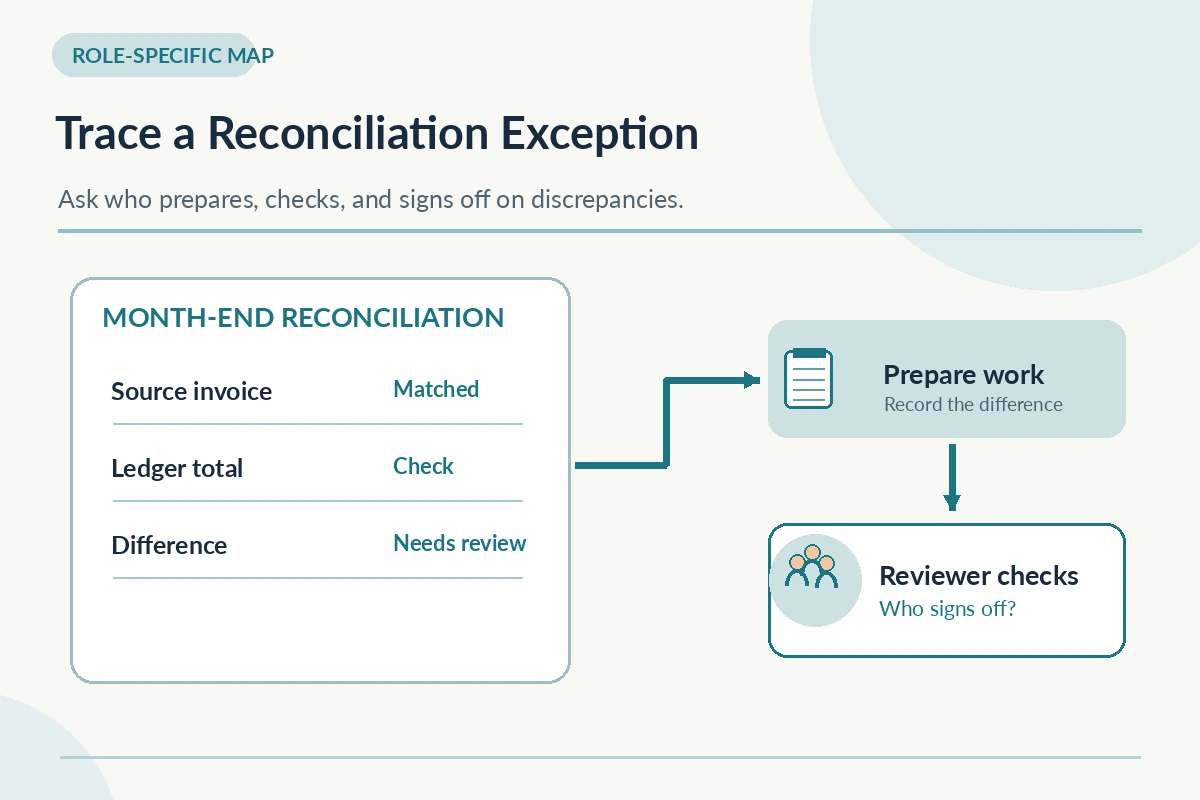
Five Questions That Reveal How the Work Operates
1. “How is the monthly close scheduled, and which deadlines are most demanding?” Learn whether reporting work follows a known calendar, which dates are fixed, and how the team coordinates requests that arrive late. Useful follow-up: “Which part of the close would I own in my first month?” A useful answer names a sequence and who coordinates exceptions, rather than assuming all employees close the same accounts.
2. “Who prepares reconciliations and who reviews unresolved differences?” Separate the work of investigating a mismatch from the authority to approve an adjustment. Useful follow-up: “What documentation is expected before a difference is escalated?” Listen for a second set of eyes, appropriate thresholds, and a route for findings; do not assume the new hire can approve entries.
3. “Which accounting systems and reports would I use each week?” Understand whether this job is mainly entry, reconciliation, variance analysis, or presentation of results. Useful follow-up: “Is training available for the specific ledger and reporting workflow?” The named software is less important than clear expectations about access, accuracy, and supervision.
4. “How do accounting and operations teams resolve missing information?” Find out who follows up on invoices, expenses, or supporting records and how the team avoids guessing. Useful follow-up: “What happens if source documents arrive after the reporting cutoff?” Look for a defined owner and documentation trail, not informal pressure to make numbers match.
5. “What does reliable performance look like after the first reporting cycle?” A realistic success measure may involve complete workpapers, timely escalation, and accurately recorded review notes. Useful follow-up: “Who gives feedback on the first close?” A clear response connects the expected work to a reviewer and a learning period.
Do not ask all five mechanically. The strongest question is the one that closes an information gap that matters to your decision. If the employer explains a process while answering an earlier question, move to the next unresolved issue rather than asking it again just because it is on your list.
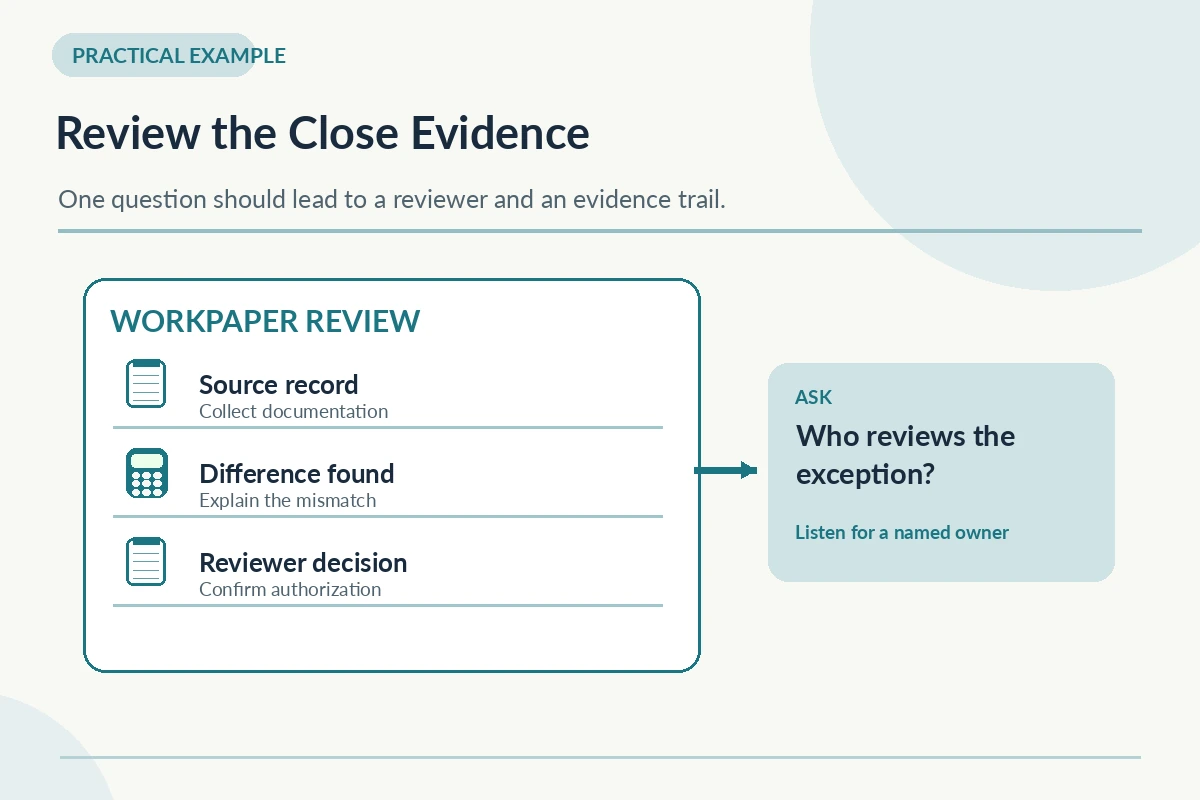
Match Each Question to the Right Interviewer
Ask a recruiter about process, reporting lines, work arrangement, and interview stages. Ask a controller or accounting manager about the close, review responsibilities, and systems. A peer may best explain handoffs and typical exception queues, provided they are comfortable discussing them. Do not request confidential client figures, private employee information, or internal audit details.
You can introduce a question by referencing something genuine from the posting or conversation: “You mentioned that this position will support the new workflow. Could you explain who handles the initial review?” This wording invites specific information while respecting the interviewer’s expertise. Do not pretend you researched an initiative unless you actually found it in a credible source.
Practice One Realistic Question and Follow-Up
Hypothetical exchange: Candidate: “Which reconciliations would I prepare, and who reviews exceptions?” Manager: “You would prepare assigned accounts and flag differences for the senior accountant.” Follow-up: “What evidence should accompany an exception so the reviewer can resolve it efficiently?” The follow-up asks for the actual workflow without volunteering to sign off work outside the position.
The hypothetical exchange shows the difference between merely listing questions and listening to the response. A strong follow-up uses an actual word from the answer—such as review, orientation, training, or escalation—and asks what that means in practice. If your interviewer cannot provide an answer, ask when and from whom you could obtain that information before deciding on an offer.
Check Risk, Authority, and Missing Information
Be cautious when the role description mixes entry-level preparation with unrestricted approval of payments or financial statements. You can ask for clarification without accusing the employer: “Could you explain the control or review step for that action?” If the interviewer does not know, request the name of the person who owns that process. Not every missing answer is a red flag; vagueness across several essential duties deserves further review.
Keep a private decision note with three columns: what the employer stated, what remains unclear, and what document or person could confirm it. This protects you from turning a pleasant conversation into assumptions about duties, pay, training, or working conditions. It also helps you draft a concise follow-up if a serious question was not answerable during the interview.
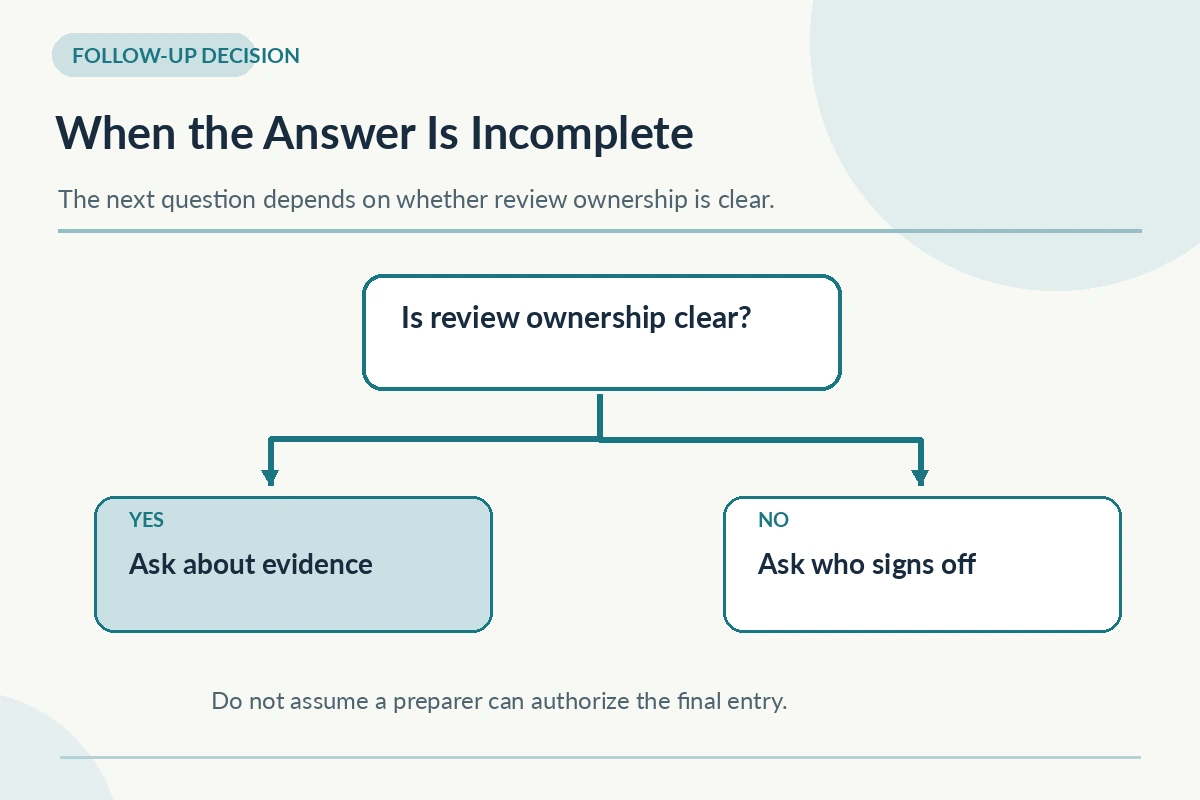
Adjust the Shortlist for Your Experience Level
If you are interviewing for accounts payable or receivable rather than a general accountant role, adjust the wording. For payables, ask who resolves invoice discrepancies before payment approval. For receivables, ask how disputed balances and unapplied cash are routed. For audit support, ask who assigns evidence requests and verifies that a workpaper is complete. None of these questions presumes you already hold approval authority.
For a first conversation, prioritize role duties and the immediate support structure. For a later interview, ask about details that remain material to your decision, such as review processes, assignment boundaries, and the next stage. If time is short, choose two questions that lead to different information rather than two variations on the same concern.
Use the Answers to Decide Your Next Step
After the meeting, separate statements of fact from your interpretation. A thoughtful interviewer may be unable to speak for another department; that is different from proof that no process exists. Summarize any answer that affects your decision, note who supplied it, and identify one unresolved item. If necessary, send a short follow-up asking who can clarify the issue. Do not send a long questionnaire that repeats everything you discussed.
The CareerOneStop preparation guide suggests researching the organization and preparing questions related to the position. Harvard career services similarly recommends discussing challenges and expectations; Penn Career Services emphasizes tailoring questions to your interviewer. The goal is informed judgment, not a magic question guaranteed to impress.
How We Research These Interview Questions
This guide uses published interview preparation recommendations and role descriptions rather than invented employer policies. Its role-specific discussion is checked against the occupational profile, and its interview approach against the three university and federal career resources linked above. All scenarios are explicitly hypothetical. We do not have inside information about any particular employer’s practices, hiring results, or current job openings. For editorial and commercial transparency, read the JobAsk affiliate disclosure; this article does not endorse an affiliate product.
More Interview Preparation Guides
- Questions to Ask a CEO in an Interview: Strategy and Your Role
- Tell Me About Yourself in an Accounting Interview: Records and Judgment
- HR Interview Questions to Ask: Confidentiality, Hiring Process, and Scope
- Manager Interview Questions to Ask: Authority, Metrics, and Team Support
- First Job Interview Questions to Ask: Training, Tasks, and Support
Yes, ask respectfully about predictable reporting deadlines, staffing support, and how peak periods are scheduled. Do not assume a fixed pattern from the occupation title.
Yes. Ask how the software fits the workflow and whether training and access are provided.
Yes. Phrase it as a workflow question about preparation, review, and authorization instead of claiming a weakness exists.
Prepare about five and prioritize two or three that have not already been answered, depending on time.
Ask what training and review a new hire receives. Describe your actual school or work experience without claiming independent close responsibility.