
Looking for bank teller jobs no experience does not mean you need to pretend you already worked in this field. This guide distinguishes genuine beginner duties from requirements that still apply, such as training, screening and supervision. Use the following task-based steps to identify the right openings, describe transferable experience honestly, and confirm the employer before submitting an application. Any example scenario is hypothetical unless explicitly presented as a sourced occupational fact. There are no invented job offers, pay rates or guarantees here.
Begin With a Teller or Branch Service Opening
Banks and credit unions hire for many different positions, but teller and some branch-service titles provide a clearer entry question than the vague search “bank jobs.” The Bureau of Labor Statistics says tellers typically need a high school diploma or equivalent and generally train on the job. This does not mean every bank hires without experience, nor that teller training qualifies you for lending, investment or other specialist work. Read each listing for transaction handling, service responsibilities, schedule and employment requirements. Compare duties instead of assuming two similar-sounding branch titles mean the same thing. If that is your next decision, our guide “Airport Jobs With No Experience” explains how to find passenger-service entry roles.
Understand the Four-Part Accuracy Habit
O*NET describes teller tasks including receiving deposits, checking amounts, entering transactions and balancing currency or records. A simple practice model is to verify the request, follow the authorized process, check the recorded result and escalate discrepancies. A beginner does not independently decide what documentation to waive or how to override banking controls. When preparing for an interview, explain that following procedure and asking for help matters more than pretending to be fast with unfamiliar systems. In actual work, only the bank’s approved workflow tells an employee when and how a transaction can proceed.

Map Real Retail Skills to the Posting
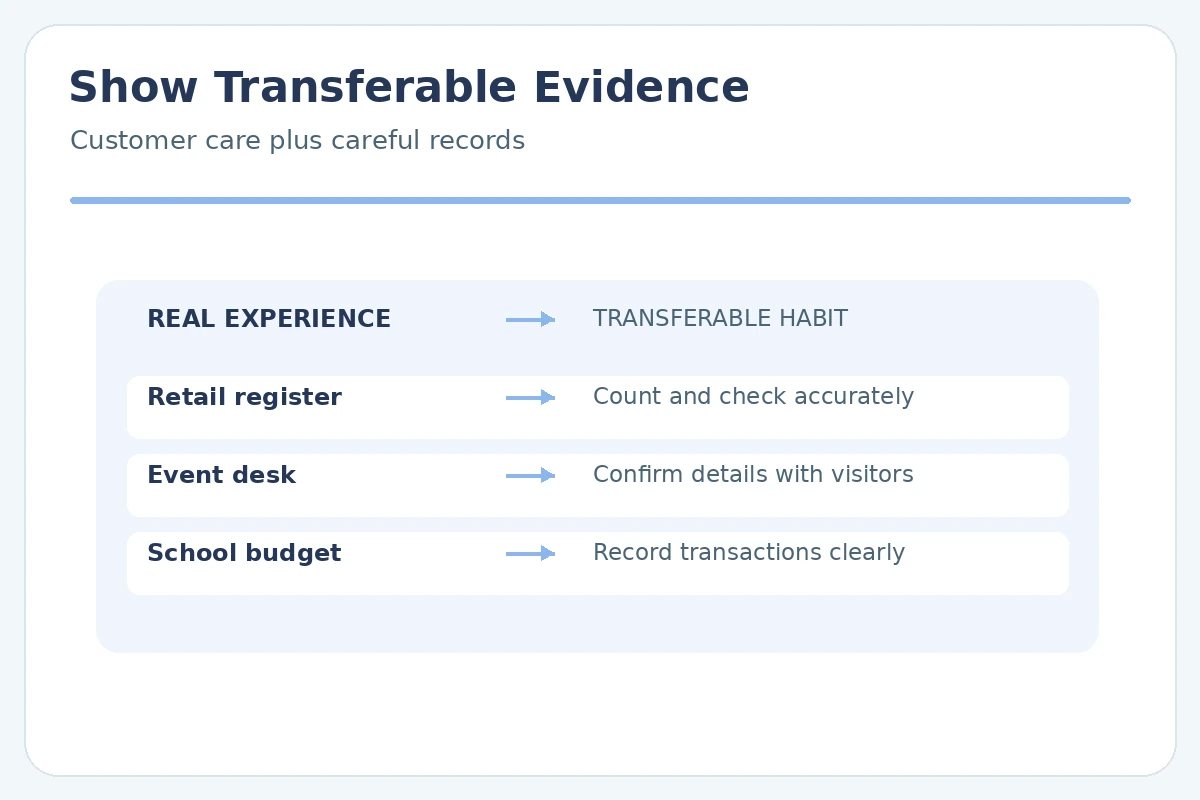
A person with retail checkout experience may have practiced counting a till, issuing receipts and answering customer questions. Those abilities are relevant only if the work really happened and were performed under the stated conditions. A student treasurer may have basic reconciliation practice, but should not claim to be an authorized bank cash handler. A hypothetical resume phrase is “Reconciled event cash totals with a supervisor’s checklist and reported a discrepancy before close.” Use that phrase only if you have that experience. Specific, modest evidence is more trustworthy than an unsupported claim of expert financial accuracy. For the next step, our guide “Library Jobs With No Experience” explains how to start with assistant roles.
Treat Privacy and Customer Trust as Essential
Bank teller work involves customers and potentially sensitive records. Do not include any real account numbers, images of checks or private client stories in a portfolio. If asked how you would handle an unfamiliar identity document or a transaction mismatch, explain that you would consult the bank’s approved procedure and an authorized supervisor rather than making up an exception. O*NET highlights checking accuracy, customer questions and careful records. These tasks reward patience and accurate communication, not the invention of secret fraud-detection tricks. Some policies and screening requirements will be employer-specific.
Look at Eligibility and Job Training Separately
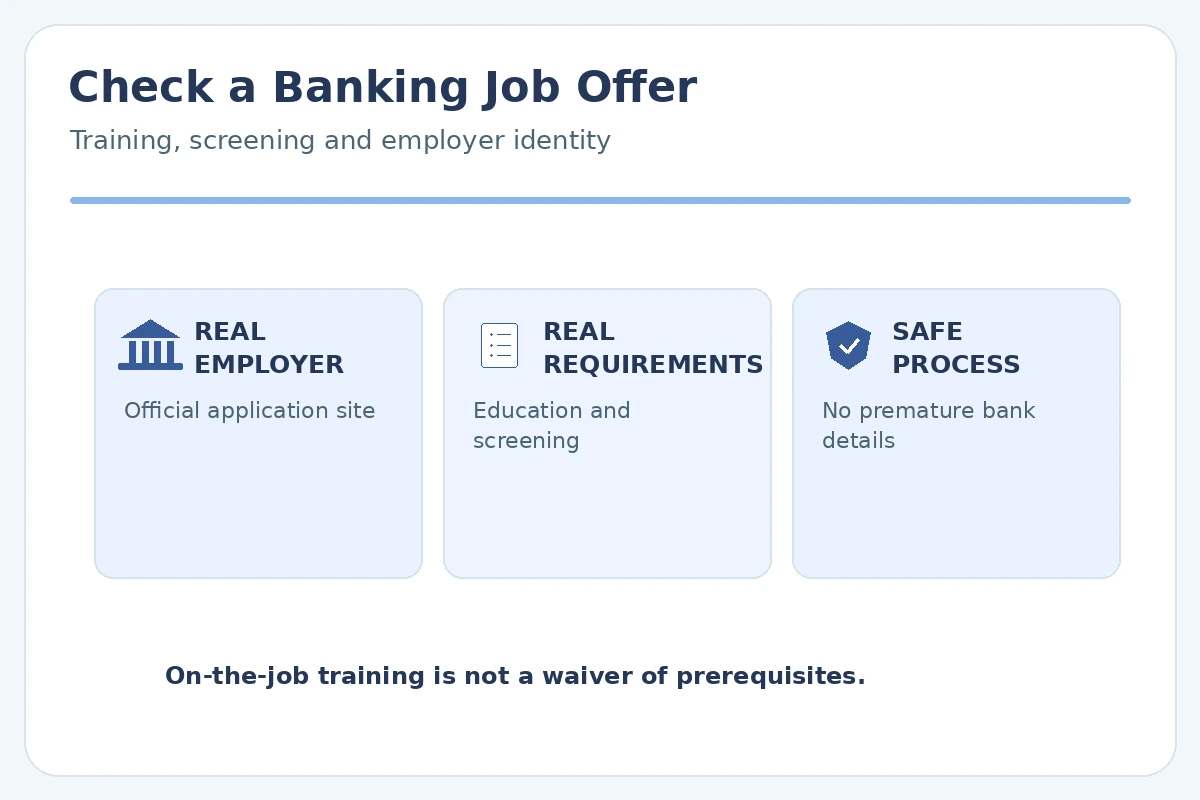
A position can offer on-the-job software and workflow training while still requiring a minimum education level, documented identity, screening or availability. BLS notes that tellers may need to pass a background check. The exact screening and any additional qualifications belong to the real employer’s posting and process. Ask how new tellers learn branch procedures and who checks work during the learning period. Do not write “certified teller” unless you actually hold a verifiable credential of that name. Training provided is not proof that the employer will overlook every other eligibility condition.
Apply Through an Identifiable Bank or Credit Union
Locate the official careers site or the organization’s verified job portal, then compare the URL and job title with any listing you found elsewhere. Save the requisition reference and role description. The FTC has documented scams in which impostors pose as recruiters for recognized employers and ask for money or sensitive financial data. A plausible logo or email signature does not prove a branch position exists. Avoid paying a recruiter to unlock employment or submitting banking information to someone who has not established a legitimate recruiting relationship. Use the organization’s approved channel for any required paperwork.
Prepare Stories for Accuracy and Service
Choose one authentic example about keeping records accurate and one about explaining something clearly to another person. Structure each in terms of the situation, your action and the evidence you can honestly describe. It is fine to discuss a school, volunteer or retail context if you have not worked in banking. If you only have a hypothetical exercise, label it as such and explain how you would follow an approved process. Do not invent amounts of cash you processed or claim zero errors without records. Practice calmly acknowledging what you still need to learn.
Evaluate the First Role Realistically
Check whether the branch has regular or rotating hours, what workday and weekend expectations apply, how onboarding is described and whether the advertised title includes sales duties beyond basic transactions. Consider whether you enjoy public interaction and detail-heavy repeated processes. Teller occupations may change as banks use more digital services; the BLS outlook is not a prediction of the outcome of one application. Choose a role that matches your genuine qualifications and work style, and track confirmations rather than assuming that submitting a resume means a human has reviewed it.
A Five-Minute Job Posting Reality Check
Write the exact employer name, position title, work location, minimum prerequisites and application channel in a short comparison list. Highlight what you genuinely meet and mark unanswered conditions for follow-up. A “no experience” search term cannot override a posted age requirement, clearance, safety training or credential. If a listing changes after you apply, confirm the updated version through an authorized recruiter. Track the source URL and your submission confirmation instead of treating an account registration as a submitted application. The strongest next step is the one you can verify.
How We Research and Evaluate Sources
This guide was prepared using the named primary and professional occupational sources reviewed on 2026-10-23. BLS describes teller work, typical high school entry education, background screening possibility and on-the-job training. O*NET enumerates teller transaction accuracy, cash balancing, customer service and records activities. FTC explains how recruiters may falsely claim to represent recognized employers and request sensitive details. These resources explain broad occupational patterns and safety or consumer guidance, not a specific employer’s private hiring decision. The hypothetical examples are not actual candidates or proven hiring outcomes. There are no claimed paid recommendations. Read our affiliate disclosure for the site’s relationship policy.
Related Guides
- Bank Jobs With No Experience: Compare Teller and Branch Support Duties
- Bank Teller Interview Questions About Accuracy and Customer Service
- Daycare Jobs With No Experience: Aide Roles and Requirements
- Bank Teller Interview Questions: Prove Accuracy and Sound Judgment
- Bank Teller Resume Summary: Explain Transaction Accuracy and Customer Trust
Not necessarily. BLS says tellers typically need a high school diploma or equivalent and receive on-the-job training; employers may also require background screening.
Yes, if real. Accurately describe your cash handling, customer assistance and reconciliation responsibilities without claiming bank-system experience.
BLS identifies a high school diploma or equivalent as typical entry education, though particular employers can list additional preferences or requirements.
Only supply sensitive information through a verified, legitimate process when appropriate. Be alert to recruiters demanding account details before meaningful screening or hiring.
No. Bank branches have different roles, responsibilities and eligibility requirements. Teller training does not confer other financial licenses or authority.