
A summary describing cashier experience should quickly tell an employer whether you have handled transactions, helped customers, followed store procedures, or learned similar skills somewhere else. It does not need an invented “100% accuracy” claim. Cashiers commonly handle payments, receipts, customer questions and returns, according to the U.S. Bureau of Labor Statistics. Your version should name what you did and what you can confidently explain. Use the payment-to-proof workflow below to choose relevant information.
A university career center resume guide recommends making the opening short and relevant to the job description. This article instead focuses on the proof specific to cashier resume summary; all examples below are hypothetical teaching cases unless a statement is explicitly identified as an occupational-source fact.
Start With the Cashier Tasks in This Posting
Read beyond the word “cashier.” Grocery checkout, fuel stations, quick-service restaurants and service counters may have different systems and policies. Identify the employer’s actual needs: scanning items, accepting payments, handling returns, answering questions or balancing a till. Mention the tasks that fit your record, not an entire occupational list. A summary should be specific enough that a manager can see why you applied, but short enough to leave the details to later bullets.
The BLS describes cashier duties as including customer assistance and register reconciliation as well as payment handling. That supports describing the occupation; it does not prove you personally worked with a register. If you have never had one, start with accurate cash-handling coursework, event check-in or customer-facing work instead.
Distinguish POS Skills From General Customer Service
A point-of-sale system is not the same thing as answering a question at a service desk. If you have used a register, identify the type of work you performed: scanning purchases, correcting a transaction under supervision, handling change or reviewing a shift tally. If your experience is only helping customers find merchandise, you can still show communication and policy-following skills without claiming register experience. Never assume software proficiency from observing a coworker. Our guide “Retail Resume Skills” goes into more detail.
In your experience bullets, use plain language to describe how you followed a process. “Explained return rules and referred exceptions to a supervisor” may be more credible than “expert in complex POS solutions.” A store-specific refund policy may change, so focus on your understanding of procedure rather than asserting authority you did not have.
Show Accuracy With a Real Check Routine
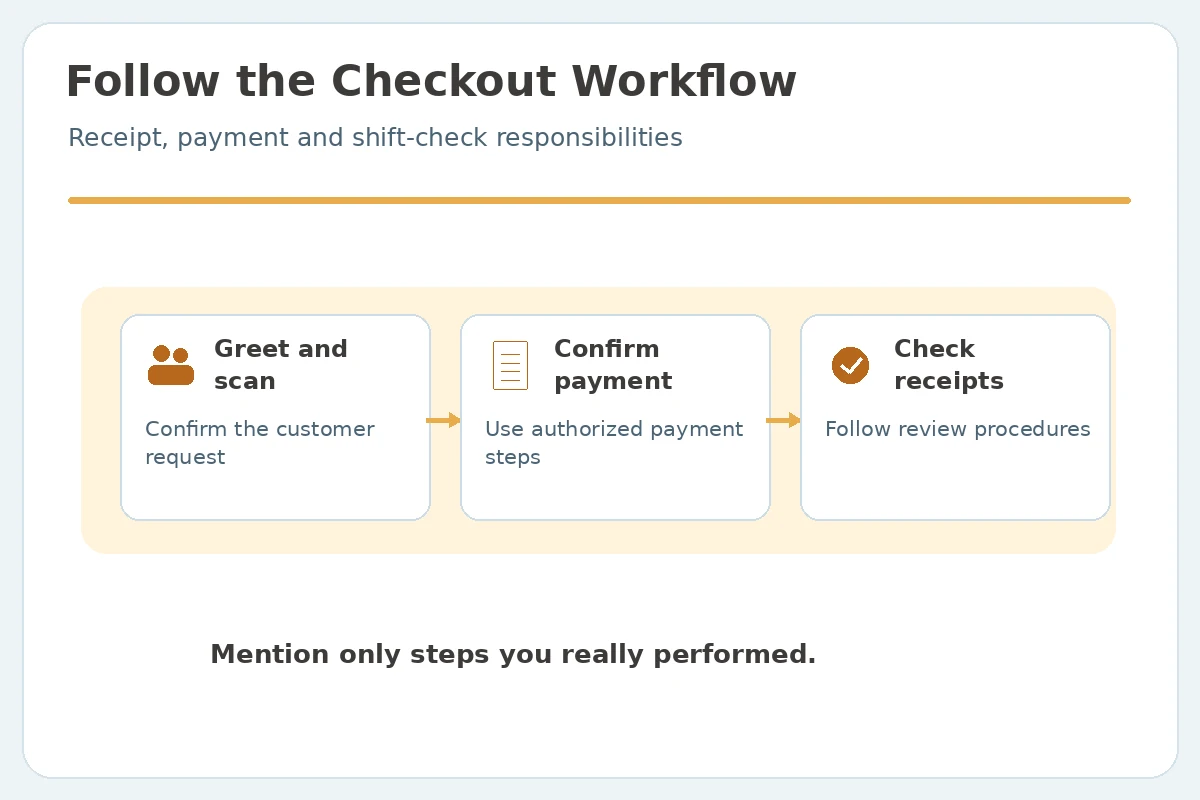
Accuracy is easiest to explain when you name a check you actually used: counting change, confirming item quantities, reviewing receipts, or reconciling an assigned drawer. If you tracked error rates and can document them, you may include the result. If you did not, do not invent a percentage or claim a perfect record. A basic sentence about checking cash and receipts can be substantial evidence of care when it accurately reflects your duties.
The image below illustrates a register workflow from customer request through payment and end-of-shift review. Use it as a prompt to remember actual responsibilities; do not copy every step unless you performed them. For an applicant with no cashier employment, describe comparable accuracy work in an authorized volunteer role and mark its setting.
Adapt the Opening for Retail or Food Service
A front-end retail role may prioritize product lookup, returns and checkout lines. A cafe or restaurant cashier may require order entry, pickup communication and coordinating with kitchen staff. Review the posting for the relevant setting and translate the language into a genuine example from your own work. If you handled high-pressure crowds at a school ticket table, explain that context without converting it into formal retail tenure.
Do not overload the opening with unrelated merchandising claims, supervisory titles, or a list of every payment network. Two or three signals are enough: the work setting, the transaction or service skill, and your verification habit. Supporting bullets can describe shift handoffs, cooperation with teammates and how you requested help on exceptions.
Try an Honest Hypothetical Summary Example
Hypothetical teaching example: “Customer-focused retail associate with experience helping shoppers, following checkout procedures and verifying receipts during assigned shifts. Comfortable explaining store policies and escalating transaction questions to a supervisor.” This illustration assumes the candidate actually handled those tasks. It is not a real employee or guaranteed successful resume statement.
For a true first-time cashier, revise the opening to “Retail job applicant with volunteer ticket-table experience, including collecting payments under supervision, answering attendee questions and checking records.” Do not copy the payment detail unless it happened. What matters is that your words and your documented experiences describe the same person.
Review the Evidence Before Claiming Speed
Fast work is valuable only when it does not imply practices you cannot support. Rather than saying “fastest cashier in the store,” describe a real rush-period task or a method used to keep lines moving. If you helped with closing, identify whether you actually reconciled a till or simply cleaned the counter. If a shift involved someone else’s register, do not take credit for their totals. Quantities belong in a resume only when their source can be explained. For the fuller picture, see our bartender resume format guide.
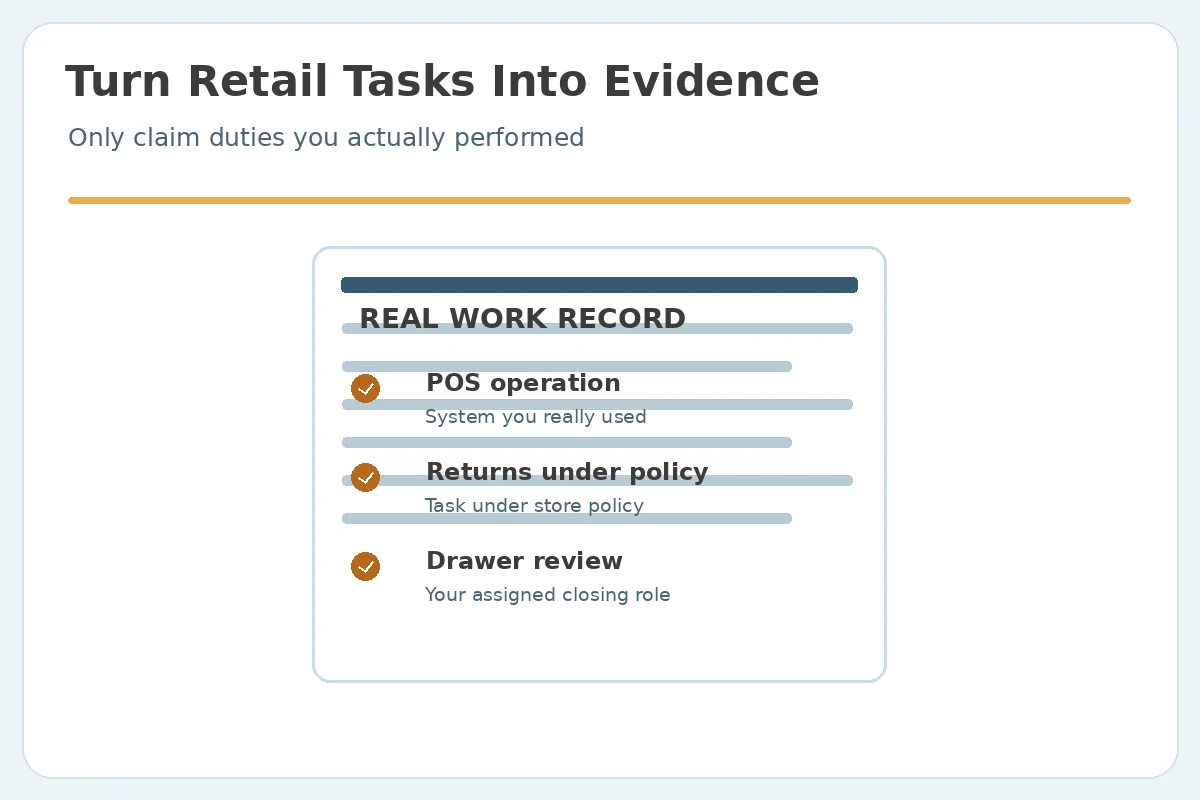
An honest summary can leave out numbers entirely. The BLS occupational description and employer posting are sources for typical tasks, not proof of individual outcomes. Read the second diagram as a reminder to separate what a job may involve from what you personally did.
Use a Final Register-Skills Audit
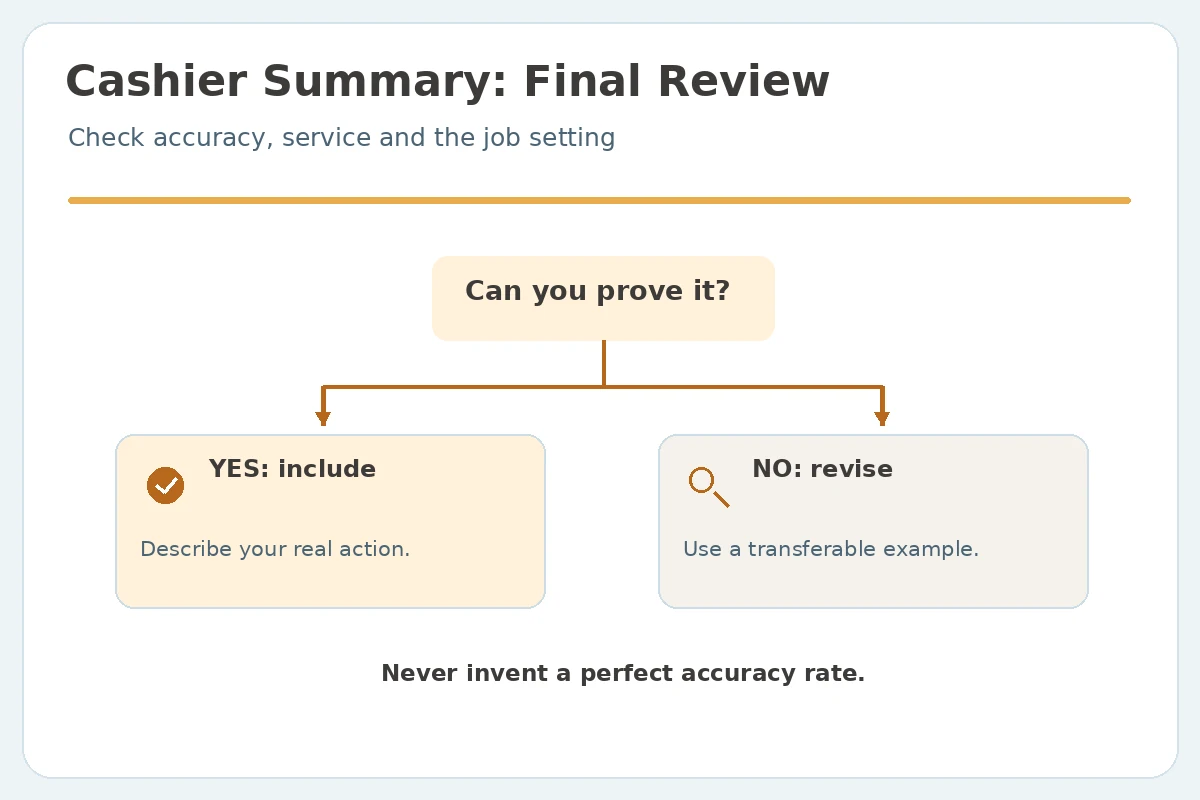
Check the finished opening against your experience bullets: does it say POS operation when you only handled cash for an event? Does it promise independent returns approval when you always needed supervisor permission? Can you explain one genuine example of accuracy and one of customer interaction? Remove inflated adjectives, company-specific assumptions and any unsourced rate of success. A concise summary remains useful when all claims survive those questions.
Before applying, verify shifts, any age restrictions tied to products, store procedures and whether the employer requires prior register training. Those conditions belong to the actual posting, not to a generic cashier summary. Save your own revised version for different retail settings instead of using a single copied statement for every role.
How We Research Resume Claims
This article was researched on 2026-10-23 from the following public primary or professional sources: careers.ucsd.edu (Career-center guidance on relating a brief resume summary to actual qualifications and the posting.) bls.gov (BLS describes cashier tasks including payments, returns, customer questions and register balances.) careerhub.umt.edu (University of Montana advises resume tailoring and verifiable, achievement-focused descriptions.) These materials support general resume-writing advice or occupational background. They do not verify any individual applicant’s background, private employer requirements, credentials, hiring decisions or outcomes. Recheck the actual posting and local rules before applying.
We do not claim an affiliate relationship; see the affiliate disclosure.
More Resume and Cover Letter Guides
- Customer Service Resume Summary: Prove Requests, Records, and Follow-Up
- Customer Service Resume Summary: Show Channels, Cases, and Judgment
- Cashier Cover Letter With No Experience: Prove Service and Payment Readiness
- Security Guard Resume Summary: Highlight Access Control and Clear Reports
- Customer Service Skills for a Resume: Show What Happened After the Request
Real transaction duties, customer support, and accuracy habits most relevant to the actual role.
Yes. Use transferable service or money-handling examples, clearly identifying volunteer or classroom settings, and avoid claiming point-of-sale work you did not perform.
Only when you can substantiate the claim. Otherwise describe checking cash, change or receipts without inventing a rate.
No. Customer communication and using a point-of-sale system are related but different responsibilities.
Only if you used it and can explain your familiarity. Follow the exact job description for required tools.