
To find legitimate remote jobs in the United States, search by the work you can do, then verify that the employer really offers the role and that your location is eligible. “Remote” does not automatically mean work from anywhere, flexible hours, part-time work, or an offer you can trust. This guide is a decision workflow, not a directory of currently open jobs. The screening matrix, examples, and sample applicant records are original and entirely hypothetical.
Separate remote location from job responsibilities
Start with a credible role family: customer support, accounting assistance, writing, software testing or scheduling are illustrative categories rather than live vacancies. List the specific tasks you have performed and can demonstrate. A remote setting changes where the work happens; it does not remove qualifications, supervision, performance expectations or required availability. Avoid searching only for “easy work from home,” because that phrase gives little information about duties and attracts promotional or suspicious offers. Start with a task-based search and add a remote-work filter after you have established what the position actually requires.
Build a compact search statement from real capabilities. A hypothetical candidate might write, “Administrative support, calendar coordination and spreadsheet updates; remote within my state; weekday afternoons.” Another might search for a junior QA role with documented testing projects. Neither statement means an employer currently has an opening. Keep separate folders for verified employers, promising leads and posts that require more research. This is narrower than the general JobAsk job-search strategy article because the deciding variables here are remote eligibility, employer identity and work setup.
Check location restrictions before applying
A posting can be remote within one state, within the United States, across selected states, or limited to a specific time zone. It may require periodic travel, initial onsite training, a local license, a secure workspace or certain equipment. The word remote alone does not settle those questions. Read the description for eligibility language and look for explicit requirements about where an employee must reside or physically work. Do not infer tax, payroll or licensing permission from a generic website checkbox; such matters can vary and must be confirmed with the employer and applicable official sources.
Enter five fields into the original screening matrix: accepted location, scheduled hours, travel expectations, technology requirements and application route. If the post says “remote, eastern time working hours” and your availability does not overlap, mark the limitation before writing a custom resume. If travel is described as occasional but not defined, politely ask what that means. A workable listing should become easier to understand as you research it, rather than harder. Save only what the employer actually says, not an invented promise of permanent home working.

Cross-check a posting with the real employer
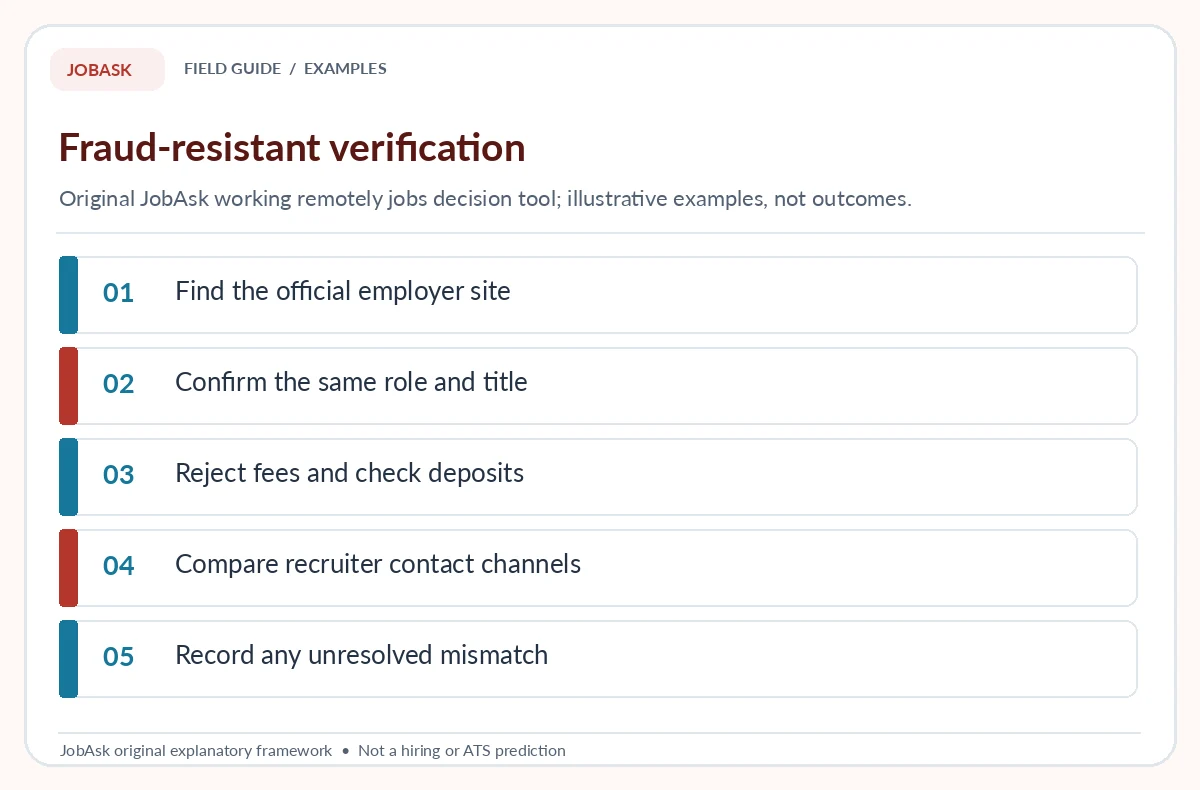
The FTC warns that scammers can copy or alter real job advertisements. A recognizable employer name, job-board logo or seemingly professional interview invitation is not independent proof that the job exists. Navigate to the employer’s website yourself, rather than relying only on a link in an unsolicited message. Compare the job title, requisition number if present, duties and location requirements. If you cannot find the listing, use contact details you found independently and ask whether the advertisement is authentic. Absence from a search index alone is not proof of fraud, but unexplained discrepancies deserve investigation.
Treat recruiter addresses and communication channels as pieces of evidence, not magical authenticity markers. A company can use legitimate third-party recruitment systems, and scammers can imitate familiar names. A hypothetical message saying “remote quality reviewer, immediate start, contact us only on Telegram and buy an activation package” has multiple red flags. Never send a deposit or transfer money as a condition of hiring. The FTC specifically cautions against fake-check purchases and money-back instructions. Do not hand over sensitive financial information on the strength of an unsolicited recruiting text.
Match actual remote skills to the posted duties
Read the substantive responsibilities before editing your resume. Employers may mention independent task planning, written handoffs, customer interactions, documented problem solving or tools relevant to the work. If you have genuine experience with a collaboration platform, give a brief, truthful example; if you only watched a demonstration, do not describe it as professional experience. A remote role may also require private handling of information or adherence to organizational security practices. You cannot know a specific employer’s unannounced screening algorithm from a generic blog, so concentrate on what the published role asks you to do.
For a completely fictional applicant, a useful experience bullet might be “Maintained an appointment calendar for a volunteer program and sent approved schedule updates to participants.” It proves a communication task without claiming a corporate remote career. A different candidate might document an actual class project delivered using shared documents. Label academic and volunteer work clearly, and describe the real deliverable. If a requirement is essential and you do not meet it, do not misrepresent your history to clear a checkbox. The application should withstand a straightforward discussion of every listed skill.
| Listing | Evidence | Decision |
|---|---|---|
| Remote support role | Official employer page; applicant state accepted | Check skills, then apply |
| Remote role with onsite training | Travel requirement outside availability | Ask officially or skip |
| Unsolicited remote task offer | Requests payment and no verified listing | Reject; consider FTC report |
Ask practical questions about the work arrangement
When a posting is credible but vague, ask narrowly framed questions through the official channel. Useful topics include whether the work is fully remote or hybrid, where employees must reside, core hours, required travel, how equipment is provided, and whether training happens remotely. Avoid assuming that an employer supplies a laptop, reimburses utilities or permits international travel. Request written clarification when a term matters to your decision. These are workplace-operational questions; questions about specific legal rights or compensation classification require separate official information rather than a promise from this article.
A hypothetical inquiry could say: “I am interested in the remote operations assistant opening listed on your careers page. Could you confirm whether applicants must reside in a particular state and whether training requires onsite attendance?” That question is precise and does not over-disclose personal information. If no verifiable contact exists, do not improvise by messaging strangers who claim to represent the employer. A real answer helps you decide whether applying is worth the time; a vague reassurance from an unverified sender should not override a published restriction.
Maintain a verified application record
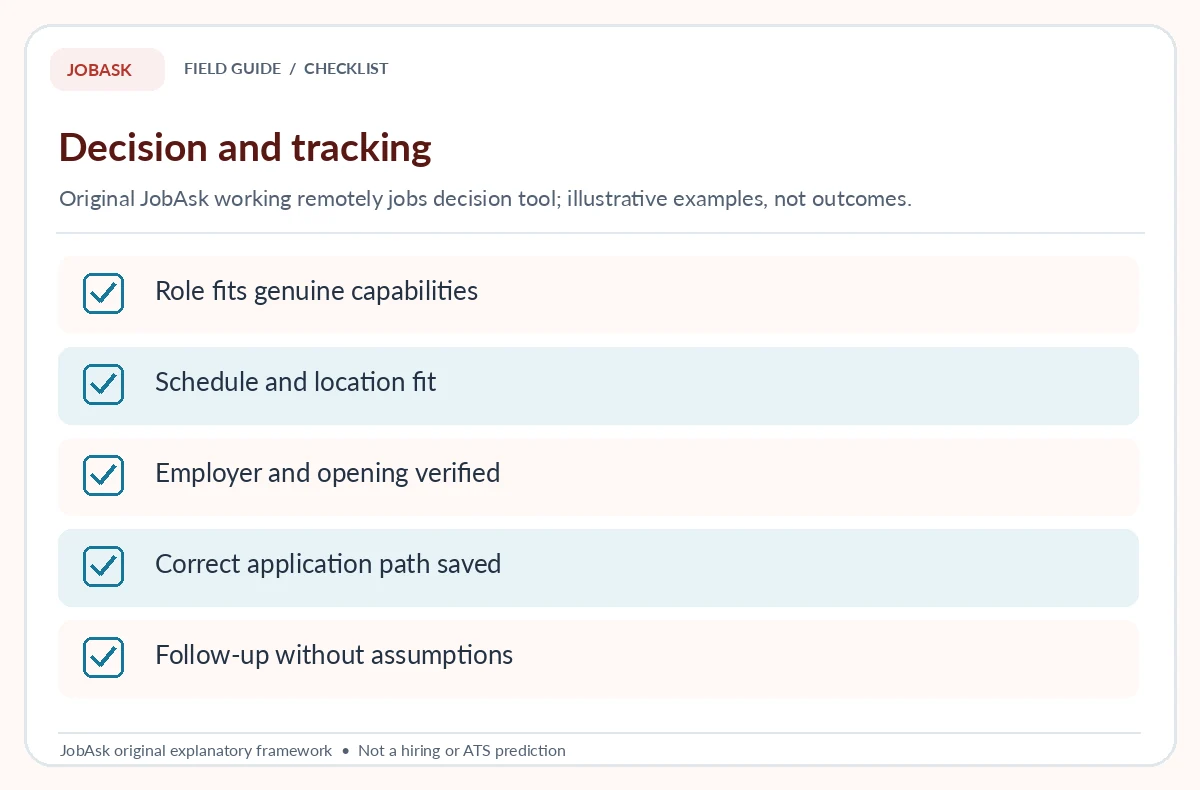
Track the employer name, role, exact careers-page address, remote location rules, date checked, application channel, resume version and any unresolved questions. Use “research,” “verified,” “applied,” “responded,” or “closed” to distinguish your actions from outcomes. If the listing disappears, keep the date you observed it without describing the role as currently vacant. This record helps you avoid applying twice through conflicting links and lets you answer a legitimate recruiter with the correct version of your materials. You do not need paid tracking software to keep a useful personal log.
Review the log weekly. If most remote ads fail the location screen, broaden the types of tasks or adjust filters while keeping your real constraints. If you encounter repeated unverified offers, move searches toward official employer sites and trusted career resources. CareerOneStop offers free job-search support that may help with search planning, though it does not authenticate any specific posting for you. No application count, job-board ranking or remote-work keyword guarantees interviews. The aim is a smaller collection of roles you understand and can verify.
Use the remote job decision table before submission
The table below illustrates a fictional three-case triage process. It is not a list of real companies or live openings. One listing explicitly allows the applicant’s state and matches their schedule; another requires onsite training outside their travel range; a third begins with an unsolicited message demanding an equipment payment. The table shows what to do next instead of pretending every mention of home-based work merits an application. Replace the examples with facts from current postings and the real employer website. For the fuller picture, see our guide “Online Jobs From Home”.
A sensible final check is binary on the essentials: you are eligible to work in the advertised location, you can perform the main duties truthfully, the employer and posting can be reasonably verified, and the application process has no obvious fraud demand. When something central remains unknown, record a research action rather than generating a false “fit score.” When it passes, follow the official instructions and keep your own copy. This process improves decisions without claiming to prevent every scam or to predict hiring outcomes.
How We Research and Limits of This Guide
We reviewed search results for remote and work-from-home job searching and isolated location eligibility and authenticity from the earlier general job-search and part-time-work pages. The FTC supports the warning about copied advertisements, fake checks, fees and unsolicited messages; CareerOneStop supports free job-search help. Every posting example and matrix scenario is fictional.
Sources reviewed October 19, 2026: FTC warns about work-from-home advertising, fake checks, and requests to pay for a job. FTC recommends independently confirming advertised openings on an employer official site. CareerOneStop describes free official job-search assistance, including online resources.
Affiliate disclosure: There is no confirmed remote-job-board affiliate relationship or paid recruiting endorsement in this guide. Read the JobAsk affiliate disclosure for the site-wide policy.
Related Job Search Guides
- Fully Remote Jobs vs. Work From Anywhere: Check Location Limits Before Applying
- Part-Time IT Support Jobs: Check Ticket Coverage, Access, and Escalation
- Entry-Level Remote Jobs: Find Genuine Training and Prove First-Role Skills
- Remote Bookkeeping Jobs: Check Reconciliations, Software, and Client Controls
- Part-Time Museum Jobs: Visitor Services, Event Shifts, and Real Requirements
Use reputable job resources as discovery tools, then verify each promising role through its actual employer or other independent official channel.
Not necessarily. Employers may specify allowed locations, time zones, onsite training or travel. Check the posting and ask the employer where unclear.
An upfront payment or check-and-return-money arrangement is a major scam warning. Do not pay for a promised job; consult FTC guidance.
No. Location, hours, employment arrangement and schedule flexibility are different terms that must each be checked.
No. This article includes no live listings. Check current employer career pages and follow the official application path.