
A career change may mean a new employer, a different function within a familiar industry or an entirely new occupation. Those are not equally disruptive decisions. Before buying training or resigning, compare what you want to change with the skills you already use and the target role’s actual requirements. This guide offers a decision framework, not an assertion that anyone can change careers in a fixed number of weeks. All candidate journeys below are fictional examples, and any wage, license or local employment facts must be checked for the particular occupation and location.
Name the problem you want the change to solve
Start by distinguishing dissatisfaction with one employer from dissatisfaction with the daily work itself. A candidate may dislike an unpredictable schedule while enjoying the underlying work, or may enjoy their coworkers but want a completely different type of problem to solve. Those two situations suggest different experiments. Make a short list of conditions you would keep, change or refuse: activities, work environment, location, training demands and realistic compensation needs. A change made without knowing the problem can reproduce it in a new setting with additional cost and uncertainty.
For a fictional worker in a service role, the appeal of “office work” could reflect a desire for regular hours more than a rejection of customer communication. An adjacent scheduling role might use more of their existing evidence than a completely different occupation would. Another fictional worker might discover they want hands-on technical repair rather than planning tasks. The comparison is a tool for making the preference explicit, not a prediction that either path will be available. Use the decision table below to keep personal motivations separate from labor-market facts and actual qualification requirements.
Compare three distinct types of career move
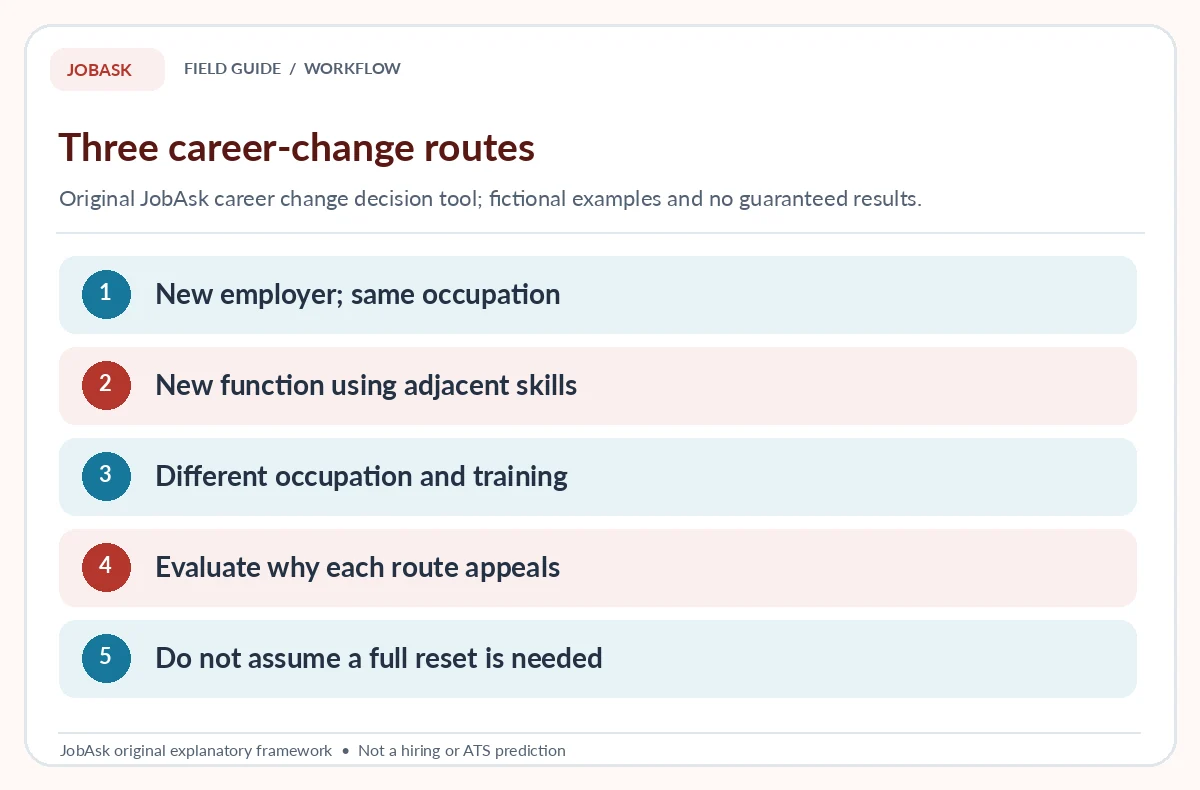
Route one changes the employer while preserving the occupation. Route two shifts the function, often building on related skills. Route three enters an occupation that may require unfamiliar training, credentials or working conditions. Write one plausible role example for each route and review real occupation descriptions before deciding. Do not treat a job title as sufficient evidence about daily work; the same label can cover different responsibilities. CareerOneStop occupation tools and the U.S. Bureau of Labor Statistics can help people explore duties, entry requirements and career information without relying on influencer success stories. Our guide “Transferable Skills” goes into more detail.
A hypothetical administrative assistant considering a move might compare another administrative employer, project coordination support and a licensed clinical occupation. The third path may have very different formal requirements; it is not simply a harder version of the first two. Verify relevant education, licensing or training with official sources rather than using a generic checklist as legal advice. Record what the target role asks for, which requirements you already meet and which remain open. This prevents an exciting narrative about starting over from hiding unavoidable practical barriers or an easier adjacent option.
Map transferable abilities to real responsibilities
CareerOneStop’s mySkills myFuture helps explore other career options using skills associated with prior occupations. Treat its suggestions as starting points, not approval to practice a regulated profession or proof of employer demand for an individual. List concrete activities you have performed and connect each to target responsibilities: scheduling, documenting, troubleshooting, teaching, organizing people or evaluating information are only useful if you can demonstrate them. Distinguish generic capabilities from occupation-specific training and experience. “Good communicator” is a claim; “prepared weekly handoff notes that team members used” is a possible example of evidence if it is true.
Create a three-column map: target duty, genuine evidence, and missing capability. A fictional retail coordinator interested in office operations might have verified experience maintaining a staffing rota, but no experience with a required finance platform. The honest plan is to highlight the rota work and learn the platform if it is truly needed. Do not retitle the retail role or invent a software certification. Where employers request years of specialized experience, a small hobby project may not be equivalent; evaluate that gap directly. The purpose of the map is to find realistic bridges rather than to disguise a mismatch.
Research credentials and local market conditions carefully
Before investing in a degree, paid bootcamp or credential, inspect current position descriptions and official occupation resources. Are the listed qualifications required or merely preferred? Does the field depend on occupational licensing, supervised hours or an accredited program? Rules can vary by jurisdiction and role. Confirm them with an appropriate official licensing or educational authority when relevant. CareerOneStop provides occupation and training discovery resources; it does not guarantee admission, placement or that a specific school’s marketing claims are accurate. Avoid basing a large financial decision on a single salary figure without location, experience or date context.
Use published occupational profiles to compare typical duties, training and broad employment information, then triangulate with current role descriptions from verified employers in your area. A fictional applicant might find a role that seems attractive nationally but has different local availability. Rather than asserting a market fact, mark the data date, location and source, then decide what further research is needed. If a training provider promises guaranteed employment, ask for defensible evidence and review the contract independently. The decision should acknowledge time, money and opportunity costs without assuming the learner will receive a particular outcome.
| Route | What stays transferable | Main uncertainty |
|---|---|---|
| Same occupation, new employer | Most practiced role skills | Does the workplace improve? |
| Adjacent function or industry | Some tasks and relationships | Which skills are missing? |
| Different occupation | General and selected relevant abilities | Training, credentials and costs |
Test a prospective path before making irreversible moves
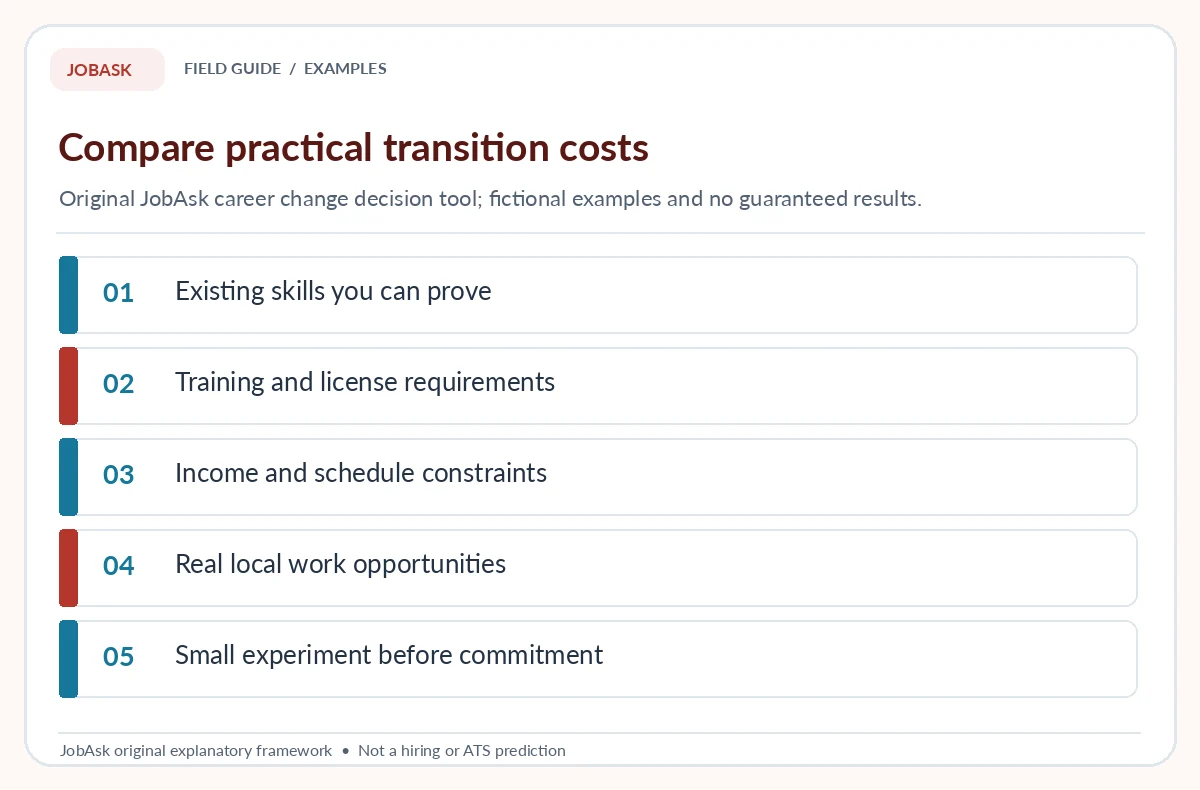
Low-cost experiments can reduce uncertainty. Read several accurate occupation profiles, speak with people who voluntarily share firsthand work experience and try a small lawful project where appropriate. A volunteer task or short introductory class can expose you to the daily activities without pretending to create a full professional credential. If you are employed, check workplace policies and privacy obligations before using any work resources for a personal experiment. Keep notes about what surprised you: required concentration, communication demands, tools, scheduling or physical conditions. These observations help refine the decision even if you ultimately stay where you are.
In a hypothetical scenario, someone curious about coordinating projects could volunteer to track milestones for an approved community event and then assess whether the planning work is energizing. Another might try a basic publicly available introductory lesson before paying for a long program. Both tests provide limited evidence, not a hiring qualification by themselves. Set an explicit question for each experiment, such as “Do I enjoy the actual work enough to pursue formal training?” A career change is a sequence of decisions, not an inspirational slogan. You can pause or revise the path if new evidence does not support the original assumption. Our guide to switching careers at 30 shows how to compare realistic paths before committing.
Build a transition plan with a realistic decision point
Turn the comparison into a small plan: target occupation, key requirements, existing evidence, most important skill gap, validation action and date to reassess. If employed, include practical constraints such as household expenses, benefits, schedule and the ability to learn while working. Do not infer universal employment rights or financial consequences from a career blog. Where a role requires a license or a significant investment, gather authoritative advice before committing. You can sometimes pursue interviews for adjacent roles while learning; in other cases it makes sense to complete prerequisite training before applying. For the fuller picture, see our guide “Changing Careers While Job Hunting”.
A fictional plan could say, “Over the next month, compare three verified role profiles, request two voluntary informational conversations and complete one introductory skills project; then decide whether to apply to an adjacent occupation.” The timetable is an example, not an evidence-based promise of qualification. Record reasons to proceed, pause or choose a different route. This article is intentionally narrower than JobAsk’s earlier general how-to-change-careers guide and transferable-skills article: its primary output is a comparison among realistic transition paths. If you want the full process, read how to change careers with a skills map and low-risk transition plan.

How We Research and Where This Guide Stops
We reviewed U.S. Department of Labor CareerOneStop tools and BLS career-transition discussion to ground the occupation-comparison method. The three-route framework and candidate examples are original hypothetical decision aids; they are not guarantees of local openings or future earnings. No private WordPress inventory or professional credential determination was performed.
Authoritative sources reviewed October 19, 2026: U.S. Department of Labor CareerOneStop offers skill-based exploration of different careers.. CareerOneStop occupation tools cover duties, training and career comparisons.. BLS outlines assessing the reason for a change, occupation data and skill gaps..
Affiliate disclosure: No training course, career coach or placement agency is represented as an approved JobAsk affiliate. See the JobAsk affiliate disclosure for the site-wide policy.
Related Guides
- Career Goals for Managers: Improve Delegation, Coaching, and Decisions
- Entry-Level Environmental Jobs: Compare Field and Lab Technician Paths
- Entry-Level Cybersecurity Jobs: Compare Security Roles and Feeder Paths
- How to Change Your Resignation Last Day With a Clear Written Request
No. You may change organizations while remaining in the same occupation; a career change can also involve switching functions or occupations.
Use occupation research and tools such as CareerOneStop’s mySkills myFuture to explore options, then check actual role requirements.
No. Skills evidence does not waive credentials, supervised practice or licenses required for a specific occupation.
Not as a universal rule. Consider personal finances, training requirements and other obligations before making an irreversible employment decision.
Verify the target role’s requirements, compare credible programs and costs, and avoid providers making unsupported placement guarantees.