
Transferable skills are capabilities you have used in one setting that can help with work in another. Communication, organizing information, analysis, and coordinating people can travel across roles—but a label alone is not proof that you can do a different job. This guide turns genuine tasks into evidence-led skills statements, identifies where translation stops, and helps you test the fit to a target posting. It is not a career-change plan or a list of qualifications every employer must accept. All role examples are fictional.
Separate portable capability from job specific knowledge
A transferable skill is an ability that appears in different kinds of work or activity, although the context may change. For example, keeping a reliable task log can matter in a service operation and an office team. Knowing the rules of a particular regulated profession is different; it may require formal training or a license before you can perform the work. UC Davis distinguishes knowledge-based skills from more portable human and task skills. The boundaries are useful because career advice often blurs a general strength with job-ready expertise.
Start by reading what the target job actually requires rather than deciding in advance that you possess all the requested abilities. “Organized” can mean handling bookings, meeting deadlines, maintaining files, or planning multiple participants’ work. Each use is different. If you once tracked volunteer attendance, you may be able to discuss records and coordination; that does not prove you have administered specialized medical records software. Be precise about the activity and setting so an employer can judge the relevance without an inflated claim.
Inventory the tasks that you personally performed
Write down work, volunteering, class assignments, home-based projects, or student activities where you had a defined responsibility. Record what the task was, what you actually did, what you used, and what output remained afterward. Case Western Reserve groups transferable skills into areas such as communication, analysis, interpersonal work, and organization. Those labels are a helpful starting inventory but they become persuasive only when connected to a truthful example. Avoid lifting impressive verbs from a list without checking your own history.
For each candidate ability, ask “Could I walk someone through how I did this?” If the answer is no, perhaps you observed a teammate or participated too briefly to describe the work as your own. Mark that difference. A student project can be legitimate evidence if the role and deliverable are described accurately; a household activity may demonstrate planning but should not be disguised as paid business management. Preserve the project context. The resulting evidence inventory is more useful than a long generic skills section because it gives you material for applications and interviews.
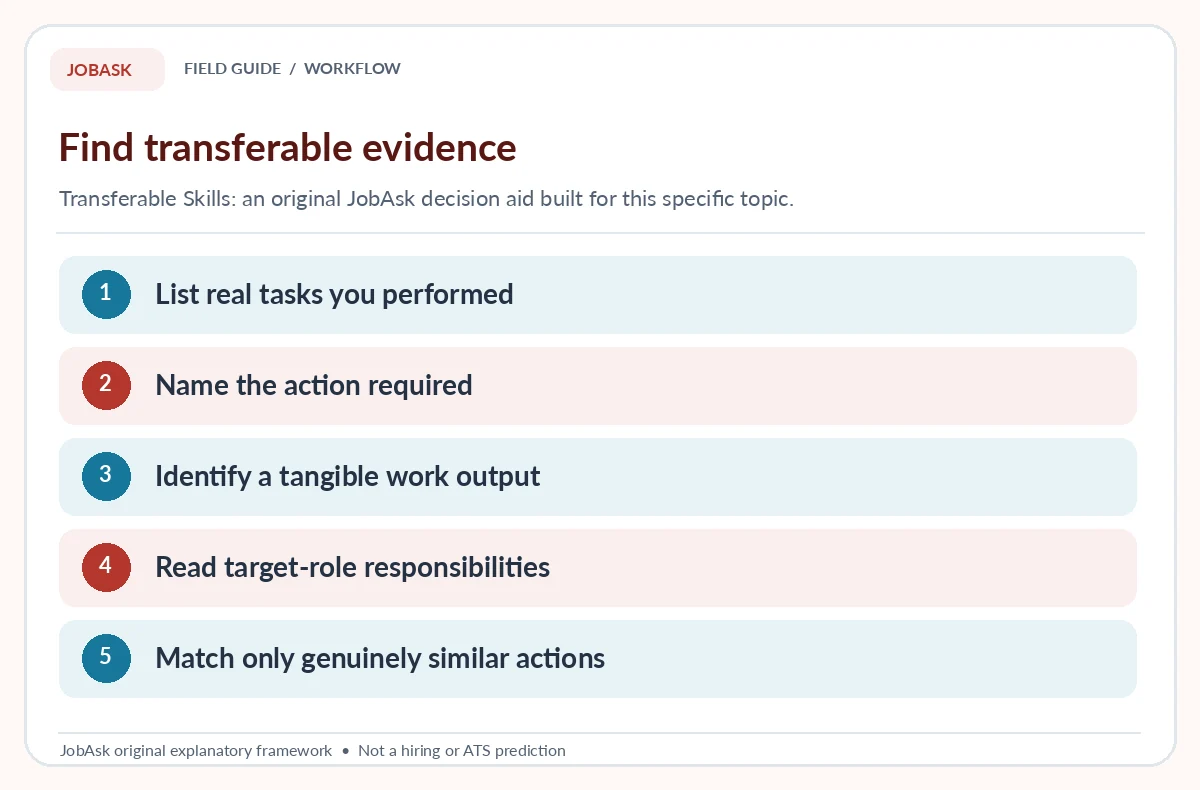
Translate a task using an original evidence map
Hypothetical retail example: “I handled store returns” might reveal several distinct capabilities, but only if the person genuinely performed them. They might have listened to customer needs, checked a policy, entered a record, and explained the result. For a service desk role, the relevant translation could be “documented customer requests and explained next steps under established procedures.” It would be inaccurate to claim conflict mediation or advanced case management solely because some returns were difficult. The function, not the job title, is what transfers.
Hypothetical community-project example: “I helped at an event” is too broad to judge. If a volunteer actually assigned time slots and updated instructions, a more precise description is “organized volunteer shift sign-ups and shared schedule changes with coordinators.” If their only contribution was greeting guests, use that task instead. Seton Hall and other university career centers favor showing how work was carried out, not merely asserting a virtue. Every example in this article is invented; no applicant should copy a duty they never performed.
Compare skill demands with the job description
Mark each target requirement as demonstrated, partly related, not yet demonstrated, or a formal prerequisite. You might have created simple spreadsheets but not know the database software named in the description. In that case you can explain your actual spreadsheet experience while identifying the tool as a learning need; you cannot present the two as interchangeable certifications. Marquette advises connecting portable abilities from academic projects, volunteering, and work to relevant parts of a resume. Select the strongest matches instead of listing every adjective.
Do not treat preferred qualifications as automatic proof of rejection or as permission to misrepresent what you know. Identify which essential tasks you could handle with your current experience and what training would be necessary for others. If the target occupation requires an active license, clearance, or other formal eligibility, use authoritative current instructions for that jurisdiction. This article does not substitute for verifying those requirements. A skill translation is a communication tool; it cannot waive a legitimate qualification or predict an employer’s final screening decision.
| Actual earlier task | Portable action | Truthful target-role framing |
|---|---|---|
| Answered service requests | Listening and documentation | Describe the requests and records handled |
| Updated club sign-up list | Scheduling and tracking | Name the project context honestly |
| Checked repeated form errors | Reviewing records | Describe the checks and outputs |
| Helped teammate with onboarding | Explaining a procedure | Specify your role; do not claim trainer title |
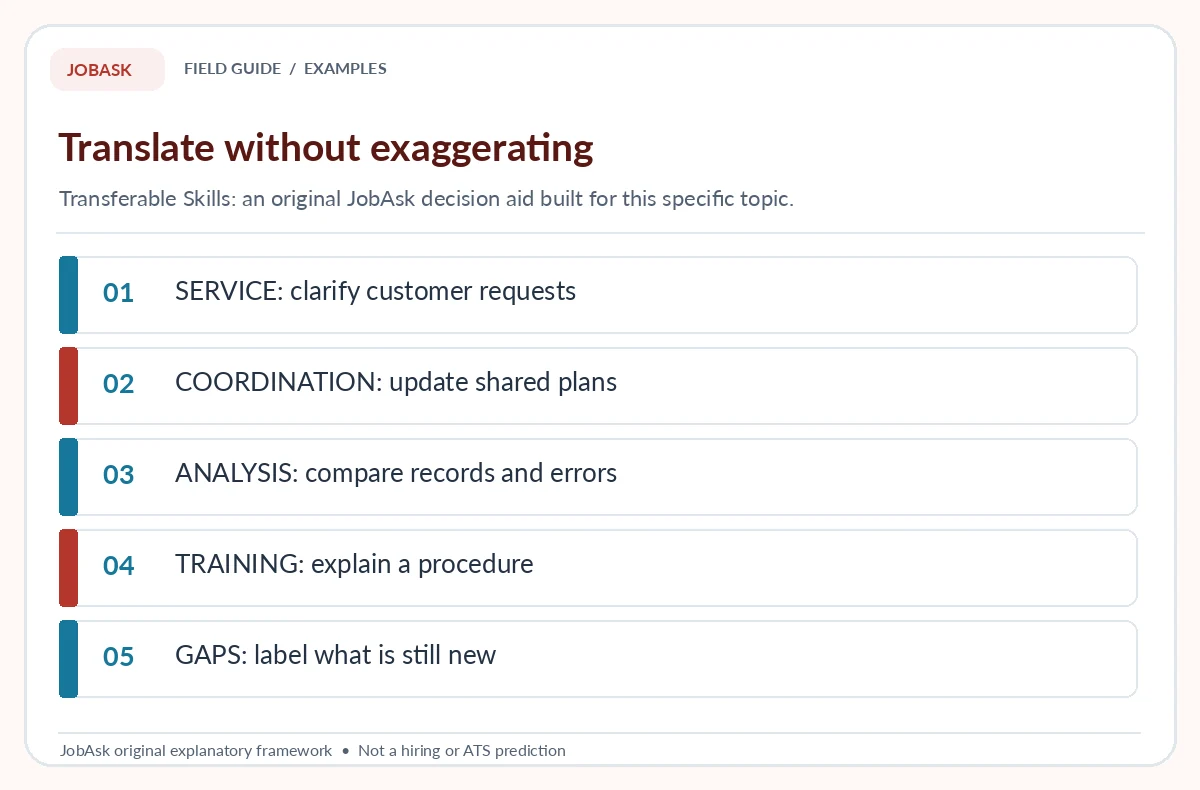
Use before and after wording that protects accuracy
Before: “Excellent communicator and leader.” After, only if true: “Summarized weekly service requests for the next shift and explained unresolved issues to colleagues.” The revised statement gives a task and an audience, and it does not invent an outcome. Before: “Advanced project management.” After, if appropriate: “Kept a shared checklist of class-project tasks and deadlines.” The latter acknowledges the actual context instead of claiming commercial project management experience. The objective is to make a real capability visible, not to dress ordinary work in a more senior title.
Where you have a legitimate result, describe it proportionately. For example, “created a one-page instruction sheet used by our club officers” is a concrete output if you have that evidence. A percentage improvement should appear only if it was measured and can be explained. In interviews, be prepared to describe the situation, action, and result without exaggerating another person’s contribution. In resumes, select a few relevant bullets; in cover letters, connect one example to the work. This article focuses on mapping, while JobAsk’s resume-summary and objective guides address their respective first-line sections.
Test evidence strength before choosing a claim
Use a three-level personal rubric. Strong: you performed the task, can explain it, and can name a relevant output. Developing: you assisted or practised and can identify what you are still learning. Unsupported: you only saw someone else do it or inferred an ability from interest. An unsupported item should not appear as proven competence. This is an original editorial method for avoiding overstatement, not a psychometric test. A learner can be a credible candidate while being honest about what they have not yet mastered.
Ask a friend or adviser to read the target posting and your evidence description. Can they connect the two without assuming a new qualification? If not, adjust the wording or keep the gap visible. Use normal terminology that employers will recognize, but do not pack a document with unsupported keywords or promise that it will beat an applicant-tracking system. Employers and tools differ. The goal is defensible communication that allows a hiring team to ask specific follow-up questions about tasks you have actually carried out.

Choose a practical next step for each missing capability
Once you see where your evidence is strong, separate learning needs from communication problems. A communication problem can be solved by making a real task clearer. A capability gap might require practice, a supervised project, coursework, or a recognized credential. A structural barrier such as licensing cannot be solved by renaming a former job. This distinction prevents vague career advice from pushing readers into expensive training without examining whether the training is actually required or respected in the target occupation.
Create a short plan with the capability, evidence you already have, the missing portion, and a way to verify improvement. For a spreadsheet skill, that might mean accurately documenting a sample workflow and learning a feature you have not used. For a regulated occupation, it could mean checking the appropriate licensing authority. Record what is hypothetical practice and what was paid work. You can then update your materials based on demonstrated facts rather than a presumed guarantee that one certificate or set of keywords will secure employment.
How We Research and Limits of This Guide
We compared UC Davis guidance on skills evidence with Case Western Reserve and Marquette skill inventories. Our task-to-skill matrix, claim-strength checks, and hypothetical revisions are original editorial exercises rather than psychometric assessments. We differentiated skill translation from broader career planning and the JobAsk Resume Summary and Resume Objective intents. Formal occupation entry requirements, personal work history, private WordPress posts, and automated screening behavior are not independently verified here.
Sources reviewed October 19, 2026: UC Davis explains skills developed in jobs, volunteering, and projects and supports evidence-led statements. Case Western Reserve describes transferable analytical, communication, interpersonal, and organizational skills. Marquette explains showing portable skills from experience in resume and job materials.
Affiliate disclosure: No paid training, resume software, or certification program is endorsed. Buttons link to public university career-center resources. Read the JobAsk affiliate disclosure for the site-wide policy.
Related Guides
- How to Get a Job With No Experience: Build Evidence and Apply
- Job Knowledge Performance Review Comments: Skills and Evidence
- Retail Resume Skills: Show Register, Stock, and Service Evidence
- Career Change Resume Objective: Explain the New Direction With Real Evidence
- Self-Evaluation Accomplishments: Write a Review With Real Evidence
They are abilities used in one context that may help in another, such as recording information, collaboration, analysis, or explaining procedures.
Yes. Projects, study, volunteering, or other responsibilities may provide evidence when your contribution and the context are described truthfully.
No. Transferable ability does not replace a required license, degree, experience level, or technical training when the role requires one.
No. Select relevant skills that you can demonstrate with examples. Generic labels alone provide little evidence.
No. They can help communicate relevance, but requirements, competition, fit, training and hiring decisions differ.