
CNA interviews often use patient-care scenarios to see how you respond when someone needs help, a task feels unsafe, or a patient’s condition appears to change. Answer with respect, prompt communication, and accurate reporting. You are interviewing for work within your training and assigned responsibilities, not for independently diagnosing or prescribing treatment.
Here is the practical approach: identify the decision behind the question, choose a genuine example, state your role, and give the outcome or lesson without stretching it. For behavior-based questions, the University of Washington STAR guide recommends explaining the situation, task, your actions, and the result. Interview questions differ by employer; the examples here are explicitly hypothetical practice material, not transcripts of real hiring interviews.
What Employers Need to Learn About Certified Nursing Assistant Work
The Bureau of Labor Statistics describes nursing assistants as members of a care team who assist with daily living and share patients’ concerns with nurses. The CDC’s Standard Precautions apply across patient care settings. Exact CNA credentials, delegated tasks and employer protocols vary by state and facility, so safe interview answers should name those boundaries explicitly.
Use the primary occupational or professional guidance alongside the related professional source to ground the responsibilities, but do not assume the same interview sequence at every employer. Read the advertised duties carefully: is this a support role, an individual contributor, a supervisory appointment, or a licensed position? The stronger an answer is tied to that role’s actual authority, the less likely it is to become vague or overstated.

Five Questions Worth Practicing With Real Examples
Question 1: What would you do if you noticed a change in a resident’s condition?
What the question tests: The answer should show observation and prompt escalation without independent clinical diagnosis. Start by clarifying the setting and the responsibility you actually held. If the interviewer asks for a specific past incident, answer with something that really happened to you. A practice response may be hypothetical, but your final interview story should never pass a constructed situation off as lived experience.
Build your answer: Keep the resident safe, communicate the change and relevant observations to the nurse immediately as indicated, and follow facility reporting procedures. Mention an observation or concrete work product when you have one, and distinguish your own contribution from any decision made by a manager, clinician, school leader, or project sponsor. Avoid: Do not promise a diagnosis, choose an intervention beyond your assignment, or wait until the end of the shift. If the scenario is new to you, explain your reasonable decision process honestly rather than claiming an outcome you have not achieved.
Question 2: How do you help a person who refuses routine care?
What the question tests: Dignity, listening and avoiding coercion matter in routine care conversations. Start by clarifying the setting and the responsibility you actually held. If the interviewer asks for a specific past incident, answer with something that really happened to you. A practice response may be hypothetical, but your final interview story should never pass a constructed situation off as lived experience.
Build your answer: Listen to the reason, explain within your role, respect preferences, and notify the supervising nurse when care is declined or concerns persist. Mention an observation or concrete work product when you have one, and distinguish your own contribution from any decision made by a manager, clinician, school leader, or project sponsor. Avoid: Never describe forcing care or overriding a person’s preferences on your own. If the scenario is new to you, explain your reasonable decision process honestly rather than claiming an outcome you have not achieved.
Question 3: How would you prevent infection during a busy shift?
What the question tests: The interviewer is looking for reliable precautions even when time is limited. Start by clarifying the setting and the responsibility you actually held. If the interviewer asks for a specific past incident, answer with something that really happened to you. A practice response may be hypothetical, but your final interview story should never pass a constructed situation off as lived experience.
Build your answer: Describe hand hygiene, appropriate PPE after a risk assessment, cleaning practices in your assigned work and adherence to facility guidance. Mention an observation or concrete work product when you have one, and distinguish your own contribution from any decision made by a manager, clinician, school leader, or project sponsor. Avoid: Gloves do not replace hand hygiene, and policies may call for specific precautions. If the scenario is new to you, explain your reasonable decision process honestly rather than claiming an outcome you have not achieved.
Question 4: How would you handle a transfer you could not do safely alone?
What the question tests: Patient and worker safety depend on proper technique and available support. Start by clarifying the setting and the responsibility you actually held. If the interviewer asks for a specific past incident, answer with something that really happened to you. A practice response may be hypothetical, but your final interview story should never pass a constructed situation off as lived experience.
Build your answer: Pause, assess what the care plan and training require, request assistance or equipment, and follow the approved lifting or transfer procedure. Mention an observation or concrete work product when you have one, and distinguish your own contribution from any decision made by a manager, clinician, school leader, or project sponsor. Avoid: Do not claim that physical strength substitutes for training, supervision or assistive equipment. If the scenario is new to you, explain your reasonable decision process honestly rather than claiming an outcome you have not achieved.
Question 5: Tell me about communicating a concern to a nurse.
What the question tests: A good answer distinguishes what you saw and heard from assumptions about the cause. Start by clarifying the setting and the responsibility you actually held. If the interviewer asks for a specific past incident, answer with something that really happened to you. A practice response may be hypothetical, but your final interview story should never pass a constructed situation off as lived experience.
Build your answer: Give a specific de-identified observation, state when and how you reported it, explain what you did within your role, and describe the follow-up you were directed to provide. Mention an observation or concrete work product when you have one, and distinguish your own contribution from any decision made by a manager, clinician, school leader, or project sponsor. Avoid: Do not discuss personal patient identifiers or suggest you made a treatment decision. If the scenario is new to you, explain your reasonable decision process honestly rather than claiming an outcome you have not achieved.
A Hypothetical Practice Answer With Clear Limits
Hypothetical situation — not a real candidate achievement: During routine care, a resident says they feel unusually weak and appears different from their usual presentation. A useful interviewer prompt might be: “What would you do next, and who should make the final decision?” This example is designed to practice an appropriate response, not to claim it happened at an identifiable employer. Your genuine story will differ; replace details only with information you can accurately disclose.
Hypothetical response: “I would stay attentive to immediate safety, use the facility’s urgent-response procedure if indicated, and promptly tell the supervising nurse what I observed and what the resident said. I would not attempt to diagnose the cause. I would record observations or actions only according to my assignment and documentation policy.” Notice that this answer describes a sequence and a boundary, not a guaranteed good outcome. When tailoring it, replace the conditional steps with the actions you actually took. If you have not encountered the situation, say how you would approach it and ask about the organization’s established procedure.
Build a Small Library of Verifiable Evidence
Choose three situations from work, internship, supervised practice, education, or volunteering that clearly match the position. For each, write a one-sentence context, the task assigned to you, two or three actions you performed, and the observable result or what you learned. Relevant evidence for this role could include: A real, properly de-identified example of repositioning support, promptly escalating an observation, or preserving patient dignity may support an answer; never disclose an identifiable patient story. Use documents only if you are allowed to show them; a precise verbal description is often enough.
Make a quick evidence inventory rather than a script. Label each story with a skill such as accuracy, communication, conflict handling, safety, or planning. Underline statements that imply a promotion, a performance percentage, a regulatory decision, or other measurable impact; remove them unless you can support them. Then rehearse the story aloud with a colleague and ask which decision was still unclear.

Keep Claims, Confidentiality, and Authority Accurate
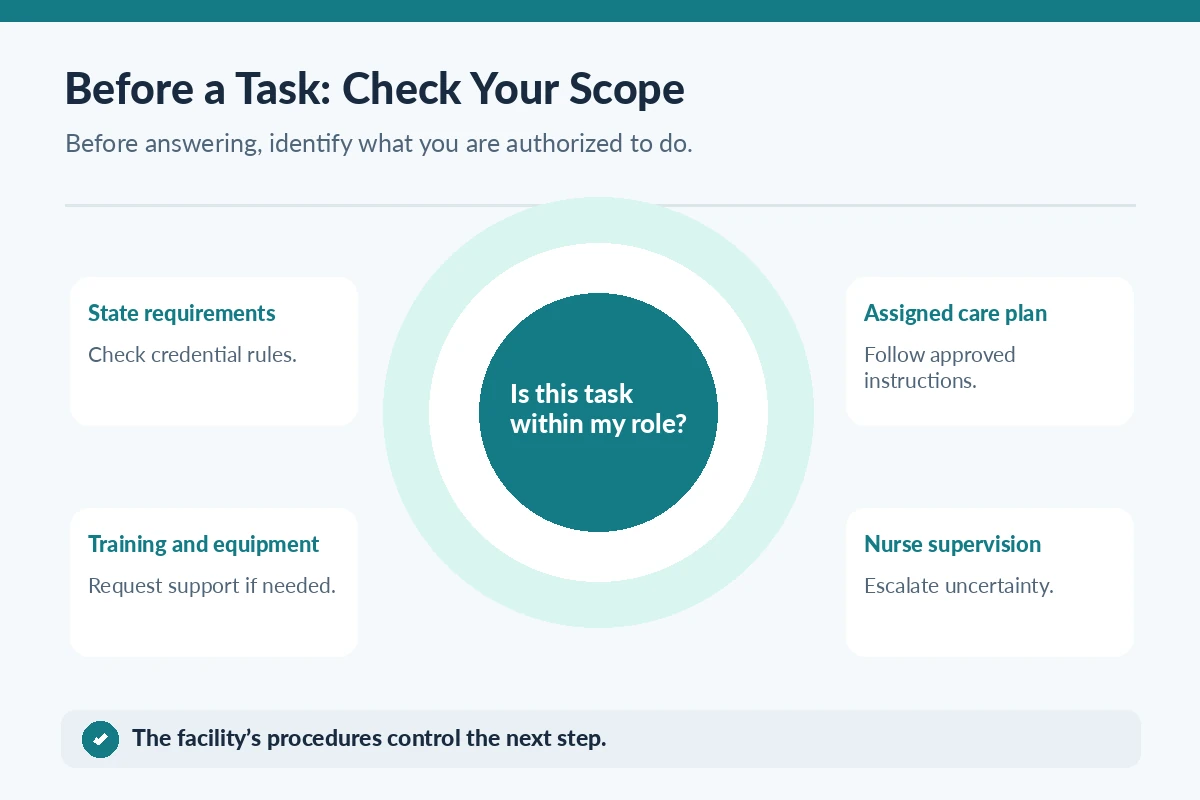
State CNA requirements and authorized tasks vary. Do not claim independent assessments, medication administration, or other procedures unless specifically authorized by your credentials, training, and workplace policy.
A question may be hypothetical even when the interviewer wants to see professional judgment. In that case, state what you would check first, what rules or instructions control the next action, who you would involve, and how you would record the outcome if authorized. For a behavioral question about the past, use a real story. Never invent an employer, client, patient, student, staffing level, salary outcome, or software capability to sound more experienced.
A Fifteen-Minute Rehearsal Before the Interview
First, spend three minutes reviewing the posting and identify the three duties that appear central to this particular certified nursing assistant role. Next, allocate five minutes to matching one true experience to each duty. Use four minutes to say an answer aloud and notice where your personal action disappears behind “we.” In the final three minutes, prepare two questions about decision rights, training, escalation, or supervision that directly fit the role.
For a remote interview, check the connection and put the question list beside—not over—the camera. For an in-person interview, carry a short, nonconfidential evidence sheet. If an interviewer asks a question outside your experience, acknowledge the limit and offer a structured next step. This is clearer and more credible than memorizing an answer that implies facts you cannot verify.
How We Research Interview Preparation Guidance
We reviewed primary occupational or professional guidance and related professional source for role responsibilities, then cross-checked interview storytelling advice against the University of Washington career guide. These sources support the work and the response structure; they do not verify that a specific employer asks any particular question or that a proposed answer wins an offer. Examples are hypothetical. The editorial team has no confirmed affiliate relationship for the resources in this guide. See the affiliate disclosure.
Related Guides
- Medical Assistant Interview Questions: Patient Care, Records, and Scope of Practice
- CNA Resume Skills: Show Patient Care Tasks and Verified Credentials
- Supervisor Interview Questions: Coaching, Coverage, and Fair Decisions
- Business Analyst Interview Questions: Requirements and Stakeholder Decisions
- Pharmacy Technician Interview Questions: Accuracy and Patient Support
No. Training, certification and permitted tasks vary. Verify the state requirements, job posting and the employer’s policy.
No. Keep examples de-identified and disclose only information needed to explain your response.
Identify the supervised training experience honestly, including your own duties rather than implying independent employment.
No. Describe when you seek a nurse, urgent help, equipment, or another authorized team member.
Ask about CNA scope, nurse supervision, safe transfer equipment, orientation, and the chain of communication for urgent changes.