
Medical assistant interview questions often connect patient interaction with record accuracy, clinical support and front-office coordination. Prepare to describe the tasks you have actually performed, the training you completed, and when you would refer a decision to a licensed clinician or supervisor. The exact scope of medical assistant duties varies with jurisdiction, delegation and the practice’s rules. These questions are for career preparation; they do not teach clinical procedures or authorize tasks.
Role tasks were checked against official occupational information and interview techniques against the University of Michigan Career Center.
What This Role Actually Requires Before You Answer
O*NET describes medical assistants as performing administrative work and certain clinical duties under physician direction; examples include appointment scheduling, maintaining records, taking vital signs and preparing patients for examinations. This occupational summary does not mean every medical assistant can perform every listed task. Employers may require specific training or credentials, and responsibilities differ between clinics and specialties. Our medical assistant resume summary guide covers how to confirm credentials and patient-care scope.
Match your preparation to the posting: rooming patients, documentation, specimen handling, scheduling, phones or coordinating with providers may appear in different combinations. Create an honest skills inventory with three labels: performed in approved practice, learned under supervision, and not yet trained. Never turn an observation-only experience into independent clinical work, and do not mention patient names or identifying records in an interview. For the fuller picture, see our preschool teacher interview questions guide.
Use Questions to Demonstrate Decisions and Evidence
The prompts below are practice scenarios about patient intake, vital signs, and records, not a real clinic’s question list. You can use a true past example with Situation, Task, Action, and Result, a structure explained by the University of Michigan. If you are asked what you would do with an unexpected patient situation, clearly mark the reply as a proposed approach.
How do you keep patient information accurate during intake?
A wrong entry can disrupt the information available to the care team. A useful way to respond is to explain following the practice’s approved identification and documentation process, confirming information within your role, and escalating mismatches. Hypothetical answer: In a hypothetical supervised clinic shift, you notice that a chart entry and the information provided at check-in do not agree. You pause, use the clinic’s verification process and alert the appropriate team member rather than silently changing an uncertain clinical fact. Accuracy boundary: Do not invent clinical authority, share patient data or imply that one documentation policy works everywhere. After practicing, replace the sample clinic setting with your own externship or patient-care experience, or say you are describing what you would do. A good answer shows how you protect patient information and when you hand a question to the provider.
What do you do when a patient is anxious or upset?
The role includes frequent human contact as well as administrative tasks. A useful way to respond is to listen respectfully, clarify what you can help with, maintain privacy and refer questions about diagnosis or treatment to a licensed clinician. Hypothetical answer: In a hypothetical waiting-room scenario, a patient worries about a delay. You acknowledge the concern, check scheduling information you are permitted to access and explain when the care team can offer an update. Accuracy boundary: Avoid giving medical advice, assurances about outcomes or private information about other patients.

How do you prioritize the front desk and patient-room tasks?
Many medical assistants coordinate several requests while protecting accuracy. A useful way to respond is to describe consulting the clinic’s triage and supervisor instructions, communicating time-sensitive concerns promptly and finishing records consistently. Hypothetical answer: In a hypothetical team shift, phones are active while rooms are being prepared. You alert the responsible staff to an urgent concern, follow the approved priority system and document pending work for the next team member. Accuracy boundary: Do not imply that you independently assess medical urgency beyond your permitted training or skip required checks.
Which clinical tasks are you trained and allowed to perform?
The interviewer must distinguish actual practice from an applicant’s wish list. A useful way to respond is to state completed training, credentials and supervised experience accurately, then ask what tasks are delegated and what oversight applies at this clinic. Hypothetical answer: In a hypothetical interview, a graduate explains that vital-sign recording was practiced during supervised training but a certain procedure has not been performed independently. The applicant asks about employer-specific onboarding rather than claiming mastery. Accuracy boundary: Never represent certification, licensure, independent authority or patient-care experience you do not have.
Tell me about a time you noticed a documentation problem.
Attention to records and handoffs is central to many clinic workflows. A useful way to respond is to use a non-identifying true example, identify your part in recognizing the issue and describe reporting through the proper channel. Hypothetical answer: In a hypothetical simulation, a student notices a duplicate appointment entry and brings it to the instructor. The team verifies the record and corrects it through the designated workflow. The applicant explains what check they now perform. Accuracy boundary: Do not reveal actual charts, patients or confidential workplace incidents.
| Evidence to prepare | What it proves | Accuracy check |
|---|---|---|
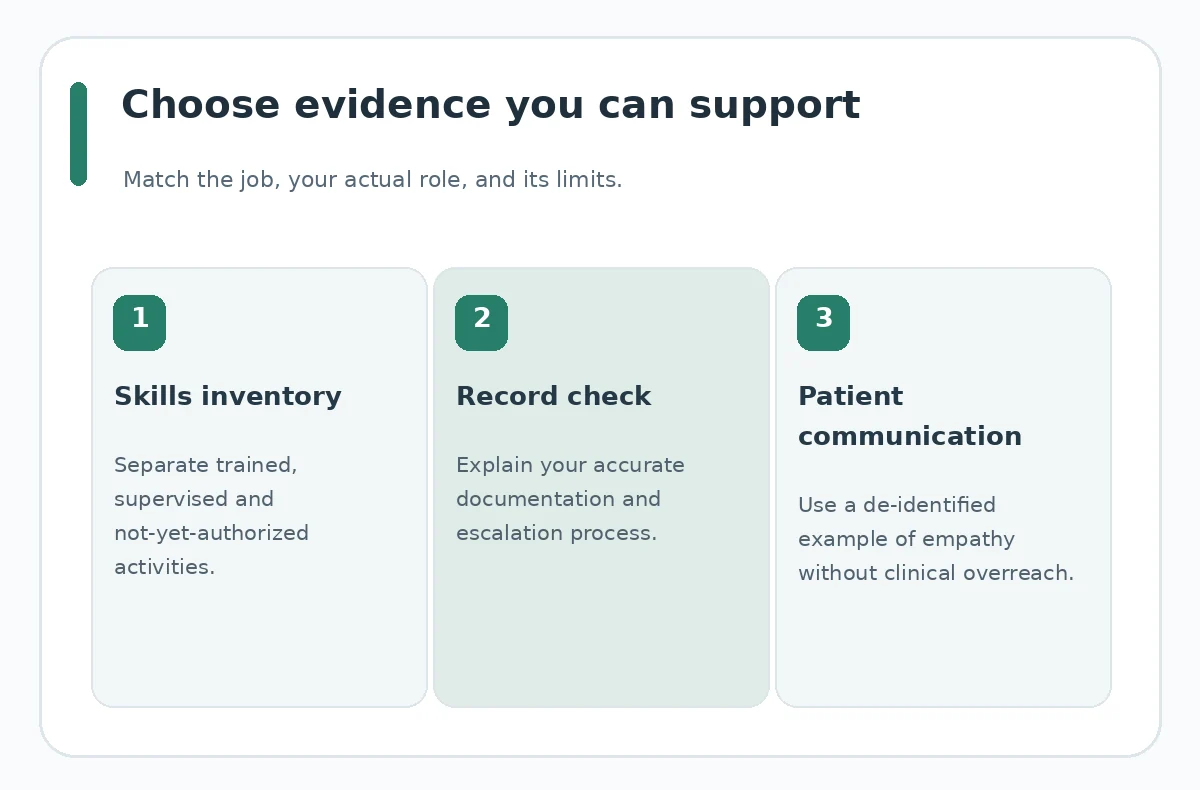
| Skills inventory | Separate trained, supervised and not-yet-authorized activities. | Only describe tasks you really performed or would propose. |
| Record check | Explain your accurate documentation and escalation process. | Only describe tasks you really performed or would propose. |
| Patient communication | Use a de-identified example of empathy without clinical overreach. | Only describe tasks you really performed or would propose. |
Prepare Stories Without Borrowing Someone Else’s Results
Write three short evidence cards about patient care or records: the situation, your action, and the result. An externship, a front-office job, or volunteer patient contact can count if it shows the advertised work. Say where it happened and who supervised you. If you have no reliable figure, describe the procedure and the feedback you received.
Then practice one case where you had to involve a nurse or provider. Explain what you checked in the chart, who had clinical authority, and how you documented the handoff. This matters because medical assistants handle protected health information and work under clinical supervision. Prepare one example about accurate intake and another about an unexpected change in the schedule.
Questions to Ask About the Actual Job
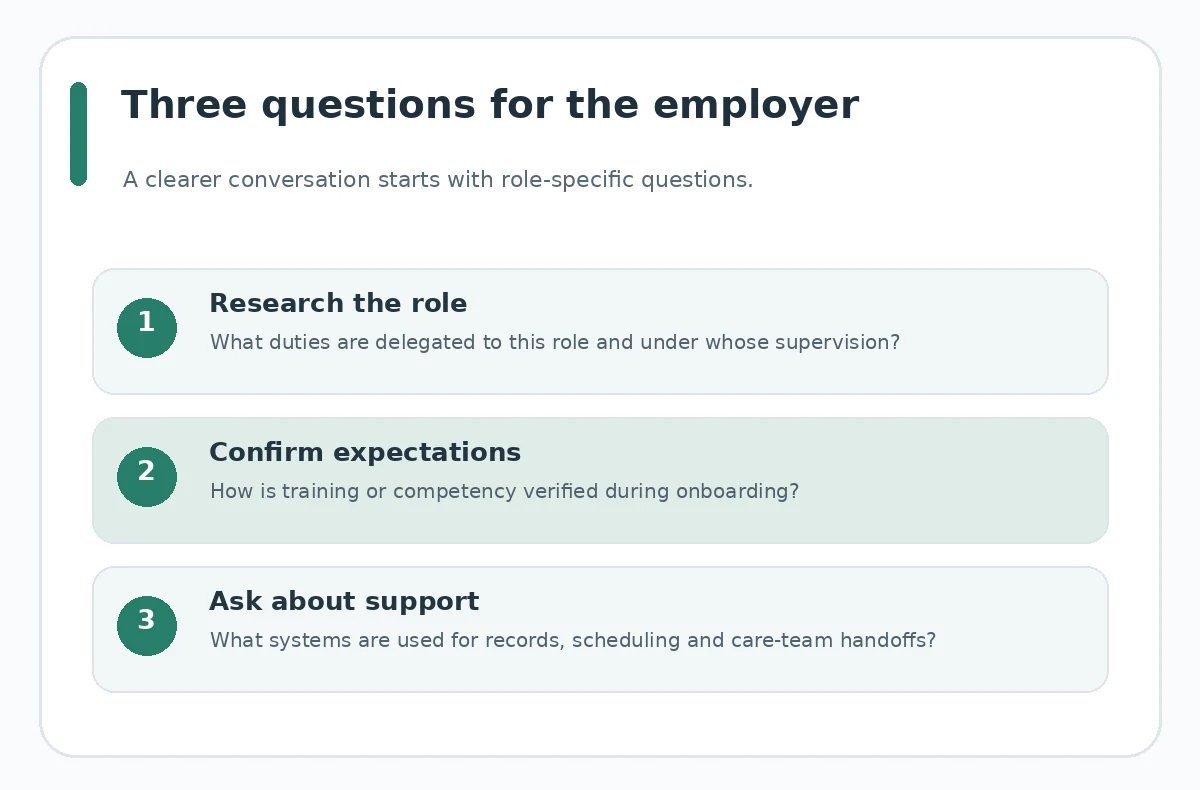
Use the last minutes to ask about the clinic’s workflow, supervision, and scope of tasks. Three useful questions for this role are: What duties are delegated to this role and under whose supervision?; How is training or competency verified during onboarding?; What systems are used for records, scheduling and care-team handoffs?. These are suggestions, not requirements. If the interviewer already covered clinical duties, thank them and ask about something else. For the fuller picture, see our electrician interview questions guide.
Listen for which tasks are clinical, which are administrative, and which need a provider’s approval. The title “medical assistant” does not tell you which procedures you may perform in that state or clinic. After the interview, note the duties discussed and any next steps, without patient details. In your follow-up, mention a real part of the conversation, such as the clinic’s patient flow.
How We Research These Interview Questions
University of Michigan career guidance informed the evidence-based answer structure.
Sources, Boundaries, and Affiliate Disclosure
Source checks completed October 21, 2026: O*NET occupational profile supports O*NET describes medical assistants’ clinical support and administrative activities under physician direction. University of Michigan interviewing guidance supports University of Michigan provides structured behavioral interview preparation, including STAR.
This guide contains no affiliate links. For the site-wide policy see the affiliate disclosure.
Related Guides
- CNA Interview Questions: Patient Care, Reporting, and Safety
- Tell Me About Yourself as a Medical Assistant: Clinical and Front-Desk Fit
- Medical Assistant Cover Letter: Present Training and Patient Support
- Part-Time Medical Assistant Jobs: Check Scope, Credentials, and Clinic Hours
- Medical Assistant Resume Summary: Clinical and Office Skills You Can Prove
No. Tasks depend on jurisdiction, training, delegation and employer workflow.
Yes. Identify it as supervised experience and describe what you personally observed or did.
Do not reveal identifying details or private records; use a suitably anonymized example or a hypothetical scenario.
Say which systems you have actually used and discuss how you learn approved workflows; do not pretend proficiency.
Ask about delegated duties, supervision, competency checks, record systems and training for the specific position.