
A customer service resume summary should show what kinds of requests you handled, how you kept records, and whether you solved the issue yourself or passed it to the appropriate team. Replace broad labels like “people person” with one or two real service actions. The best opening is not a claim that every customer was satisfied; it is a concise description of work you can explain and support.
O*NET’s customer service task profile identifies responding to inquiries, recording details, checking actions and referring unresolved complaints. BLS similarly describes orders, questions, accounts and supervisor referrals. These public descriptions establish what the work can involve, not whether any individual applicant achieved a particular satisfaction score.
Match the Service Channel and Responsibility
Start by checking whether the employer serves customers in person, by phone, chat, email or a mixture. A retail return counter may emphasize payment rules and product questions; a contact center may emphasize account notes, verification steps and callbacks. State channels only when you have used them. A cashier who answered basic product questions should not imply they independently handled complex regulated account disputes.
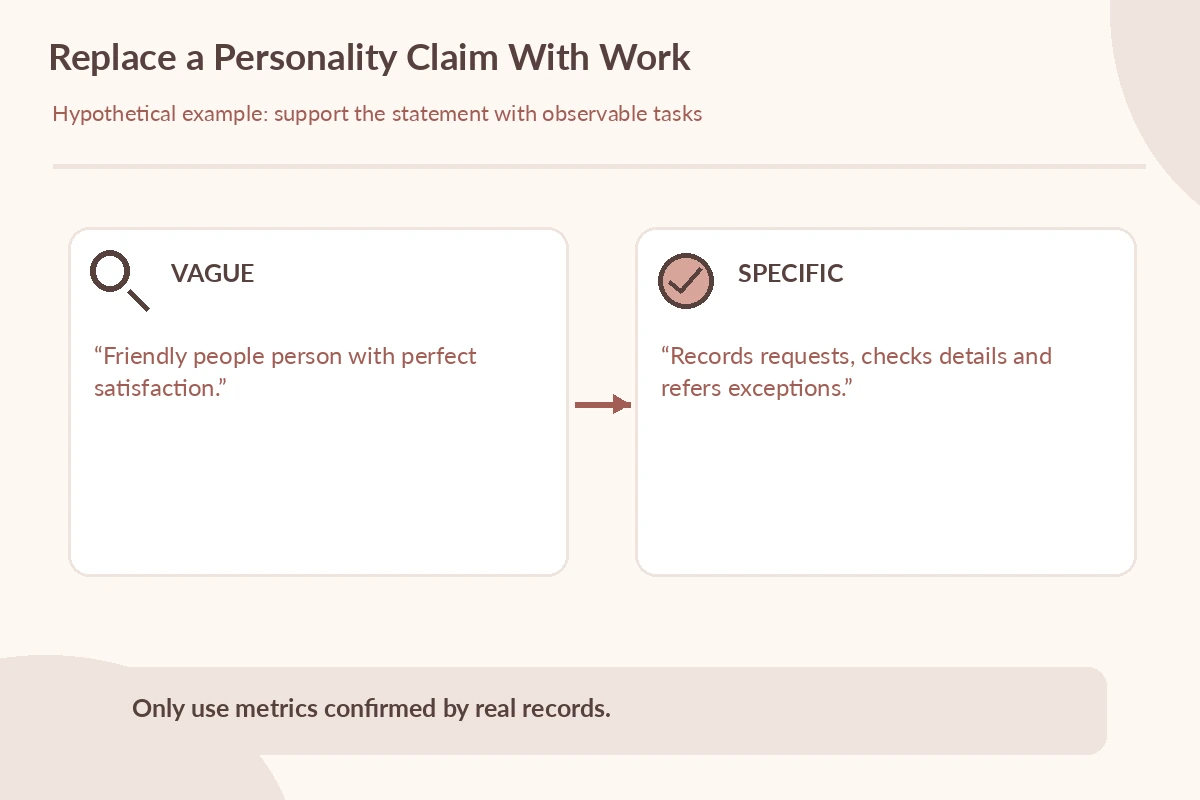
Map the posting’s actual activities to your previous work. “Responded to order inquiries by email” is more informative than “excellent interpersonal skills.” If you have experience in hospitality, volunteering or classroom-facing roles, use the comparable communication tasks honestly and identify the context. The summary should not erase differences between a casual conversation, a formal customer support case and a financial or medical transaction.

Show the Full Path From Inquiry to Follow-Up
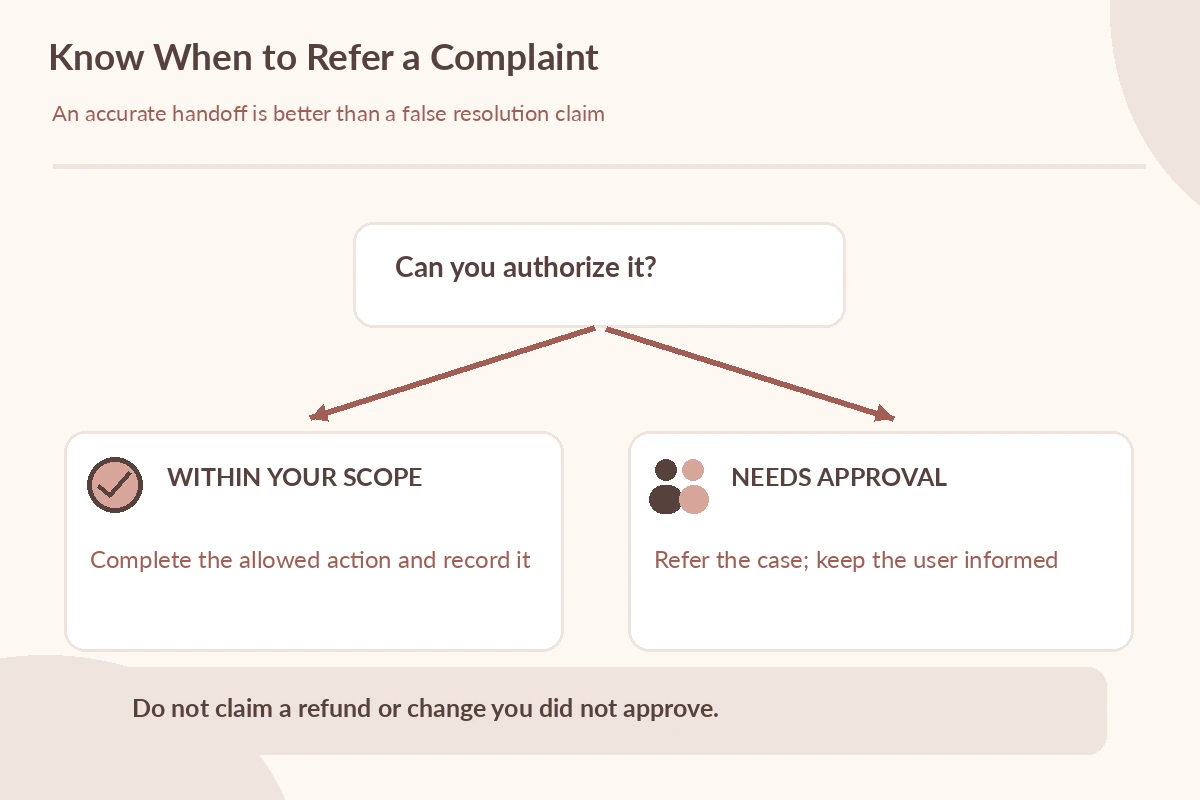
Choose a real case you are permitted to summarize. Identify the customer’s request, what you checked, what change you were authorized to make, how you recorded the interaction and how the person received an update. The most useful detail is often the handoff or verification step, not an emotional adjective. A record of the action and the next owner may be essential even when the issue cannot be closed immediately.
If you could process an ordinary replacement but not approve refunds over a threshold, keep that distinction clear. Do not say “resolved billing disputes” when your job was to gather documents and send the case to accounting. Service work includes clear boundaries. O*NET lists both taking actions on complaints and referring unresolved matters, illustrating why these are different contributions.
Choose Measures Only When You Can Verify Them
A real metric can clarify workload or quality if you know its source and meaning. Examples might include verified inquiry volume, documented follow-up completion or an actual quality-review result. A subjective feeling that customers were pleased does not justify “100% satisfaction.” Never copy percentages or call volumes from a resume website and present them as your own; each employer measures performance differently.
You can demonstrate quality without a fabricated score: “checked order details before updating the customer” describes a real control. If the team met a service target, distinguish your assigned part from a collective outcome. The number of cases entered into a system is not automatically the number solved. A short summary has space for one strong verifiable detail, not a dashboard of unsupported achievements.
Write a Summary Based on Actual Service Actions
A useful two-sentence structure includes channel or setting, type of inquiry, recordkeeping or follow-up, and only authorized decisions. Keep the role label truthful: “retail associate with customer inquiry experience” is appropriate when the work was retail, whereas “contact center specialist” is inaccurate for someone who never held that role. The opening can be tailored to a support opening without renaming past experience.
Hypothetical example: “Retail associate experienced in answering product questions and recording customer return requests. Checks receipt details, explains store options and refers exceptions to the supervisor responsible for approval.” This invented paragraph does not claim a particular employer, outcome or measured score. If your actual role did not involve returns, choose a different service interaction. One defensible process can convey more credibility than five generic soft skills.
Separate De-Escalation From a Final Resolution
Listening calmly and providing accurate updates are meaningful even when a complaint is still being investigated. Do not suggest you made a refund or account change if you only supplied information or forwarded a case. If the issue required a specialist, mention gathering the relevant details and maintaining a clear handoff. “Ensured resolution” is a broad claim that should be reserved for a result you actually verified.
Avoid including customer names, health details, account balances or case identifiers in public resumes. Summarize categories of work instead: returns, delivery updates or product guidance. When a role involves protected information, describe the approved process and confidentiality practices only if those were part of your responsibilities. Professional discretion is stronger than sharing supposedly impressive confidential examples.
Proofread Against the Rest of the Resume
The summary should match your documented employment dates, setting and actual authority. If you say you “managed escalations,” check whether your bullets prove direct management or just referral. If you name a CRM, confirm you used it, can discuss the task and are not substituting generic software familiarity. Prefer everyday language over repeated hiring buzzwords. Each phrase should help a reader ask a useful follow-up question.
Tailor your strongest evidence to the advertised channel and tasks, not to an imagined universal customer-service ideal. Some postings emphasize order accuracy; others prioritize patient explanations, clear case notes or coordination. A verified description of an inquiry, action and handoff gives a recruiter something concrete to evaluate without promising a particular interview outcome.
How We Research Resume Summary Guidance
This article combines a professional or first-party source with a second relevant source and the additional references linked above. They support the role of summaries or the described occupational tasks; they do not validate the performance of a hypothetical applicant. Sources were checked on October 26, 2026. The matrices and sample statements are independent educational examples, not recruiter endorsements or tested hiring strategies.
All model candidate statements in this article are explicitly hypothetical. No made-up employer, performance number, credential, hiring advantage, or universal software screening result is represented as fact. Job postings and qualifications vary. No paid affiliate partnership is claimed. See the affiliate disclosure for site policy.
More Resume and Cover Letter Guides
- Inventory Specialist Resume Summary: Prove Counts, Variances, and Handoffs
- Bookkeeper Resume Summary: Prove Reconciliation and Ledger Scope
- Customer Service Cover Letter: Show Resolution and Clear Follow-Up
- Cashier Resume Summary: Highlight Payment Accuracy and Customer Service
- Customer Service Skills for a Resume: Show What Happened After the Request
Use a specific inquiry type, your authorized action, recordkeeping and the actual follow-up.
Yes, when you accurately identify customer-facing tasks and do not invent contact-center duties.
Only when that outcome is truly documented; distinguish your updates or referrals from final resolution.
Yes, if you genuinely used them for relevant tasks and the experience is shown elsewhere.
Use your real title and emphasize the service tasks you performed without renaming the position.