
A short cover letter is not a full letter with all the nouns removed. It is a focused application note that identifies the role, gives one credible example of relevant work or preparation, explains the connection, and closes politely. Employers may ask for a brief message or have a limited field. Fit and accuracy matter more than reaching an arbitrary word count, so adapt your length to the posting and the evidence available.
CareerOneStop describes an ordinary concise letter of about 200–400 words; Harvard career guidance also emphasizes brevity, specific examples and factual writing. A shorter message can work in a limited text field, but no universal 100-word or 150-word rule is established by these sources.
Keep Four Necessary Jobs in the Draft
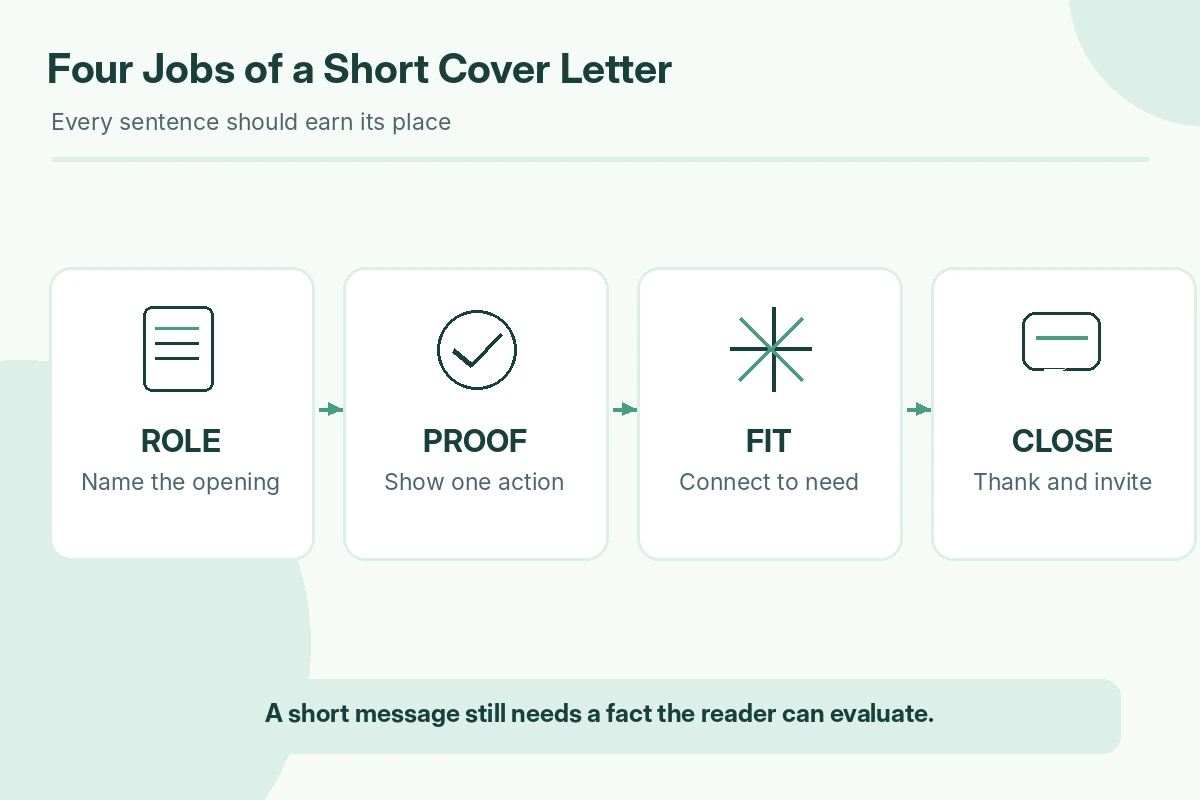
Even a brief letter should do four jobs: identify the target position, show a relevant piece of evidence, explain why that evidence helps with the role, and make a clear respectful close. An employer already has your resume, so do not fill the message with a full work history. Instead, bring one important connection into focus, such as scheduling changes handled accurately or a software problem documented carefully.
Start by marking each sentence with its purpose: ROLE, PROOF, FIT or CLOSE. If a sentence performs none of these functions, challenge it. “I am hardworking, passionate, dynamic and deeply motivated” gives no verifiable evidence. “I recorded ticket symptoms and followed a documented troubleshooting checklist during training” offers more substance, provided the statement is true and the training context is stated.
See a Brief Entry-Level Example With Honest Context
Hypothetical sample — entry-level office support: “Dear Hiring Manager, I am applying for the office assistant position. In a volunteer program, I maintained a shared shift schedule and alerted the coordinator when availability changed. This taught me to check details before sending updates, a task relevant to the scheduling work in your posting. I would welcome the opportunity to discuss my preparation. Thank you for your consideration. Sincerely, [Candidate Name].”
This is an invented teaching example, not a true applicant or proof of hiring success. It does not claim formal employment, company-specific familiarity, a dramatic metric or authority to approve shift changes. If your experience concerns a class project rather than volunteering, identify it as such. Keep the job title exact and remove placeholders before using your own edited version.

See a Short Experienced-Applicant Example
Hypothetical sample — service coordination: “Dear Hiring Manager, I am interested in your customer support coordinator role. In a previous support position, I documented unresolved requests and confirmed handoff notes with the assigned team before closing my own follow-up. I would bring that attention to accurate records and clear ownership to this role. Thank you for considering my application; I would be glad to discuss the match. Sincerely, [Candidate Name].”
Again, this fictional excerpt must not be presented as a real candidate’s history. Notice that it describes one traceable behavior without claiming a response-time improvement that was never measured. The reader can see how the action connects to the job. If the posting asks for multiple essential technical qualifications, this tiny sample may be too thin; expand evidence rather than padding with praise.
Cut Repeated Information, Not the Evidence
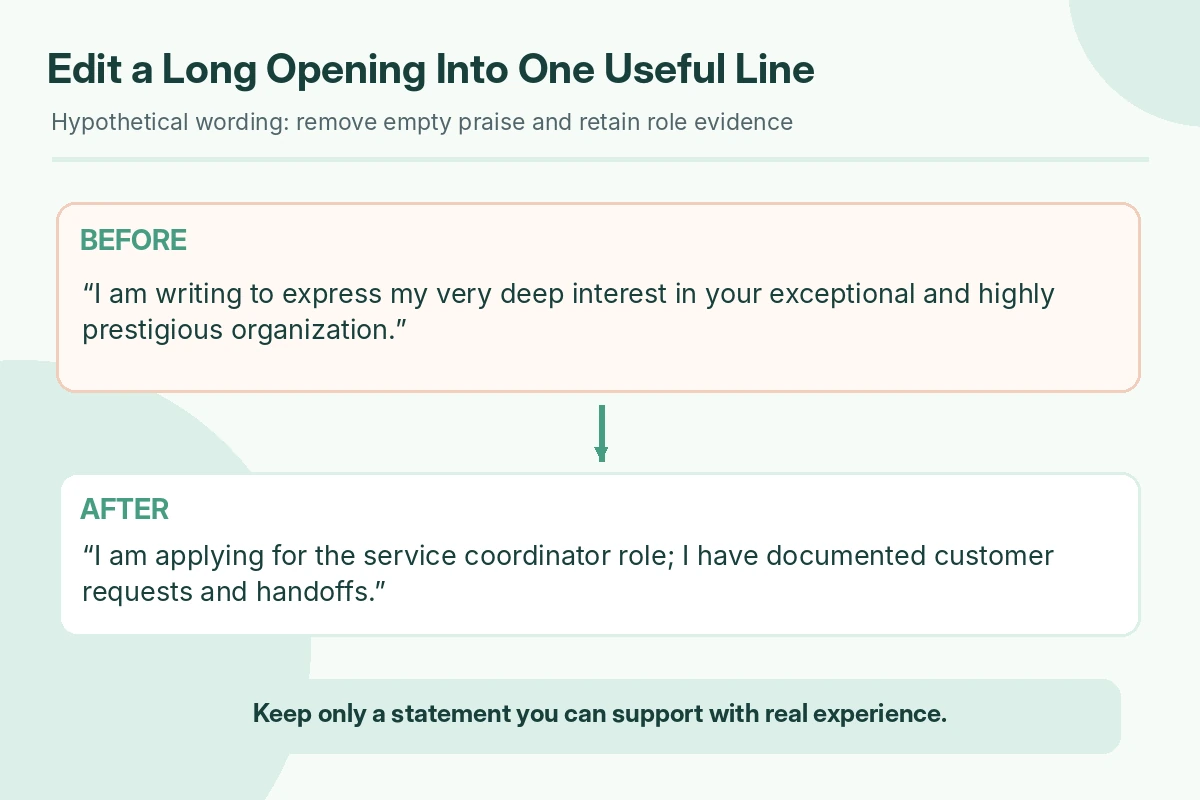
Try an editing pass in three colors: highlight the job-specific sentence, underline the concrete action, and cross out lines that merely repeat resume bullets. Delete ornate opening phrases such as “I am writing this letter to formally express my strong interest” when “I am applying for” does the work. Condense two synonymous adjectives into a specific verb or observable task. Shorter sentences often make the actual experience easier to evaluate.
Do not trim away the crucial setting or authority boundary. “Led all operations” may be shorter than “coordinated a volunteer schedule under the program lead,” but it is misleading if you never controlled operations. Also retain the organization name only if it is verified and relevant. A one-line claim with unexplained jargon is not stronger merely because it takes fewer characters.
Use the Right Form for Email or Attachment
When the employer requests a cover letter as the email body, the subject line should identify the actual opening, and the message can start with an appropriate greeting. Avoid attaching an extra document if the instructions tell you to write only in the email or portal field. When a separate PDF is requested, include a clear contact heading and confirm the layout after export rather than pasting email-specific conventions blindly.
A very short portal message can omit a full postal address, but it should not omit facts that the employer specifically requested. If an application field has a maximum character count, use it as a real limit rather than an invitation to remove necessary qualifications. Always follow the employer’s actual instructions over a sample’s decorative layout.
Check the Finished Message Against the Role
Ask what someone can actually learn from this letter that is not obvious in a list of previous positions. If the answer is only that you are enthusiastic, add one verified example. If there is more than one relevant example, choose the one closest to the role’s main task. Save the full experience history for the resume, which can provide dates, job titles and details that do not belong in the short message.
Proofread names and attachments, then read the letter aloud for unclear phrases. Penn Career Services recommends going beyond simply restating the resume; Illinois career guidance makes the same point by emphasizing evidence for qualifications. Neither endorses a single magic sentence or guaranteed outcome.
How We Research Cover Letter Guidance
The editorial team compared guidance from federal career guidance, university career services, professional career resources, federal career guidance. Those sources support common letter structure, readability, tailoring, evidence selection or salutation choices; they do not establish a single hiring algorithm, guarantee an interview, or prove the fictional candidate examples. Sources were checked on October 26, 2026, and the diagrams are original teaching tools.
Any candidate example on this page is explicitly hypothetical; it does not depict a true job offer, employment record, metric or employer endorsement. Adapt examples only with your own verifiable facts, follow the particular employer’s instructions, and protect private information. No affiliate arrangement is asserted. Read the affiliate disclosure.
Related Guides
- Short Interview Thank-You Email: Write a Specific Note Without Filler
- Part-Time Job Cover Letter: Match Skills and Availability
- What to Include in a Cover Letter: A Content Checklist That Avoids Filler
- Receptionist Cover Letter: Show Front Desk Judgment With Real Examples
- Administrative Assistant Cover Letter: Scheduling and Accuracy Examples
Use enough space to identify the role, give one defensible piece of evidence and close; comply with any employer-specific length limit.
It may be enough for a short message, but it is not an industry-wide target or guarantee of effectiveness.
Include a genuine observed result if relevant; never invent percentages or business effects merely to sound concise.
Reuse a truthful example if appropriate, but update the actual role, requirement and reason for contacting that employer.
Follow the employer’s instructions: some applications ask for an email body or portal text, while others require an attached document.