
A part-time job cover letter should show that you can do the work and that your available hours match what the employer needs. It should not become a long explanation of why you want a flexible schedule. Read the shift requirements, select evidence of task fit, and describe your availability precisely when it is relevant or requested. A well-written letter is not permission to promise shifts you cannot work.
The University of Washington recommends connecting past experiences to future role requirements and keeping the letter concise. UC Berkeley emphasizes employer-specific skills and clear writing. For a part-time opening, these principles apply alongside the posting’s hours, expected duties, and instructions; specific employers may evaluate availability differently.
Read Shift Language Before Promising Availability
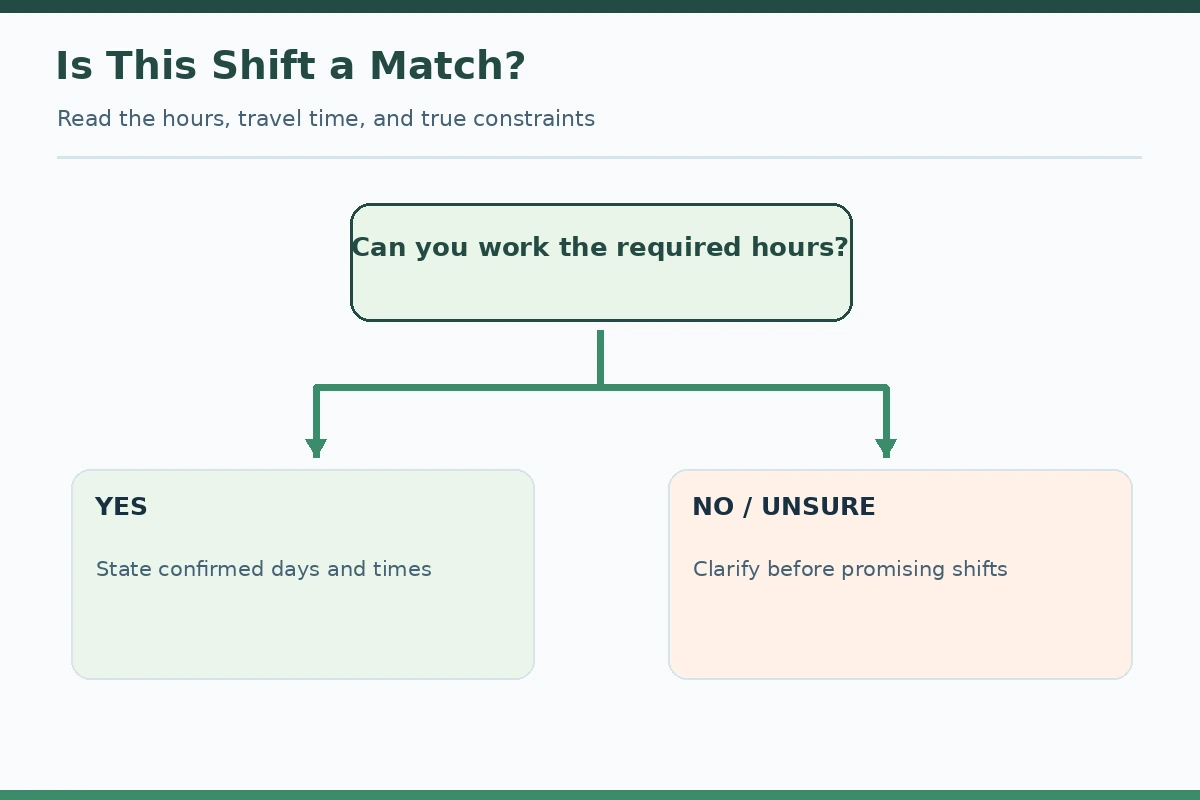
Identify what the employer actually asks: evening coverage, weekend hours, rotating shifts, fixed days, or seasonal peaks. Separate required hours from preferred hours and possible overtime. If the posting does not specify a timetable, do not invent one. You can ask about shifts later or mention only a clearly established availability pattern in your application.
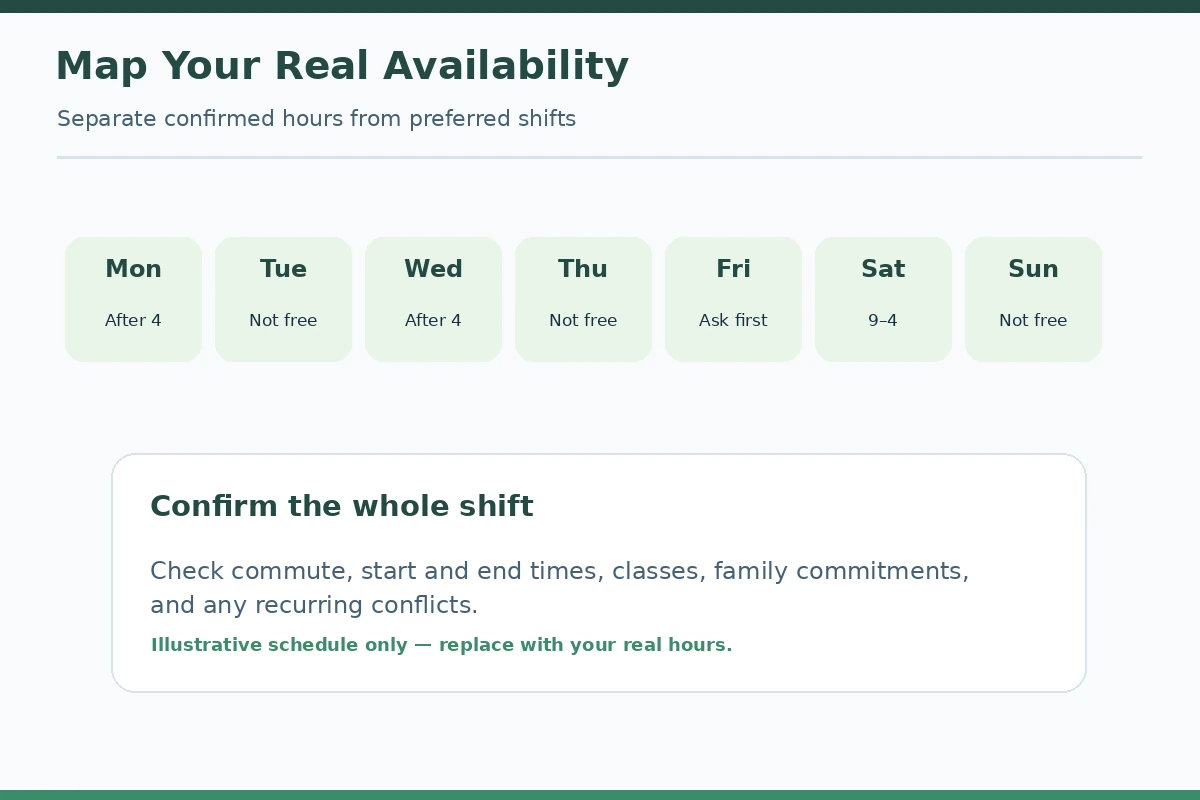
Make a simple weekly map of times you can reliably work after travel, classes, care commitments, or other jobs. Include the time a shift can realistically begin and end, not just the calendar day. “Available Tuesday and Thursday after 5 p.m.” is clearer than “flexible evenings” when the latter might imply all evenings.
Choose a Strong Example Even Without a Part-Time History
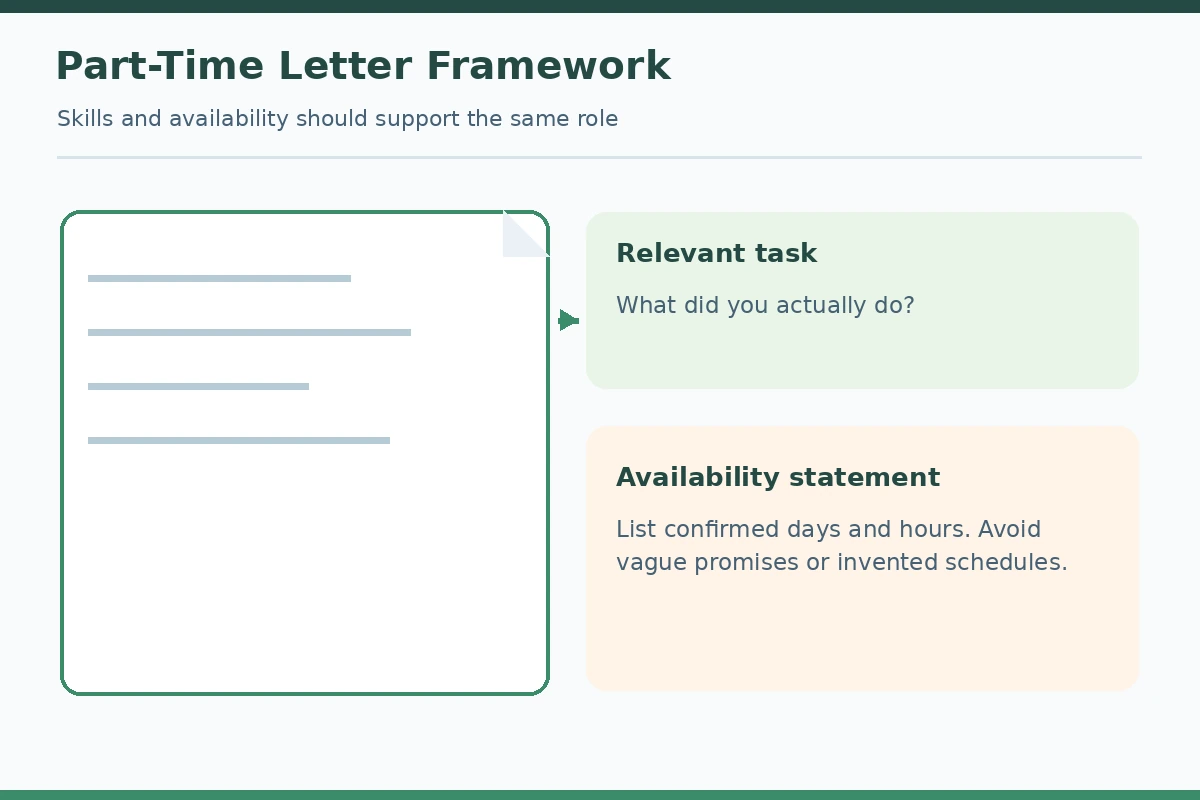
Look for responsibilities in the vacancy: greeting customers, accurate transactions, stocking, preparing records, answering calls, or working safely with a team. Select a real experience that shows one relevant behavior. It may come from volunteering, an academic project, household logistics, or a prior full-time job as long as the setting is described truthfully.
If you helped coordinate an event, explain the task you handled and the outcome you can verify. Do not invent a revenue increase or suggest that an unpaid activity was formal employment. An employer needs to understand what you can contribute during the shift, not a fictional job history.
Write an Opening Focused on Employer Requirements
State the position and one matching ability first. Availability can follow if it is a prominent requirement. Avoid leading with your need for extra income or the convenience of a nearby workplace; these details rarely establish the relevant skills. An employer-specific opening can be brief and practical.
Hypothetical opening: “I’m applying for the part-time Guest Services Associate role. In my campus volunteer work, I tracked attendee questions and helped direct visitors; I’m available for the advertised Saturday shifts.” Include the Saturday claim only if true, and do not copy the example into a different role without adapting the tasks.
Present Availability Without Overpromising
If you are available for a clearly defined set of hours, say so once. State any constraints the employer explicitly asks about, such as a reliable start date or a required weekend shift. Do not assume availability on public holidays, closing shifts, or short-notice call-ins unless you can actually accept them.
Hypothetical availability note: “I can work Mondays and Wednesdays after 4 p.m. and most Saturdays between 9 a.m. and 4 p.m.” The word “most” is ambiguous for a fixed weekly requirement, so clarify exceptions through the application if the employer expects an every-week commitment. Accuracy now reduces later confusion; it does not guarantee a matching schedule.
Demonstrate Reliability Through Actions, Not Adjectives
Instead of calling yourself highly reliable, show how you have met commitments: you prepared materials before a meeting, handed over accurate records, or gave timely notice when a conflict emerged. The letter can cite one verified example and explain why the same habit matters in a staffed shift. Avoid unverified attendance percentages or fabricated supervisor praise.
For jobs with customer contact, combine reliability with a role-specific skill. You might explain how you checked a registration list before admitting participants at an event, if you did that work. If the job is more physical, focus instead on applicable tasks, training, and any clearly listed workplace expectations.
Keep the Letter Short and Adjust It to Each Posting
A compact structure works well: first paragraph states the role and two relevant strengths; middle paragraph gives an example; closing paragraph confirms fit and thanks the employer. Refer to availability only when it helps answer an actual requirement. A letter that recites a school timetable in detail can distract from your ability to perform the job.
If the employer uses an online form without attachments, put the content in the correct field and respect word limits. If a separate availability form exists, complete it accurately rather than repeating every detail in the cover letter. Keep dates, names, and contact details consistent across application materials.
Check the Schedule and Application Before Submitting
Compare your letter’s stated availability against the form you are submitting. Watch for mistaken time zones, school term changes, or commitments that could make a promised shift impossible. Check that the letter identifies the correct employer and position, and that the example reflects the duties actually advertised. Our referral cover letter guide adds more detail on this.
Ask about travel distance and shift end times before you accept a later offer. At the application stage, the purpose is to give accurate relevant information and show readiness for the tasks. Do not suggest that the employer has guaranteed hours or specific schedules merely because an opening is described as part-time.
How We Research These Cover Letter Examples
We checked UC Berkeley’s cover letter guidance on connecting experience and qualifications to a specific employer, and the University of Washington’s recommendations on using concise stories, concrete contribution, and accurate formatting. These sources support a writing approach, not a guarantee that any letter leads to an interview. The example wording in this article is explicitly hypothetical and must be replaced with the reader’s real experience.
We also reviewed additional guidance relevant to this scenario. The examples do not represent real applicants, employers, internal company policies, hiring outcomes, or verified referrals. No affiliate partnership is claimed here; see our affiliate disclosure for site-wide information.
Related Guides
- Internship Cover Letter: Match Your Projects to the Role
- How to Resign From a Part-Time Job and Cover Your Remaining Shifts
- Part-Time Retail Jobs: Match Store Duties With Your Availability
- Weekend-Only Part-Time Jobs: Find Roles That Fit Your Actual Availability
- Short Cover Letter Examples: Keep the Job Match Without Empty Filler
Yes when it directly answers the posting’s requirements or the employer requests it. Use precise, truthful hours.
Yes. Identify it as volunteer work and connect the tasks honestly to the vacancy.
Usually focus on job fit and availability. Share personal scheduling details only when necessary and appropriate.
State the availability you can currently commit to and clarify future changes through the appropriate application or hiring conversation.
Only if you can actually work them. Inaccurate availability can create a mismatch after hiring.