
Hard skills describe tasks or tools you can demonstrate; soft skills describe how you work with people, information, and changing situations. A strong resume uses both, but each claim should connect to a real example relevant to the target job. You do not need to label every skill as hard or soft in the finished document. Instead, show where the skill appears in a task and what you personally did.
Tell Hard and Soft Skills Apart Before Listing Them
A hard skill is generally teachable and observable through a method, tool, procedure, or deliverable. Examples include spreadsheet formulas, cash reconciliation, conversational Spanish, inventory counting, and basic HTML. A soft skill is a way of working: active listening, collaboration, judgment under changing priorities, or explaining a decision. The boundary is not always sharp. Writing a clear service ticket uses a document system and communication judgment. Classify skills only to clarify your evidence, not to force a complicated split in your resume.
A useful test is to ask two different questions. For a hard skill, what could someone watch you do or inspect when you finish? For a soft skill, what situation required your behavior, and how did you respond? “Excel” without a task tells little; “team player” without a contribution tells even less. If you cannot answer either question yet, leave the claim out or identify a legitimate project, course, volunteer shift, or prior job that lets you demonstrate it.
Read the Job Posting for Tasks and Behaviors
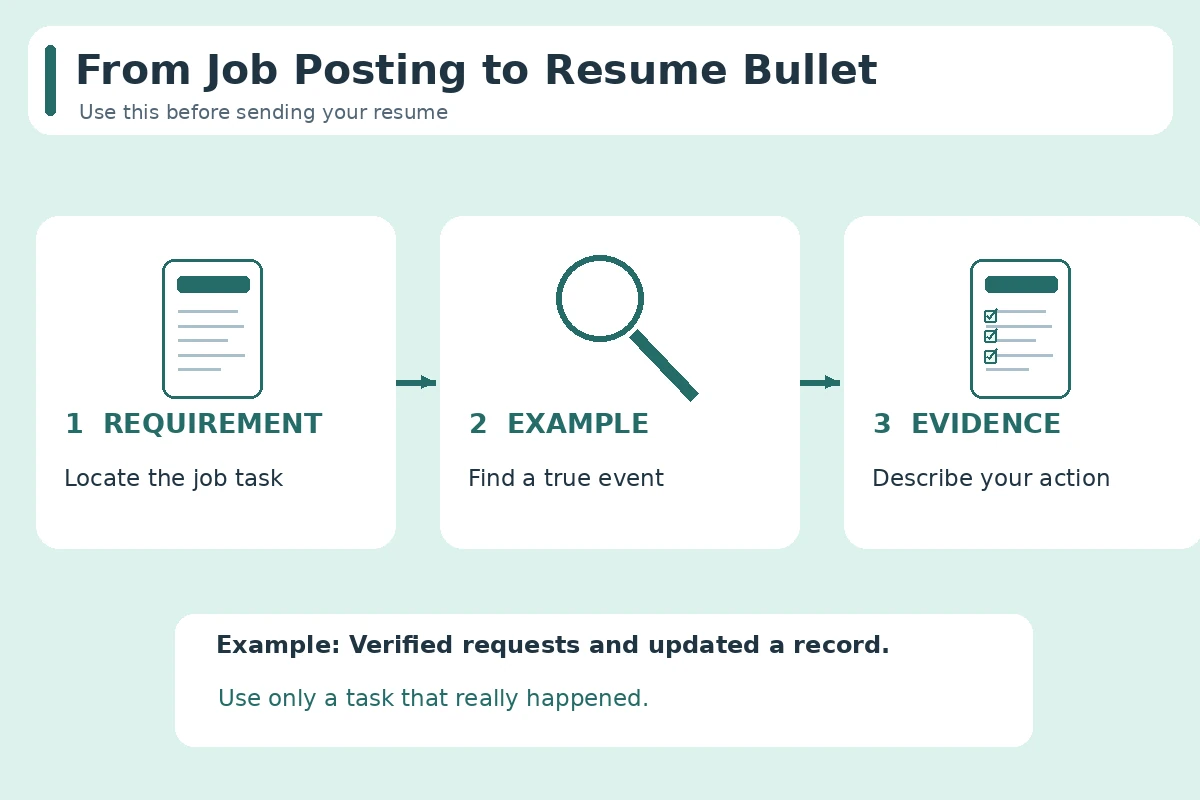
Start with the actual vacancy, not a popular list of impressive skills. Highlight concrete verbs such as schedule, resolve, verify, present, document, and coordinate. Separate requirements from preferences; a requested credential is not just another skill word. Then make a small three-column worksheet: employer need, your truthful example, and the evidence that supports it. “Tracks invoices” may match a class ledger project. “Handles confidential client records” requires experience with appropriate privacy practices; a class simulation is not professional authority.
The CareerOneStop resume resources encourage targeting your experience to the job you seek. Do not copy an employer phrase to create an ability you have not acquired. A posting may mention Salesforce, but knowing a different spreadsheet application is not the same thing. If you can learn quickly, demonstrate learning through a real example rather than pretending to have used an unfamiliar tool. This preparation also prevents the same generic list from appearing on five resumes for unrelated positions.

Select Hard Skills That Match Your Actual Work
Specific tools and processes are useful when they matter to the role. Write “Excel pivot tables” only if you can build or interpret them, and name the relevant method rather than claiming “advanced Excel” without context. A student applying for an office assistant position might name appointment scheduling and document formatting from a campus club project. An experienced warehouse worker might name order picking and cycle counts if those were assigned duties. Avoid piling up generic software names because they happen to appear in a keyword tool.
Use the skill section for compact labels, then demonstrate the stronger skills in experience or project bullets. For instance, a hypothetical student who actually reconciled a club event ledger could write: “Matched event receipts to the ledger and flagged missing documents for the treasurer.” The example illustrates a task without inventing a dollar amount or calling the student an accountant. In every case, the underlying record or a clear description should exist if a recruiter asks you to explain the claim.
Show Soft Skills as Decisions and Actions
Professionalism, communication, teamwork, and critical thinking are among the competencies described by NACE. That framework describes broad behaviors, not a certification of any one candidate. Translate a relevant behavior into an observable action: who needed information, what changed, which part you handled, and what happened next. “Communicated with the team” is less informative than “Updated the shift handoff checklist and notified the incoming coordinator of unresolved requests.” Do not give yourself credit for the whole team’s work.
Some soft skills belong in the interview more than in a long list of resume adjectives. To support adaptability, describe a genuine last-minute change, your decision, and how you kept the work organized. To support listening, explain how you clarified a request before acting. There is no need to invent a percentage improvement to make an account credible. Clear responsibility, real context, and a documented follow-up can be stronger than an unsupported metric.
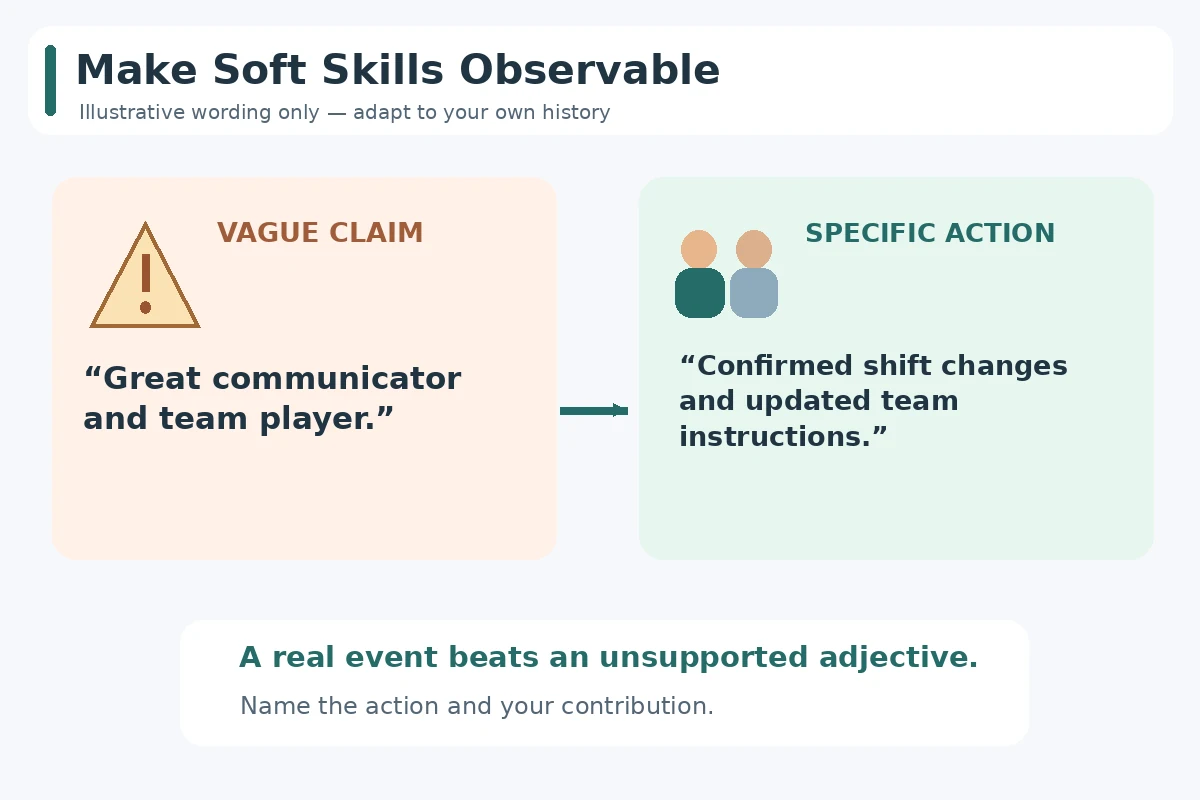
Compare Vague Claims With Evidence-Based Bullets
Here is a hypothetical weak line: “Excellent communication and organization skills.” A stronger version, if true for the candidate, is “Maintained the volunteer signup sheet, confirmed shift changes, and sent updated instructions to the event team.” This gives the reader tasks to discuss. A second weak line is “Proficient in data analysis.” A candidate with actual coursework could instead say “Used spreadsheet filters to review a course dataset and documented inconsistent records.” The honest wording specifies the setting and avoids claiming paid analyst experience.
The strength of a bullet depends on relevance, truth, and clarity, not on the length of the sentence. Identify a verb, a real object of work, and a visible decision or output. If the role is customer-facing, communication may be the priority. If it requires careful records, accuracy and documentation may matter more. A short skills label like “Spreadsheet data validation” can sit in the skills section, while the supporting bullet appears under the project or job where you used it.
Edit Skill Labels for Readability and Accuracy
Keep the Skills heading recognizable and separate from your experience section. Group a handful of related hard skills when grouping actually improves scanning; do not create twelve subcategories for a short resume. Soft skills usually need stronger support through experience bullets, so consider whether they earn space as standalone labels. CareerOneStop formatting guidance recommends standard section headings, including Skills, that readers can recognize. File readability matters more than decorative rating bars or unexplained five-star self-scores.
After drafting, read every claimed skill as if you were asked to perform it tomorrow. Would you recognize the tool, explain the procedure, or give a truthful example? If not, revise the label or remove it. Ask a second question: does the employer care about this task or behavior? A resume has limited space, and a short list of verified strengths is often clearer than a catalogue copied from the internet. Keep the detailed story available for the interview without turning the page into a full narrative.
How We Research Resume Skills and Examples
We use public U.S. occupational descriptions, career-service guidance and documented competency frameworks to distinguish typical duties from individual qualifications. Links were checked on October 27, 2026. All sample resume sentences here are hypothetical writing examples, not claims about real applicants or JobAsk clients. Our review of public search results and the supplied local topic index does not reveal private WordPress drafts or establish availability of a slug in the database.
Source: CareerOneStop. Resume guidance on selecting relevant skills and achievements for a target job.
Source: NACE. Descriptions of workplace competencies, including communication, teamwork and technology.
Source: CareerOneStop. Guidance on readable standard resume headings and formatting.
These editorial references are informational, not a claim of endorsement or a commercial partnership. See the JobAsk affiliate disclosure. Skill examples must be adapted only to work you actually performed; no particular resume layout guarantees hiring or automated screening results.
More Resume and Cover Letter Guides
- Teamwork Skills on a Resume: Prove Collaboration and Your Role
- Organizational Skills on a Resume: Prove Priorities and Handoffs
- Communication Skills on a Resume: Prove Writing, Listening, and Speaking
- Scheduling Skills on a Resume: Prove Calendar Accuracy and Conflict Resolution
- Technical Skills on a Resume: Match Each Tool to Real Work
It is commonly treated as a transferable or soft skill. Show the problem, action and reasoned decision; particular analytical methods may also be hard skills.
Not necessarily. A single readable Skills section plus supported experience bullets may communicate your abilities better.
Yes, when the coursework genuinely required you to use that tool or process. Label it as academic work rather than paid experience.
There is no universal number. Select only a manageable set of relevant, defensible skills that fit the available space.
Only if your actual breadth of work justifies the word and you can explain it. Specific tasks are usually clearer than unsupported proficiency labels.