
Before accepting an internal promotion, confirm the approved title, the limits of your new authority, who you will report to, and how current work will be transferred. A promotion is not complete merely because your supervisor congratulated you. Use the approved written terms and coordinate a handoff rather than announcing the change or promising authority you do not yet have.
All names, dates, roles, and messages used as examples in this guide are hypothetical. Replace them with the details in your authentic offer and use your employer’s stated process. No example implies a guarantee of hiring, a legal conclusion, or permission to act outside your assigned authority.
Verify That This Is an Approved Promotion, Not an Informal Promise
A manager may say a promotion is coming, yet the title, pay change, reporting line, or effective date may still need approval. Ask for the organization’s official notice, amended role description, or written confirmation from authorized HR staff. Distinguish a conversation about future possibilities from an approved offer you can actually accept. A promotion that is still awaiting budget or personnel approval should not be described in your email as finalized.
Write a simple four-column review: proposed title, new responsibilities, effective date, and approval source. If one field remains provisional, direct a question to the person managing the approval. This prevents accidentally announcing a position before your organization is prepared to implement the change. Your current manager and new manager may have separate responsibilities, so do not assume one has authorized every detail.
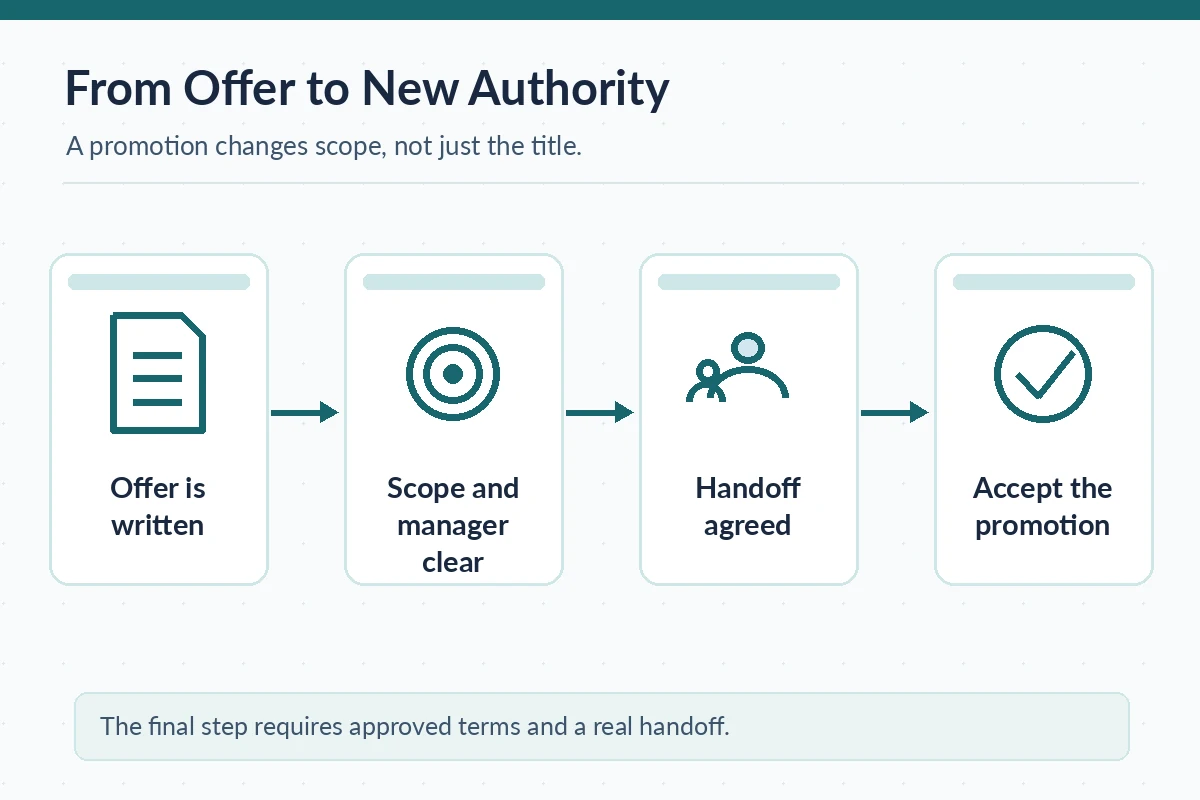
Check How Your Authority and Reporting Will Change
A new title does not automatically authorize approving spending, evaluating colleagues, accessing confidential files, or changing schedules. Ask which decisions belong to the promoted position, which require another approver, and whether any training or access permission is still outstanding. Describe the actual team or program you will support, not an inflated interpretation of the title. The written role description should identify at least the functional purpose and reporting relationship.
For example, a coordinator promoted to team lead might be asked to assign daily priorities while payroll approval remains with a manager. In your acceptance, acknowledge the team lead assignment without promising authority the organization has not formally granted. If the new job includes supervising former peers, agree on how leadership will explain the reporting change and handle confidential personnel matters.
Review the Offer Terms Before You Say Yes
Check whether the effective date, base pay, work location, schedule, exempt or nonexempt classification if stated, benefits changes, and any probationary or evaluation period are actually documented. The CareerOneStop offer review guidance recommends understanding duties, supervisors, schedule, and benefits rather than focusing solely on salary. Employment terms depend on policy and applicable law; this page does not determine legal classification or entitlement.
If compensation or scope differs between the promotion notice and the discussion, ask for a corrected version before you accept. For a compensation change, compare when the change takes effect with the transition date: the dates can differ, and the written record should be clear. Do not announce a new salary to colleagues or treat an estimated future bonus as guaranteed.
Arrange the Old-Role Handoff Without Promising an Impossible Date
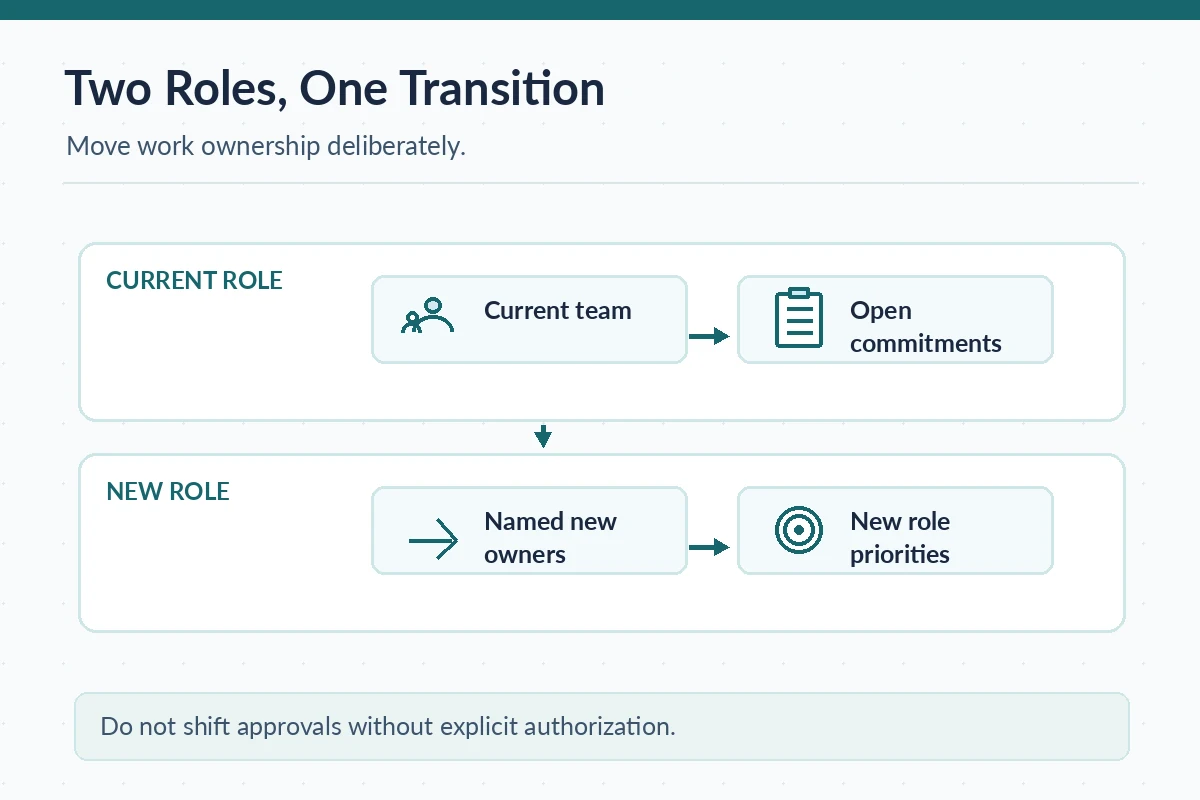
Internal moves can leave open customer requests, scheduled reports, vendor contacts, or team coverage. List the work that needs an owner, its next deadline, where approved documentation lives, and any access limitation. Ask current and receiving managers to agree on a transfer date; you should not unilaterally promise to work two full roles for an indefinite period. If there is an overlap, clarify its actual duration and which work takes priority.
A useful handoff note names a replacement owner for each critical item and records a status rather than quietly carrying unresolved tasks into the new position. Avoid transferring private records to personal accounts. The receiving team may request a quick start, but an informed acceptance recognizes the organization’s internal planning instead of sacrificing compliance or leaving the former team without coverage.
Write a Short Acceptance Email With a Transition Question
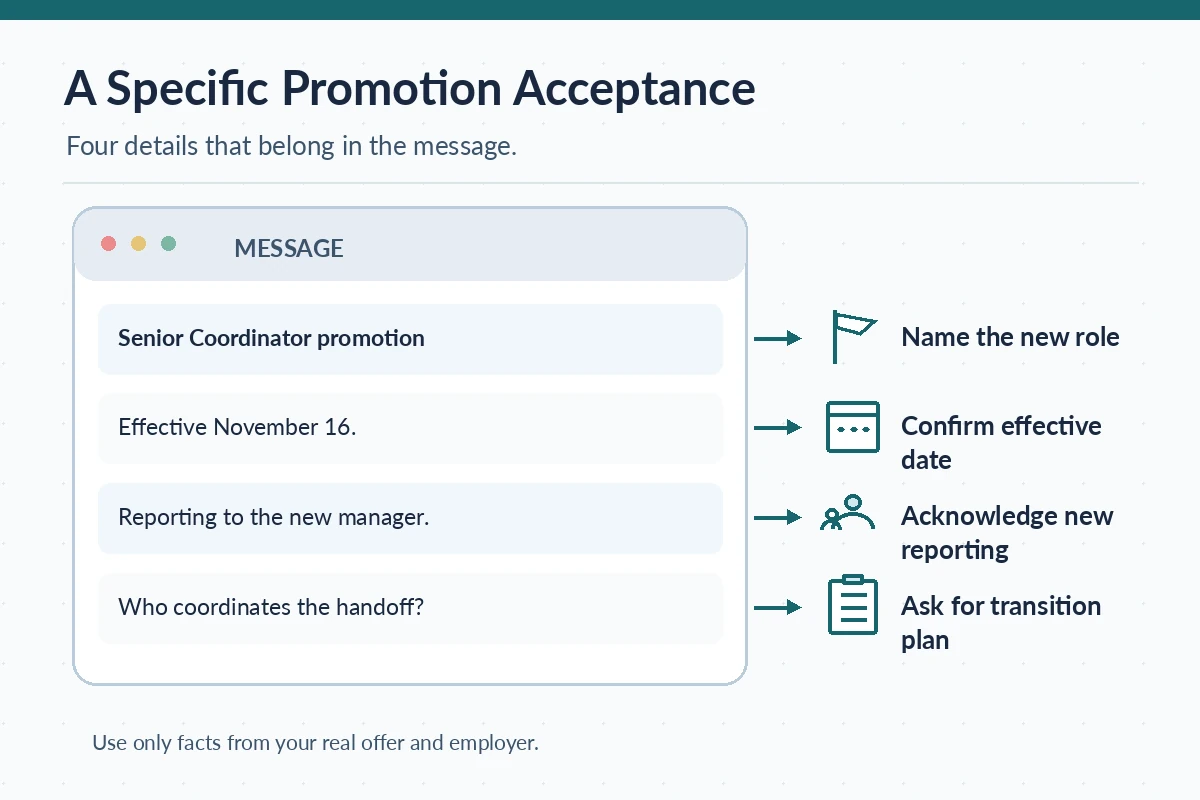
Once terms and authority are approved, accept explicitly: “I am pleased to accept the Senior Operations Coordinator role under the terms of the revised written offer.” Include the new title and effective date as written, then ask one actionable transition question. If there are multiple outstanding issues, resolve them first instead of burying reservations inside a sentence that otherwise sounds like unconditional acceptance.
Hypothetical example (adapt the dates and role to your real documents): “Thank you for the promotion offer. I accept the Senior Operations Coordinator role effective November 16 under the terms shared by HR. Could we confirm who will manage the handoff of my current scheduling assignments?” This stays friendly and practical. It does not imply that your acceptance alone can override required internal approvals.
Confirm the Announcement and Your First Priorities
Ask when the organization intends to tell your current team and new colleagues, who will send that communication, and when reporting access will change. Do not announce the promotion publicly before the authorized communication. The new supervisor can identify the first set of priorities, introductions, and required training. If you manage people, request a clear list of responsibilities and escalation routes rather than making personnel decisions on day one.
Save the final approved offer and acknowledgment in an appropriate private location. If later changes are proposed, obtain the revised details in writing before treating them as agreed. A good acceptance does three things: commits to an approved role, names the terms you actually reviewed, and creates a clean transition to the next team.
A Hypothetical Email You Can Adapt
Subject: Acceptance — Senior Operations Coordinator
Hello Morgan,
Thank you for offering me the Senior Operations Coordinator position. I am pleased to accept the role under the terms in the revised offer dated October 27, including the agreed effective date of November 16. Please confirm who will coordinate the handoff of my current scheduling assignments and the timing of my new-team orientation.
Thank you,
Jordan
This model uses invented people and dates solely to show structure. Change the subject line, title, dates, and decisions to match an authorized written record. If your real terms are still unresolved, do not copy unconditional acceptance language from another example.
How We Research Job Offer Decisions
We distinguish documented career-service advice about evaluating and responding to an offer from scenario-specific practical suggestions. For matters such as employee classifications, required notice, transfer approvals, or enforceability, the applicable contract, workplace policy, and qualified local advice control. These sources do not create employer-specific rules:
cloudfront.careeronestop.org — CareerOneStop explains reviewing roles, working conditions, compensation and benefits before deciding on an offer.
careerservices.fas.harvard.edu — Harvard career guidance covers acknowledging offers, obtaining written details, extension requests, and keeping commitments.
business.unl.edu — University of Nebraska career guidance advises resolving negotiations before accepting and confirming official terms in writing.
JobAsk provides editorial information, not legal representation or a verified recruiting service. We do not guarantee an offer, promotion, or acceptance. Review our affiliate disclosure; no affiliate partnership is claimed in this article.
Related Guides
- Decline an Internal Promotion Offer Without Misleading Your Manager
- Internal Promotion Interview Preparation: Prove Readiness for the Next Role
- Internal Transfer Acceptance Email: Confirm Team, Date, and Duties
- How to Accept an Internship Offer and Confirm Dates, Worksite, and Hours
- Ask for More Time to Accept a Job Offer: Deadline Extension Email
Follow your employer’s process. A discussion can express appreciation, but use a clear written acknowledgment once authorized terms and the effective date are confirmed.
Request the final compensation terms from the authorized contact before giving unconditional acceptance. Do not assume a pending adjustment has been approved.
Not necessarily. Coordinate the timing and owner of the announcement with the managers or HR staff who control the change.
Only within authority actually granted by your employer, and subject to required access, training, and policies. A new title does not grant every approval right.
List open items, due dates, and owners; agree on the handoff with your current and new managers before transferring responsibilities.