
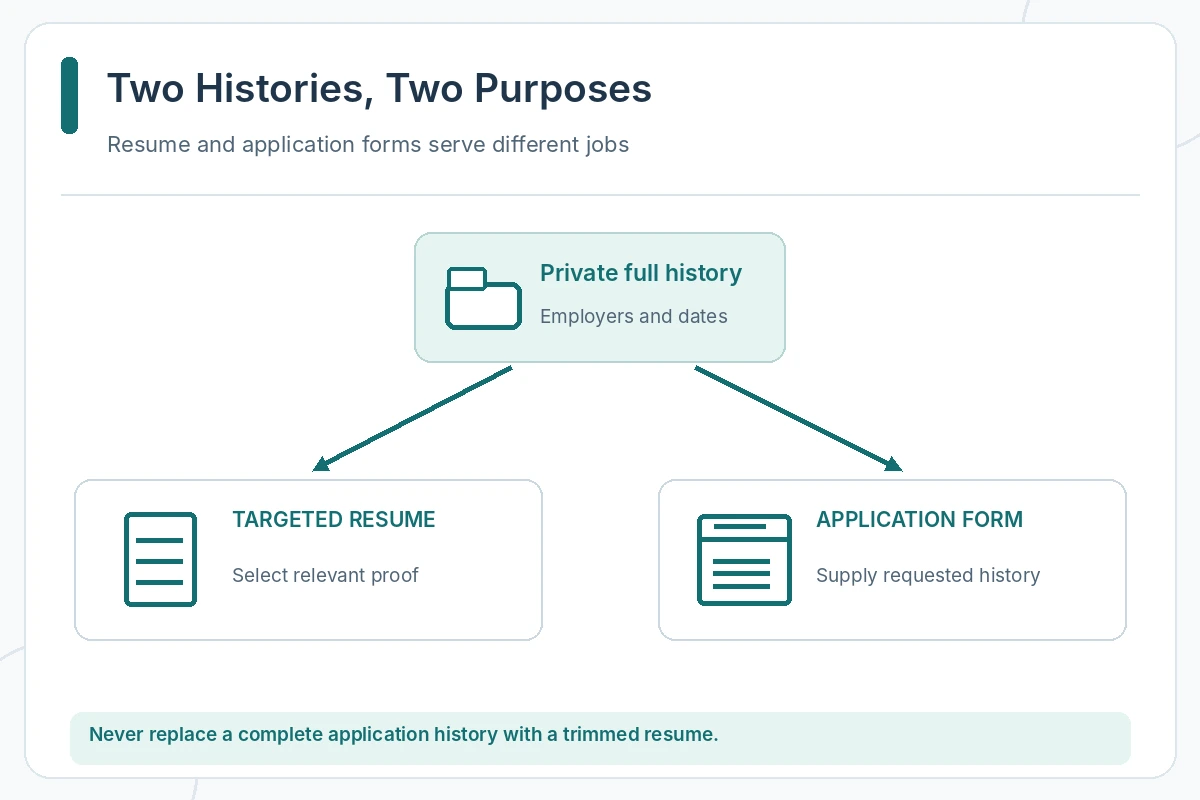
There is no fixed number of previous jobs that belongs on every resume. Include the positions that most clearly demonstrate qualifications for the specific opening, give more detail to relevant recent work, and shorten older or unrelated roles when space is tight. Keep a separate complete employment record so a short targeted resume does not become an inaccurate application form.
All names, organizations, dates, and personal examples identified as hypothetical in this guide are invented demonstrations, not real employment claims. Replace them only with your verifiable experience. A resume can be selectively relevant, but forms requiring a complete employment history must be answered according to their instructions.
Decide What the Reader Needs to Verify
Start with the employer’s job posting, not a target number such as three, five, or ten jobs. Highlight requested responsibilities, required tools, minimum experience, and people or processes the person will support. Under each requirement, identify where you actually performed comparable work. A relevant job may be older than an unrelated recent one; the purpose of the work-history section is to make the strongest qualification visible without falsifying your timeline.
The CareerOneStop work-experience guide recommends highlighting jobs and accomplishments tied to your goal. It notes that extensive careers often benefit from emphasis on more recent relevant experience, while applicants with little paid experience may show most of their jobs. Treat its broad time guidance as advice, not a legal limit, universal recruiter rule, or automatic applicant-tracking-system cutoff.
Rank Previous Roles by Proof and Relevance
Create a private inventory with job title, employer, exact dates, responsibilities, tools, who relied on your work, and verifiable outcomes. Add two ratings: how directly the role matches the posting and how specific your proof is. A clerical role involving scheduling and confidential records could matter more for an office coordinator application than an unrelated higher-paid role. Do not rate prestige or salary as proof of job fit.
Use three outcomes. Keep a full entry for high-value roles. Compress a less relevant position to one line or a short bullet if it explains your path. Omit an older unrelated role if the resume still tells a clear story and the employer has not requested a complete history. For a separate employment application, supply the requested complete history accurately. A curated resume and a formal work-history form serve different purposes.

Balance Recent Work With Distinctive Older Evidence
Recent work can show that skills are current, but recency is not the only test. If an older assignment demonstrates a required process you have not repeated since, you can retain it concisely and explain the historical timing. Conversely, a position in the same industry may not deserve much space if it proves none of the present role’s needs. This trade-off is especially important after career changes or long periods in one organization.
Imagine a hypothetical applicant seeking operations coordination: a present retail supervisor role documents shift handoffs, an earlier scheduling assistant role documents calendars, and an old unrelated summer position adds little. Keep the supervisor and assistant entries detailed; shorten or omit the summer role as appropriate. This is an invented illustration, not an actual applicant outcome or proof that one specific resume would receive an interview.

Keep Employment Dates and Job Titles Accurate
Every included role needs a title, employer or organization, and dates that correspond to reality. You can choose a consistent month-and-year format when appropriate, but do not alter dates to hide gaps, combine separate employers into one, or claim a promotion earlier than it occurred. The CareerOneStop formatting guidance discusses clear dates, ordinary typography, and readable sections. Consistency makes verification easier than creative spacing.
If several short jobs are genuinely separate, do not silently turn them into a single continuous position. You may give them shorter entries or group related freelance work with a truthful label, but employer identity and actual work periods should remain understandable. Keep a fuller private list with supervisor or HR contacts where appropriate, since a later application form may ask for more detail than the resume shows.
Make Space by Editing Bullets Before Deleting Useful Jobs
If your work-history section is crowded, first cut repeated claims and routine bullets that prove little. Two thoughtful bullets about decisions, software, and follow-through may say more than six interchangeable duties. University of Michigan’s resume resources suggest connecting an action to the work performed and its how, why, or impact. That principle helps you preserve meaningful experience while reducing volume.
Also look for stale technical terms that no longer match your actual proficiency, broad adjectives without evidence, and duplicated bullets across roles. Do not fabricate statistics just to shorten a point. A plain description such as “Verified inventory records against received orders and documented discrepancies for supervisor review” can be defensible without an invented percentage or savings claim.
Use a Final Keep–Compress–Omit Audit
Read the target posting once more and mark every required competence that your chosen entries support. Check whether the remaining timeline is clear, whether your oldest item adds specific value, and whether one irrelevant job crowds out a relevant project. Read the resume aloud as a first-time reviewer: could someone distinguish what you did, when you did it, and for whom?
The best number of jobs is whatever meets those tests on a readable document. If an employer or regulated application requests every employer for a defined period, that instruction is different and takes priority for that form. A resume is not permission to make inaccurate statements in a background questionnaire. Maintain truthful records for both documents.
A Practical Work-History Worksheet to Save
Before editing a real application, make a private worksheet with six fields: official employer or organization, actual role title, start and end dates, work arrangement, two or three tasks you can personally describe, and which target-job requirement each task proves. For temporary placements, record the staffing relationship and assignment dates separately. For an active role, distinguish completed work from ongoing work. If any item is uncertain, check records rather than filling the gap from memory alone.
Read the finished resume as a first-time reviewer. Is the role you want apparent? Can the reader find the most relevant proof quickly? Are the dates credible and consistent? Have you avoided copying sensitive records, claiming another person’s result, promising an ATS score, or turning example numbers into actual achievements? The worksheet helps you make decisions; it cannot certify an employer’s selection criteria or ensure an interview.
How We Research Resume Work Experience
We reviewed professional U.S. career resources for work-history selection, honest dates, and bullet construction. These explain useful writing conventions; they do not guarantee a particular employer outcome. Source pages below were checked on October 27, 2026:
cloudfront.careeronestop.org — Guidance on selecting relevant jobs and documenting accomplishments.
cloudfront.careeronestop.org — Practical advice on consistent work dates and readable formatting.
careercenter.umich.edu — Action-plus-context model for concise, meaningful experience bullets.
This is editorial career information, not a claim about specific employers or applicant-tracking systems. No affiliate agreement or paid partnership is represented here. Read the JobAsk affiliate disclosure and check individual employer instructions.
More Resume and Cover Letter Guides
- How Many Resume Bullet Points per Job? Prioritize Proof Over Count
- Relevant Coursework on a Resume: Select and Explain the Right Classes
- How to Write a Resume That Shows Relevant Work Clearly
- How to List Freelance Work on a Resume Without Inflating Your Role
- How to List a Promotion on Your Resume: Show Each Role and Its Dates
No. The number depends on relevant evidence, career length, and the role. Use a consistent, understandable history rather than aiming for a fixed count.
Include it if it materially proves a current requirement, perhaps in condensed form. Recency guidelines are editorial advice, not an absolute ban.
Often yes for a targeted resume, but never omit it from a separate form that explicitly asks for complete employment history.
No universal ATS rule supports that claim. Follow the employer’s stated requirements and keep dates and qualifications accurate.
Consider a brief factual line with employer, title, and dates. Avoid padding it with generic duties or inventing achievements.