
For “Tell me about yourself” in a medical assistant interview, lead with the relevant work or training you can verify, give one concrete example, and explain why this particular role is your next step. The strongest answer does not list every job you have ever held. It shows how your actual experience connects to patient intake and scheduling with defined clinical scope. You can use the format below whether you are applying for a first role or moving from another field, but never copy a hypothetical example as your personal history.
Yale career guidance recommends a short introduction rooted in your background and interest; Georgetown interview guidance similarly emphasizes a concise, role-specific answer. For this occupation, BLS occupational information identifies work activities worth discussing. These occupational descriptions are not proof that you personally performed a task. Select only examples you can describe accurately under follow-up questioning.
State Your Actual Training and Setting
Begin by describing your program, actual credential status, and the clinic or classroom setting you know. The wording should differentiate completing coursework, a supervised externship, and paid medical assistant work.
If a credential exam is scheduled but not passed, say that rather than calling yourself certified. Employers may have specialty-specific hiring requirements, and duties authorized in one state or clinic may not transfer unchanged to another.
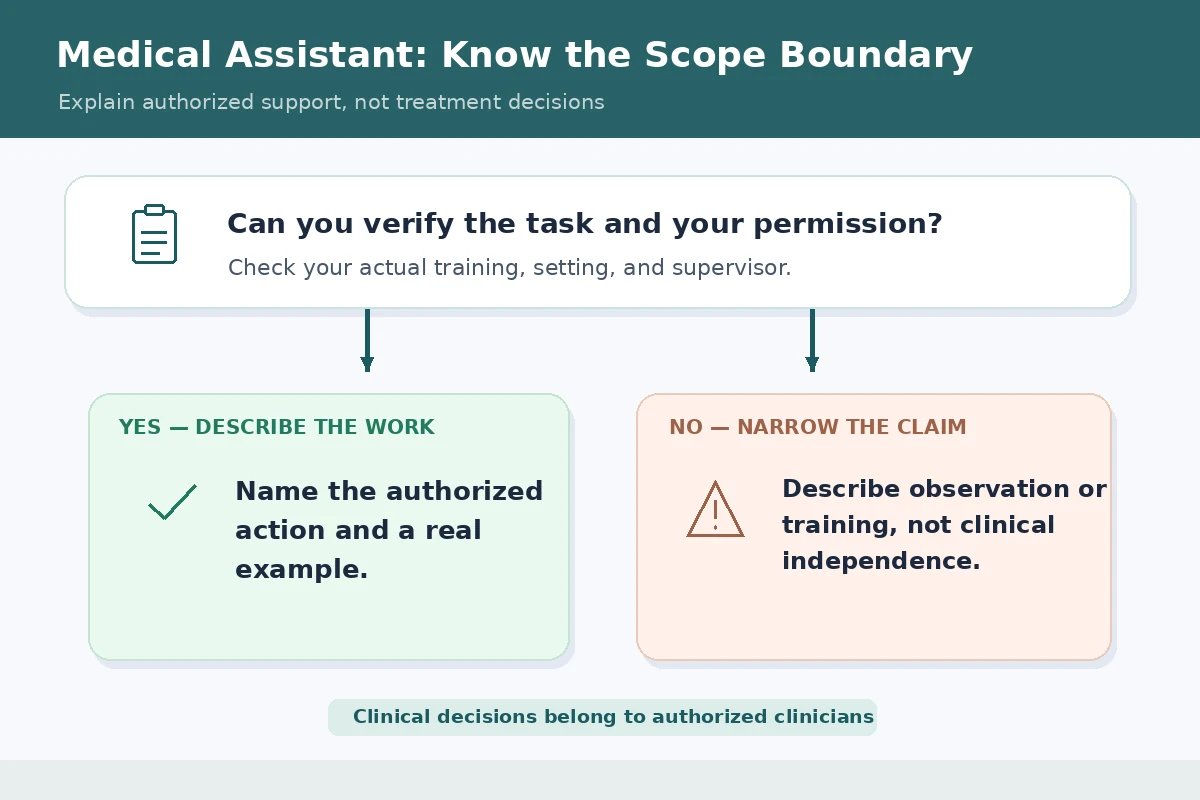
Separate Front-Desk Work From Clinical Tasks
Administrative experience can include appointment scheduling, intake forms, phone messages, supply requests, and entering information into a designated system. Clinical support may include permitted measurements or exam preparation under workplace rules.
Do not bundle all those tasks into one claim if you only did some of them. A person who scheduled appointments should not imply that they collected specimens or administered medication. The dual-lane approach in the image helps you select only work you can verify.

Use a Patient-Respect Example Without Details
Tell a brief story about communication: explaining the next check-in step, recognizing that a question needed a clinician, or confirming that a chart was routed properly. Focus on the process, not on private patient facts.
Never repeat a recognizable patient case from a past clinic. Your introduction can say “a patient asked about a treatment decision” without personal identifiers, and then explain that you referred the question to licensed staff rather than answering it independently.
Describe Accurate Record Handling
If you actually entered or checked information, specify which kind of non-sensitive workflow you performed and how discrepancies were resolved. For example, you might have confirmed a scheduling field with your supervisor before submitting it.
“Expert in all EMR systems” is not a useful substitute for a true tool and task. Mention software only when you used it and were authorized to do so. Avoid suggesting broad access to medical records or independent correction of clinical findings.

Explain Why Supervision Shows Good Judgment
A strong medical assistant introduction can demonstrate knowing when to ask for help. BLS notes that clinical responsibilities can vary by location, specialty, and employer, so do not describe one clinic’s permissions as a nationwide rule.
A safe sample is “I followed our training site’s process for referring clinical questions to the clinician.” That shows respect for the care team without implying a personal ability to make treatment decisions.
Build a First-Role Answer From Practicum Evidence
A supervised practicum, school simulation, or customer-service position can each provide useful evidence if properly labeled. Choose the most relevant example for the actual posting and name where it occurred.
A classroom blood-pressure practice station is not the same as independently performing patient care. If you are new to healthcare, an accurate example of scheduling, respectful listening, or carefully filing forms can still show readiness to learn.
Keep the Spoken Introduction Concise
A strong sequence is actual status, one relevant workflow, a short proof point, and the reason this job interests you. Rehearse a version that fits around 60–90 seconds, then let the interviewer guide the detail level.
Do not list every module of a training program or explain the full history of the clinic. A helpful answer sounds like a calm handoff, not a résumé read aloud. Leave clinical scenarios for structured questions with the appropriate context.
Finish With Questions About the Actual Role
The closing sentence should connect your evidence to the advertised mix of front-desk and patient-support work. Do not assume this employer’s duties are identical to another office’s or that all staff have the same permissions.
You can say you want to learn their intake flow, confidentiality procedures, and training expectations. This also gives you thoughtful follow-up questions about supervision, scheduling and certification requirements.
A Full Sample Answer You Can Adapt
Hypothetical example: “I completed medical assisting coursework and a supervised practicum focused on appointment preparation, respectful patient communication, and accurate record entry. During training I observed the team’s workflow and documented permitted tasks under the preceptor’s direction. I am applying because this role combines patient support and reliable front-desk coordination, and I want to learn your clinic’s specific procedures.” Every detail is illustrative, not a claim about any real candidate. Use the same structure with your own role, the specific work you did, and your genuine reason for applying. Do not adopt the exact training, responsibilities, or results if they are not yours. Replace broad claims with facts that an interviewer could reasonably verify.
Compare Weak and More Credible Wording
A weak opening sounds impressive but does not provide a reliable example: “I know how to treat patients and manage their conditions.” A more grounded version is: “I can explain documented administrative work and the clinical tasks I performed only when authorized and supervised.” This second wording makes the actual process visible. It also gives the interviewer a sensible next question about responsibilities, supervision, evidence, or the steps taken when something was unclear.
When you edit your own answer, underline every verb and check whether you actually performed that action. Then circle any claim about outcomes, permission, or expertise. Do not claim independent diagnosis, prescribing, injections, patient treatment, protected-record access, or certification unless each claim is accurate and authorized. If a statement cannot be defended, narrow it or remove it. There is no need to replace a missing fact with a louder adjective.
Use a Focused Practice and Review Routine
Write your answer in four beats: current professional focus, specific relevant example, the method you used, and the fit with the advertised role. Read it aloud without racing. Ask someone to listen for a clear link to medical assistant responsibilities, not just a likable personality. If the answer needs extra context, put that context in a follow-up story rather than overloading your introduction.
Practice a second, shorter version for an interviewer who immediately interrupts with a question. Also rehearse the three likely follow-ups: what exactly did you do, who authorized or reviewed the action, and what evidence supports the outcome? Being ready to answer plainly matters more than delivering a perfect memorized monologue. The goal is a credible first impression that invites a useful conversation.
How We Research This Interview Guidance
This guide compares Yale career guidance and Georgetown interview guidance with BLS occupational information. The career-center resources support the interview structure and concision advice; the occupational source supports the examples of role duties. The sample scripts are explicitly hypothetical. Requirements and permissions depend on the actual employer, job posting, training, and relevant rules. For site policies and commercial relationships, read the affiliate disclosure. No affiliate partnership is assumed here.
Related Guides
- Tell Me About Yourself for Security Guards: Access Checks and Clear Reports
- Tell Me About Yourself for HR Coordinators: Records and Hiring Support
- Tell Me About Yourself for UX Designers: Research, Prototypes, and Feedback
- Medical Assistant Interview Questions: Patient Care, Records, and Scope of Practice
- Medical Assistant Resume Summary: Clinical and Office Skills You Can Prove
Start with your actual professional or training status, then name one role-relevant task. For this type of role, appointment schedule can be useful evidence only if it reflects work you genuinely performed.
No. Clearly labeled coursework, supervised placements, volunteer assignments, and relevant projects may provide evidence. Do not rename classroom practice as licensed or paid professional work.
As a practice target, many career centers suggest a brief answer around one to two minutes. Prepare a shorter version too, and follow the interviewer’s cues rather than forcing a set length.
Mention a credential early when the posting requires it and your status can be verified. If it is in progress, pending, expired, or restricted, state that status accurately instead of implying full qualification.
Do not claim independent diagnosis, prescribing, injections, patient treatment, protected-record access, or certification unless each claim is accurate and authorized. Also avoid invented figures, private details about other people, and a memorized resume recitation unrelated to the job.