
Quick answer: A railroad can hire applicants who have never worked in rail, but “no prior rail experience” does not mean “no training.” Begin with roles explicitly labeled trainee, apprentice, or entry-level. Compare conductor or yard operations with track-maintenance support, and identify the training or qualification required before the employer assigns safety-critical duties.
Rail operations have strict procedures, demanding schedules, and specialized equipment. A candidate may apply without experience while still needing to meet the actual employer’s education, screening, safety, and physical requirements. Never represent a job search guide as permission to enter a track area or operate railroad equipment.
Identify Which Railroad Job Is Actually Entry-Level
“Railroad worker” can mean conductor trainee, yard worker, track laborer, signal trainee, or an administrative role. The BLS railroad occupations guide says rail workers typically receive company training, while conductors and locomotive engineers have formal certification requirements. Separate an advertisement that accepts newcomers from one demanding current conductor certification or prior train-handling experience.
Make a two-column comparison before applying: operational duties and qualifications. A yard job may emphasize switching operations and communication; track work may be outdoors and require a different on-track safety program; a rail office job may involve schedules and records without entering the track. Do not infer eligibility from the employer’s name. Read the exact position title, assigned duties, location, and qualifications.

Check Training Before Any Safety-Critical Assignment
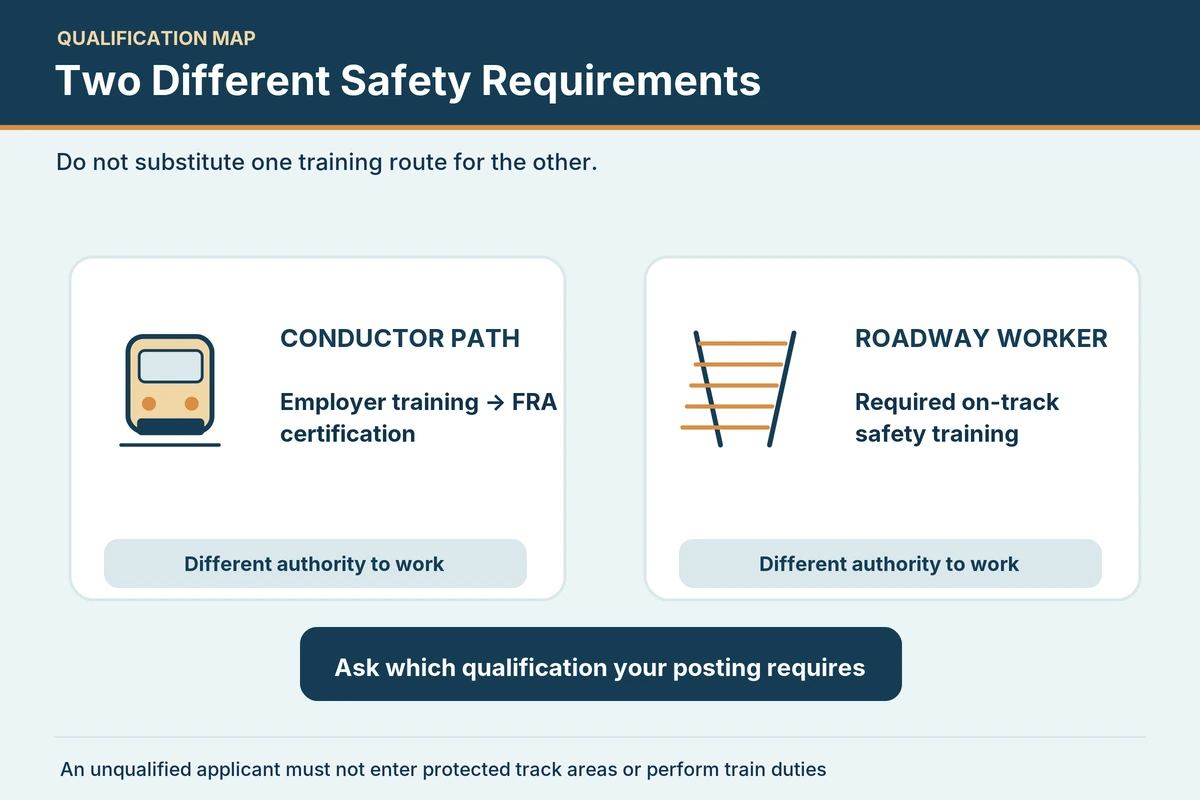
The Federal Railroad Administration explains that roadway worker protection governs work on or around track; training and qualification requirements are not optional just because someone is new. A trainee should expect supervised instruction before performing applicable work. Candidates should ask when initial training begins, which duties require qualification, and who verifies that the trainee may participate.
Certification for train crew positions is a separate matter from roadway worker protection. A conductor trainee is not an independently qualified conductor on the first day, and an untrained applicant should never act on railway signals, handle switches, or enter active track to demonstrate enthusiasm. If an employer cannot describe how safety procedures and supervision work, treat that as a reason to seek clarification.
Understand Shifts, Travel, and Physical Demands
Rail service may run continuously, so some positions involve nights, weekends, irregular assignments, outdoor exposure, or time away from home. Ask about the actual reporting location, whether a trainee is assigned to a fixed schedule or on-call list, and how far the worksite is from home. Do not assume every yard or track role has the same shift arrangement.
The practical comparison is not “highest advertised wage” but training period, guaranteed versus variable hours, paid travel rules if applicable, work location, and reporting expectations. Keep costs and your available hours on the same page. If you cannot meet an on-call response window, say so before applying; a mismatch can cause problems even when your other qualifications are strong.
Translate Non-Rail Experience Into Relevant Evidence
A school shop project, supervised equipment work, warehouse inventory, utility field work, or a role with checklists can provide truthful evidence of following procedures. Example: “Used a documented receiving checklist and reported damaged items to the supervisor.” That is stronger than “I know railroad safety” when you have never completed rail training.
For a track-support application, describe genuine experience with outdoor work, physical activity, weather preparation, and teamwork. For conductor trainee roles, emphasize listening, accurate communication, following instructions, and managing changing priorities. State any certifications exactly as issued; do not convert a general workplace safety course into an FRA qualification or imply you are already certified.
Build a Role-Specific Search and Application Record
Search the careers pages of actual passenger and freight rail operators, transit agencies, and railway contractors using terms such as “conductor trainee,” “track laborer trainee,” and “rail operations apprentice.” Some contractors employ roadway workers under the applicable rail safety rules. Save the original job number, location, deadline, qualification list, and official application URL in a simple tracker.
Compare postings on the same day rather than relying on a social-media screenshot that may be old. When an application asks about physical abilities, driving, availability, or background-screening requirements, respond accurately. Supporting records should match the claim in your resume. If no appropriate trainee role exists, consider a different but related job rather than reshaping your history to fit an experienced opening.
Practice Questions That Reveal the Training Route
Ask: “Which duties can a new hire perform during supervised training?” “How is qualification documented?” “What is the schedule during and after training?” and “Who decides whether the employee is ready for the next responsibility?” The FRA source is a safety framework, not evidence of what a particular railroad does. Your interviewer should explain that company’s actual process.
Prepare one real example of stopping to verify an instruction, recording an error correctly, or asking for help rather than taking an unsafe shortcut. The best answer names your action and the limits of your role. Avoid rehearsing pretend emergency railway commands: this interview is not a setting to demonstrate unauthorised technical procedure.

Verify Recruiter Identity and Written Terms
Use the employer’s independently found careers page to verify the opening, especially when someone offers you a train-crew job through a chat app without an interview. The FTC job-scam advice warns that scammers may impersonate recruiters and seek financial details early. A rail company logo attached to an email is not enough proof that the sender works there.
When an offer appears, check the job title, home terminal, training location, pay basis, shift expectations, and any required clearances. Do not send money to a personal account for “training access.” If a condition is unclear, request confirmation through an official company contact. Keep correspondence separate from speculative claims about future certification or advancement.
How We Research Entry-Level Opportunities
This guide draws on published occupational descriptions, government guidance, and task-specific safety resources: bls.gov; railroads.dot.gov; consumer.ftc.gov. Those sources describe typical work or regulations; they do not verify any particular job posting, wages, employer policies, or a job offer. All suggested application messages and scenarios are hypothetical and must be rewritten using your actual experience. Review JobAsk’s affiliate disclosure; this guide makes no affiliate recommendation.
Related Job Search Guides
- CNC Jobs With No Experience: Operator Trainee Skills and Machine Safety
- Gardening Jobs With No Experience: Plant Care, Grounds Tasks, and Safety
- Kitchen Jobs With No Experience: Compare Prep, Dishroom, and Trainee Roles
- Cleaning Jobs With No Experience: Compare Sites, Shifts, and Safety
- Bank Jobs With No Experience: Compare Teller and Branch Support Duties
Some railroads advertise conductor-trainee roles. You still must complete the employer’s training and required certification before independently performing certified duties.
No. Track maintenance and train operations have different tasks, risks, training, and qualification requirements. Read the exact posting.
No. Some require variable shifts, weekends, on-call availability, or travel. Confirm the schedule for the specific job.
Requirements depend on the role. Ask the railroad whether training and certification occur after hiring and what prerequisites apply.
Use the actual rail operator or contractor careers page and contact the organization through independently sourced details.