
Quick answer: A laboratory assistant cover letter without professional lab work can lead with coursework, supervised demonstrations, sample labeling, clean records, and readiness for facility-specific safety instruction. It must also clarify what kind of lab the position serves: teaching, industrial, research, or clinical. A classroom technique is not proof of independent testing authorization or medical credentials. Use one real, checkable project step and explicitly separate skills you have practiced from duties requiring employer training.
Identify the Kind of Laboratory Before Writing
A school teaching lab may need stockroom organization and equipment setup. A research group may need sample records, and a clinical lab may require regulated credentials for specific activities. Do not treat the title “laboratory assistant” as one national job with identical tasks. Read the real posting for specimens, inventory, glassware, documentation, protective equipment, supervision, and any required education. The O*NET biological technician profile is occupational context for some of these activities, not a statement that every assistant can conduct clinical testing.
Turn Coursework Into Verifiable Evidence
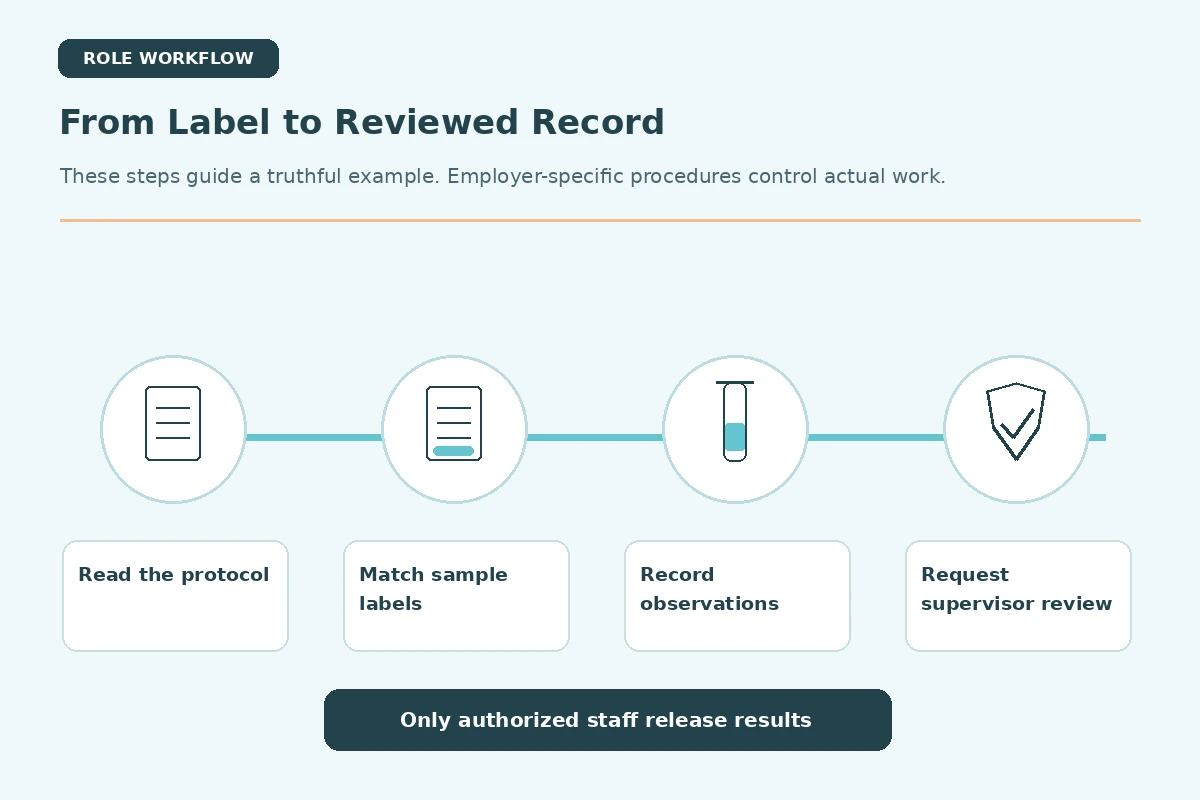
If you completed a science lab assignment, name the actual procedures you practiced under instruction. Perhaps you labeled tubes, recorded observations in a notebook, checked a spreadsheet for transcription mistakes, or returned approved supplies to their storage locations. Do not describe a demonstration as a professional research project. If your school prohibited independent sample handling, note that the exercise was supervised. A specific statement such as “I matched each classroom sample label with the observation sheet before submission” makes a stronger case than “I have extensive laboratory expertise.”
Adapt a Short Sample Letter Without Inflating Your Role
Hypothetical cover letter: “Dear Laboratory Hiring Team, I am applying for the Laboratory Assistant opening advertised by your organization. In an introductory biology course, I used the assigned specimen labels, recorded observations in a class notebook, and cross-checked entries before submitting them to the instructor. I have not worked in a professional laboratory, and I would follow your documented training, protective-equipment rules, and supervised assignment limits. I am especially interested in the role’s focus on organized records and careful preparation. Thank you for considering my application. Sincerely, Applicant.” This is a fictional example, not evidence of actual qualifications.
Keep Sample Labels and Records Traceable
Labels matter because a correct observation attached to a wrong sample may still be unusable. In your letter, emphasize a genuine experience checking identifiers, dates, assigned containers, or the source record. Never share private patient details, actual specimen identifiers, or unpublished results. If you learned spreadsheet functions for a class, describe the functions you used, not unfamiliar laboratory information systems. The employer’s procedures determine chain of custody and any controlled documentation. Your ability to follow instructions is relevant; authority to release results is not implied.

Treat PPE and Chemicals as Training Requirements
Do not write that you can mix reagents, operate centrifuges, handle infectious specimens, or dispose of hazardous waste independently unless your evidence and the role support it. State that you will use the laboratory’s training, protective-equipment instructions, and escalation route. The OSHA laboratory chemical exposure standard is relevant to covered uses of hazardous chemicals, but a cover letter must not substitute for employer-provided procedures. Ask what tasks are performed under supervision and which require separate credentials.
Show Careful Communication With a Real Handoff
Useful lab work often depends on one person handing an accurate record to another. A school group project may offer an example if you honestly say who checked the sheet and what you handed off. Explain what you did when a reading was unclear: rechecked the source, asked the instructor, or flagged a discrepancy. Avoid claiming that you validated scientific findings if you simply copied measurements. A credible sentence might say, “I marked an incomplete observation for instructor review instead of filling in a result from memory.” Use it only if true.
Mention the Required Qualifications Without Guessing
Some postings require a degree, certificate, prior laboratory experience, or role-specific approval. Others explicitly hire trainees for stockroom or support duties. List only real coursework, certificates, or assessments and give their precise status. “Biology coursework completed” differs from “certified medical laboratory technician.” Do not suggest that enthusiasm or a persuasive letter replaces a required professional credential. If you are missing an essential condition, review whether the advertised position is appropriate before investing in an application.

Inspect the Final Document Like a Sample Record
Check the exact lab role, organization, relevant project, supervised actions, safety boundary, and requested application format. Remove unsupported research results or imagined publications. If you have a portfolio with a permitted school report, share only content that may be disclosed and label it as coursework. Read the letter for accidental contradictions: did you say “no lab experience” and then “ran diagnostic tests independently”? Explain the distinction between classroom exposure and professional employment. A concise, accurate account of your readiness can stand on its own.
Build a Small Evidence Table From Real Course Notes
Before sending, list the laboratory skill, the assignment, your exact action, and the supervisor or instructor. For example, a real biology worksheet might document checking tube labels against a printed protocol and recording a measurement for instructor review. If you worked only with digital exercises, say they were digital; do not imply handling biological samples. This table helps you avoid vague claims such as “expert in laboratory testing.” If the vacancy requires specific medical credentials or safety qualifications you lack, a polished letter will not replace them. Check those requirements before describing yourself as eligible.
How We Research These Cover Letter Examples
This guide uses the U.S. Department of Labor-sponsored CareerOneStop advice on writing cover letters to check when a letter is useful and why it should connect real skills to the advertised job. It also compares the role with official occupational descriptions and the relevant professional task or safety guidance. Those sources provide context, not an assurance that a specific employer offers training or waives credentials. Confirm the actual job posting before applying.
All sample letters and scenarios in this article are explicitly hypothetical. They must be rewritten from the reader’s own education, volunteer activities, employment and permissions; never copy invented results or confidential records. We have no verified hiring outcome or automated screening guarantee to report. For information about site relationships and recommendations, read our affiliate disclosure. This guide contains no affiliate product recommendation.
Related Guides
- Animal Care Assistant Cover Letter With No Experience: Show Routine and Care
- Library Assistant Cover Letter With No Experience: Show Service and Accuracy
- Entry-Level Laboratory Assistant Jobs: Match Samples to Training Limits
- Cover Letter With No Experience: Honest Examples That Show Potential
- Medical Assistant Cover Letter: Present Training and Patient Support
Yes, as classroom or supervised project work. Name the setting and exact techniques rather than claiming employment.
Only if the specific duties, required credentials, supervision and actual training support it; do not imply unrestricted clinical authority.
Yes, when you actually completed it; follow the employer’s required instructions for the specific hazards.
Not necessarily for every assistant opening. List only software you used and check the posting’s essential requirements.
State your own contribution, who verified the work, and which observations were actually recorded.