
Quick answer: A convincing “why this company” paragraph makes three links: a specific, publicly verifiable fact about the employer or role; a genuine reason that work matters to you; and relevant experience you actually have. Avoid generic compliments, invented inside knowledge, and copied mission statements. Your goal is to show informed fit, not to prove you know the employer’s marketing language.
Research the Employer Before Writing About It
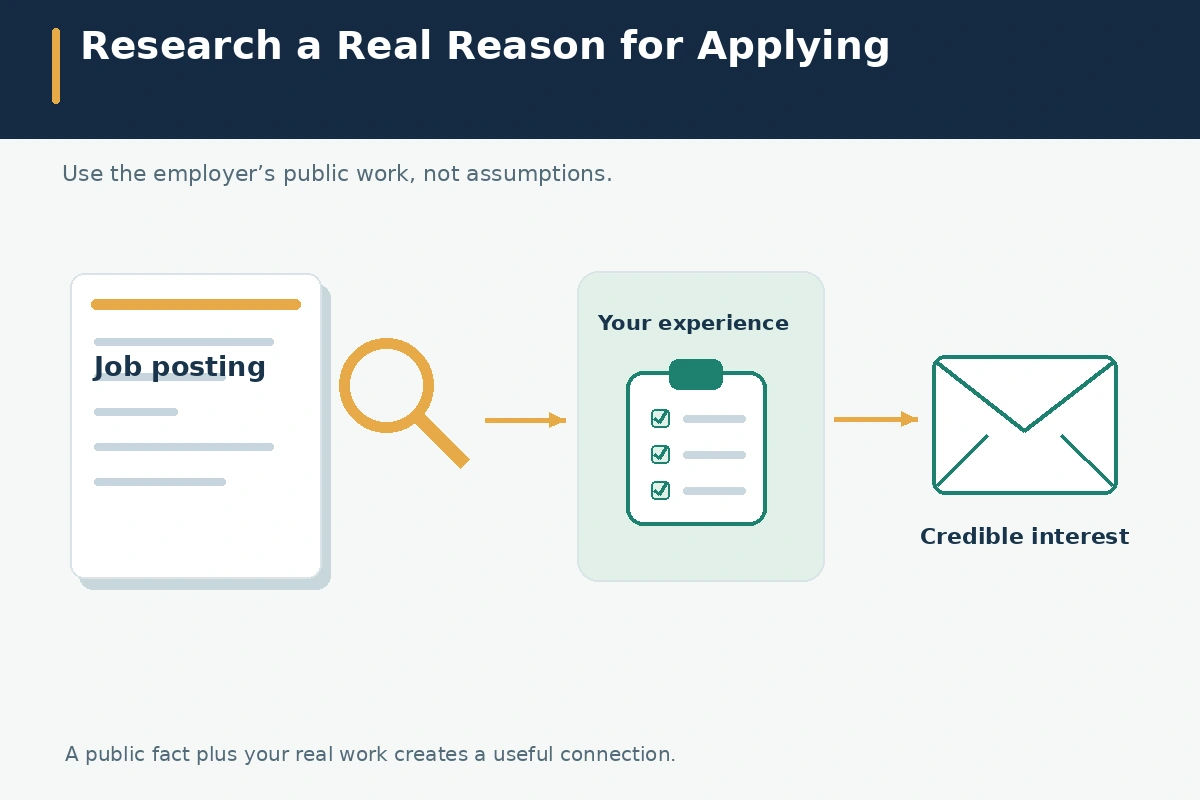
Start with the official careers page and the specific job description. Look for actual responsibilities, who the team serves, tools or processes mentioned, and the service or product being delivered. Then check one official employer page describing the organization’s work. Keep a note of the source URL and the date you viewed it. Avoid depending on a vague social post, an unverifiable rumor, or a company fact taken from an unrelated organization with a similar name.
University of Michigan recommends researching an organization to explain both what attracts you and what you offer. UC Berkeley similarly advises demonstrating knowledge of the position and company. That does not require knowing confidential plans. A factual statement like “The posting emphasizes coordination across several locations” is useful only when that wording really appears in the posting. If you cannot verify a claim, leave it out rather than adding an impressive-sounding guess.
Distinguish a Verifiable Fact From a Personal Opinion
Split your notes into “employer says” and “I can show.” The first column contains source-backed information, such as a public description of service hours, program goals or team functions. The second holds your own completed tasks, education, volunteer contributions and genuine preferences. A third column can connect them: why the listed work fits your experience. This separation stops a cover letter from presenting personal assumptions as corporate facts.
For example, a wholly invented sample role in visitor services might emphasize accurate arrival records in its posting. If you actually maintained sign-in lists for an event, you could explain why that operational focus appeals to you. But do not write that the company is “the industry leader,” “growing rapidly,” or “committed to diversity” without an appropriate source and genuine relevance. Copying an organization’s values page verbatim is not evidence that you understand the job.
Build a Fact, Connection, and Contribution Paragraph
A reliable paragraph structure is: “Your [verified team task or public priority] appeals to me because [genuine connection]. In [actual setting], I [specific related action]. I would welcome the opportunity to contribute those habits to [advertised task].” Every bracketed element should be replaced by something true. Keep the employer fact modest and avoid promising a result you cannot control. The paragraph should sound like an applicant, not a brochure.
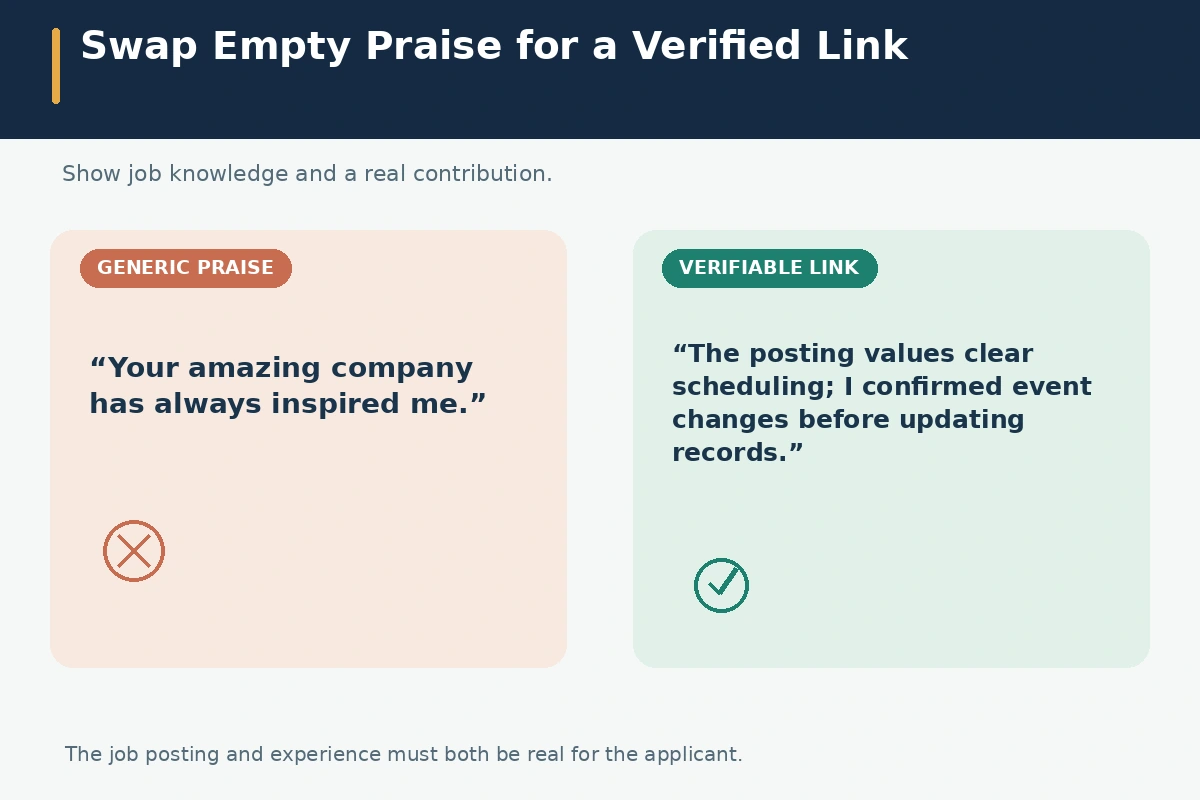
Hypothetical wording: “The program assistant posting emphasizes clear schedule changes and consistent visitor information. I enjoy coordinating details that other people rely on; in a volunteer event, I confirmed room changes with the organizer before updating a shared calendar. I would be interested in bringing that careful communication to the role.” The employer and activity are illustrative, not a report of an existing job or real achievement. Use only your actual circumstances.
Avoid Generic Praise and Excessive Enthusiasm
“I have always dreamed of joining your world-class organization” could describe almost any employer. It offers no information about the job or your ability to do the work. Replace broad admiration with one source-backed detail and one relevant example. If the company has an official public program that genuinely interests you, explain its connection to work you have done or hope to do, without suggesting that you have worked with the program already.
The word “passion” is not banned, but unsupported emotional language often occupies space that could carry evidence. A direct “I am interested in your records coordinator role because it prioritizes accurate handoffs” is easier to support than a grand claim about lifelong devotion. Be careful with values and social-impact claims; neither a website slogan nor an applicant’s admiration proves actual practices or outcomes. You are showing thoughtful interest, not performing an external audit of the employer.
Link Company Interest to the Particular Position
If the role involves customer records, discuss why you value accurate service information. If it involves training, focus on genuine coaching or instructional tasks you have performed. Do not replace a role-specific connection with a paragraph about the company’s building, size, awards, or general reputation. A company fact becomes useful when it helps explain this exact position. Relevant experience makes the connection credible and gives the interviewer something concrete to ask about.
Penn Career Services describes the cover letter as a narrative that connects your background with the organization and job. Your narrative should remain consistent with the resume: dates, tools, settings, level of responsibility and any approvals. If you only observed a process, do not write that you managed it. If a school project simulated a business workflow, identify it as a class project. Specific honest limits do not weaken the writing; they tell the reader exactly what you can substantiate.
Check Whether Public Facts Are Current
A page about a program from several years ago may no longer represent what an employer is hiring for today. Prefer the current official job posting, current careers page, and recent organization information when a claim depends on change. If you cannot verify a project is active, use the enduring duties in the listing instead. Avoid citing future company plans you heard secondhand. Do not fabricate a personal referral or claim a recruiter recommended that you apply.
When an employer describes a priority vaguely, phrase your interest cautiously. You can say, “The listed role focuses on accurate customer records,” if the listing supports it. Do not convert that into “Your company has the best data accuracy in the industry.” Remember that official employer marketing can express aspirations rather than independent proof. For a cover letter, you need a genuine fit reason, not an exaggerated factual assessment. Keep your citation notes private, but make the letter itself natural.

Run a Three-Question Authenticity Review
Before sending, underline the employer fact, your own contribution, and the connection between them. If any is missing, revise. Ask whether the fact is publicly verifiable, whether you can explain your experience with concrete details, and whether the paragraph belongs to this specific job rather than every employer in the industry. Read it aloud to catch copied phrases that sound unlike you. The Harvard career center emphasizes authentic and accurate applicant writing.
Finally, check that the letter is concise and free of invented statistics, confidential details and absolute promises. A thoughtful reason for applying can strengthen the narrative, but it cannot guarantee that a reviewer will read the letter or make an offer. Preserve the role’s exact name, verify organization spelling, and submit in the required format. Good employer research is the beginning of a credible application, not proof of a hiring outcome.
How We Research and Check Cover Letter Advice
How We Research: We reviewed the following original U.S. employment and university career resources on October 28, 2026: University of Michigan Career Center; UC Berkeley Career Engagement; University of Pennsylvania Career Services; Harvard Mignone Center for Career Success. The sources support general advice on applications, evidence and formatting, not claims about any employer’s current hiring decisions. We compared this specific intent with the historical JobAsk slug index and publicly searchable pages; that does not prove unpublished WordPress slugs are free. All sample people, positions, employers and outcomes in this guide are hypothetical. Employer instructions have priority. These editorial references are not presented as paid endorsements. Read our affiliate disclosure.
More Resume and Cover Letter Guides
- Cover Letters for Multiple Jobs at One Company: Make Each Version Specific
- Cover Letter With No Work Experience: Use Coursework and Volunteer Proof
- How to Write a Cover Letter That Connects Your Experience to the Role
- How to Start a Cover Letter with a Specific, Credible Opening
- Cover Letter When You Do Not Meet Every Requirement: Explain the Fit Honestly
A genuine interest linked to a verified employer task, service or program and your relevant experience.
You can refer accurately to a relevant priority, but copying a slogan alone does not explain your fit.
Use verifiable duties in the official job posting and avoid inventing organizational details.
Only if accurately sourced, current, relevant to your reason for applying, and not the entire argument.
Revisit the facts and job connection; the core experience may remain, but unsupported or mismatched company claims must change.