
Quick answer: To prepare for admin assistant interview questions, practice how you would handle calendars, records, and priority changes. Answer with the real situation, your specific action, who had authority to decide, and how you checked the outcome. These are illustrative questions, not a claim to know any employer’s actual interview script.
Why a Calendar Conflict Tests Administrative Judgment
A hiring manager may ask about your experience, or offer a hypothetical task and ask what you would do. Those are different formats. An experience-based answer should describe something you genuinely did; a scenario answer should describe steps you would propose under the new employer’s policy. The U.S. Office of Personnel Management recommends questions based on job-related competencies and a clear account of situation, action, and result. It does not supply a magic script that guarantees a favorable interview.
For this role, the interview should reveal practical judgment about calendars, records, and priority changes. O*NET’s occupational description is a starting point for relevant tasks, not a list of universal responsibilities or proof that one applicant performed them. Read the job advertisement and match its actual duties to a small number of true examples; leave out any work you have not done.
Five Questions About Calendars and Confidential Records
1. How would you handle two urgent meetings booked for the same time? Explain how you confirm who requested each appointment, assess the stated constraints, offer feasible options, and ask the correct decision maker before moving anyone. A calendar invitation is not authority to cancel a leader’s commitment.
2. What would you do if a caller requested a confidential document? Check the caller’s identity and the organization’s sharing rules; do not read or forward protected material on the strength of a verbal request. Refer access decisions to an authorized colleague.
3. How do you prevent errors when entering information? Describe your comparison of source documents, field checks, second review for sensitive entries, and a correction trail. Choose one step you actually used rather than claiming a nonexistent zero-error record.
4. What happens when several people say their task is highest priority? Identify true deadlines, dependencies, and who owns priority decisions. Communicate trade-offs early; record the revised order so others do not rely on outdated expectations.
5. Tell me about a routine you improved without changing policy. Use a real example of a checklist, folder naming rule, or reminder system. Distinguish suggesting a change from approving the organization’s official procedure.
A calendar change has more than one audience. A manager may own the decision, but a visitor may need directions, a colleague may have arranged a room, and a client may depend on a video link. In your practice answer, identify those dependencies before describing how you send a correction. An administrator can be highly effective without suggesting that they can move someone else’s private appointment on their own authority.

Move From a Request to a Confirmed Calendar Change
Use a practical four-step answer: Check the request; then compare calendars; next ask the owner; finally send an update. The order matters because a polished answer that skips confirmation or goes beyond your authority may sound confident while describing a bad work decision. Explain which information is missing, whose permission is required, and how you would let affected people know the result.
For example, the question “A client arrives early while the manager is in a private meeting” is an invitation to show your reasoning rather than promise a perfect result. Acknowledge arrival, verify whether the appointment is confirmed, send a discreet message, and avoid disclosing meeting details. In your answer, explain how you would know that the next action is appropriate. If the new employer uses a different procedure, say that you would learn and follow it.

What a Responsible Scheduling Answer Sounds Like
Weak answer: “I just move the less important meeting.” This answer omits the necessary checks, the decision maker, or evidence of follow-through. Stronger answer: “I check constraints, confirm the owner’s decision, and notify everyone affected.” It shows a sequence that another person could verify. Treat these as writing models, not as a personal history you can repeat word for word.
Illustrative interview response: “I would first check whether either meeting has a fixed external participant or deadline. I would contact the owners with two viable options, ask the calendar owner to confirm the change, update the invitations, and notify affected attendees.” Notice that the speaker describes a specific choice and the boundaries around it. If you have never held a admin assistant position, adapt the structure to genuine coursework, volunteer responsibility, an internship, or a different job; label that context accurately rather than inventing professional experience.
Practice the Office Situations Interviewers May Raise
Scenario: A client arrives early while the manager is in a private meeting. Acknowledge arrival, verify whether the appointment is confirmed, send a discreet message, and avoid disclosing meeting details. An interviewer may ask what you would do if the first plan failed. Prepare one reasonable alternative and an escalation point, but avoid presenting your preferred plan as a universal policy.
Scenario: An expense form has an unclear total. Recheck the original, flag the mismatch, and return it to the person responsible for approval; do not invent a corrected amount. An interviewer may ask what you would do if the first plan failed. Prepare one reasonable alternative and an escalation point, but avoid presenting your preferred plan as a universal policy.
Scenario: A recurring appointment needs a last-minute change. Check conflicts and traveler constraints, seek calendar-owner approval, then document the agreed time and send corrected invitations. An interviewer may ask what you would do if the first plan failed. Prepare one reasonable alternative and an escalation point, but avoid presenting your preferred plan as a universal policy.
Name the Calendar Owner and Record Access Rules
A useful response distinguishes three roles: Calendar ownership, Change authority, and Document access. They may be assigned differently at different organizations. Describe which duties you personally completed, which you coordinated, and which somebody else authorized. This is especially important where information access, safety, personnel decisions, or external claims could affect other people.
Practice two follow-up questions for your own examples: “What information did you verify before acting?” and “Who could reverse or approve that action?” If you do not know a policy, do not guess. A credible candidate can say, “I would check the written procedure and ask the responsible person before proceeding.” That is more useful than inventing confidence about an unfamiliar workplace.
Prepare one example that starts with a written request and ends with a confirmed update. State where the original instruction came from, what you checked, what you escalated, and how you made sure a stale invitation was not left in circulation. For records, explain how you check the recipient and permitted channel before sending; accuracy and privacy are separate parts of a complete answer.
Prepare a Short Evidence Bank Before the Interview
Create three small notes from real events: one routine task performed accurately, one unexpected problem handled with a clear handoff, and one instance of feedback that led to an improvement. For each note, record the context, your individual part, what changed, and what evidence you could lawfully discuss. Do not take confidential records, names, credentials, screenshots, or proprietary documents into your interview.
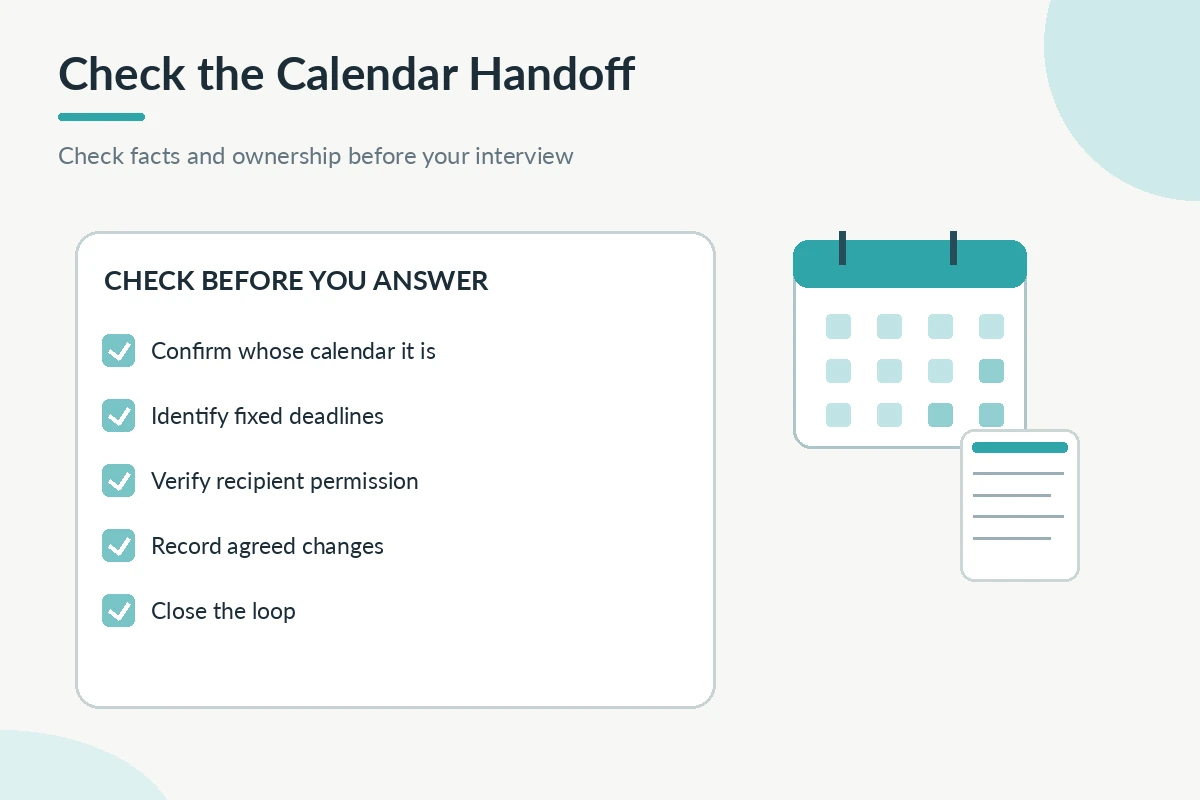
The quick check for this role is: Confirm whose calendar it is; Identify fixed deadlines; Verify recipient permission; Record agreed changes; Close the loop. Keep your examples consistent with the dates and responsibilities on your resume. If your outcome is difficult to quantify, an accurate qualitative description of what you verified or communicated is preferable to fabricated percentages, revenue, customer counts, or guaranteed results.
Finish With Questions That Reveal the Real Role
Ask who owns change authority, what written procedures cover document access, how new staff are trained, and what a satisfactory first month actually looks like. These questions help you assess the role without implying that every workplace works alike. If the interviewer mentions a tool or certification you do not have, say what you know, identify the gap, and ask what training the employer expects.
Another hypothetical answer pattern: “In a prior office role, I compared incoming requests with the scheduling calendar, recorded missing details before routing them, and followed up on unresolved items. I did not make decisions reserved for the supervisor.” Use it as a structure for reporting what you did, not as a ready-made story to memorize. After a practice session, listen for unsupported “always,” “never,” or “I guaranteed” statements. Replace them with the precise procedure and outcome that your evidence supports.
How We Research These Interview Scenarios
The questions are editorial illustrations built from O*NET occupational descriptions, OPM interview design guidance, and additional official role-specific guidance. The sources help define task scope, response structure, and constraints; they do not verify any individual’s résumé or predict a particular employer’s questions. Examples contain no real employer, student, customer, incident, or numerical achievement. Review your own experience and the job posting before use.
JobAsk does not claim an endorsement or paid relationship with the referenced agencies. For information about any commercial relationships, read the affiliate disclosure before following any external recommendations.
Related Guides
- Team Lead Interview Questions: Coaching, Coverage, and Escalation
- IT Manager Interview Questions: Incidents, Priorities, and Decision Rights
- Administrative Assistant Resume Summary: Show Scheduling and Records
- Administrative Assistant Cover Letter: Scheduling and Accuracy Examples
- Administrative Assistant Resume Skills: Calendars, Records, and Scope
Mention the calendar, spreadsheet, or filing tool you actually used and pair it with the task. A generic product name alone does not demonstrate accuracy.
Use a real event roster, club calendar, or sign-up process. State the context accurately and do not present it as paid office employment.
Distinguish entering approved hours or records from authorizing payroll. State what you have been trained to do and what would require instruction.
Usually a compact explanation of the conflict, verification, decision owner, communication, and check-back is more useful than reciting every click.
No. Use anonymized examples and describe the process without sharing protected schedules, contact details, or records.