
Quick answer: A strong flight attendant resume puts safety awareness and communication ahead of decorative design. If you are already a flight attendant, show the cabin duties, training and credentials you actually hold. If you are applying from hospitality, retail or another service job, lead with relevant passenger-facing behaviors—clear instructions, calm complaint handling and teamwork—without pretending you have performed airline cabin safety duties.
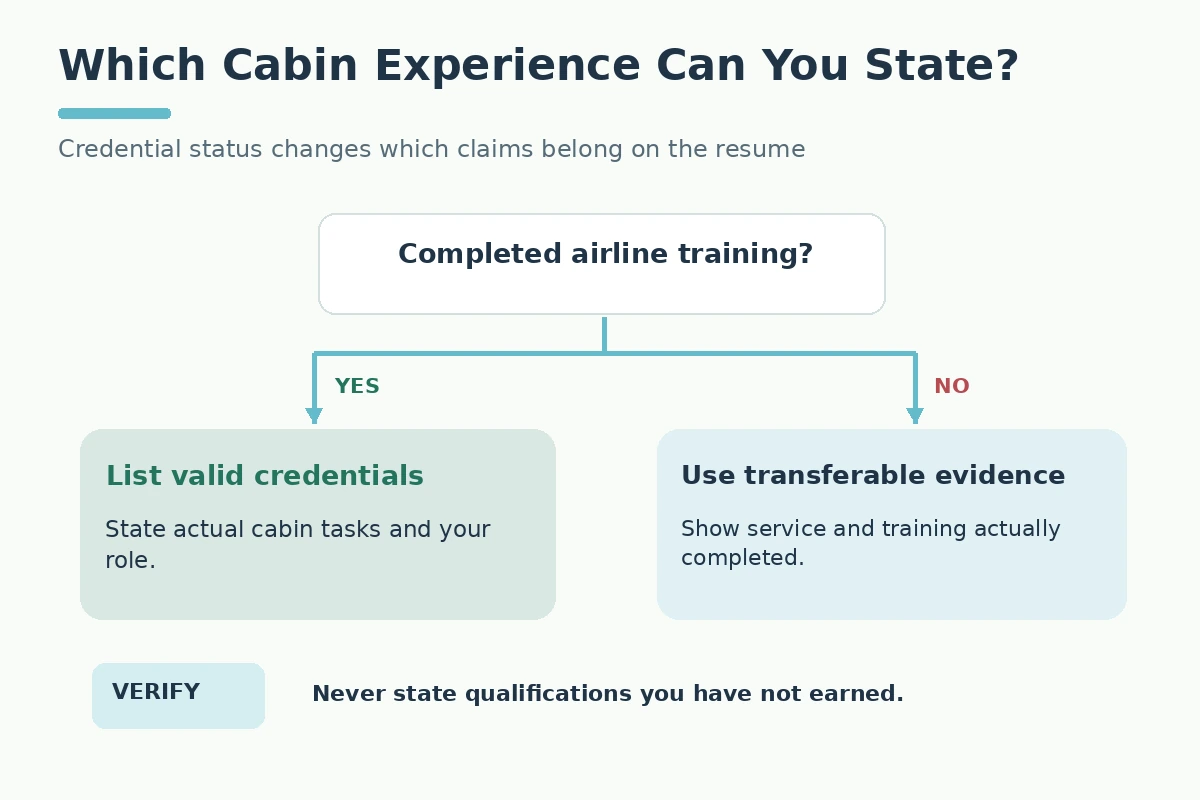
The US Bureau of Labor Statistics describes flight attendants as safety-focused crew members who also provide passenger service. It also explains that FAA certification follows an airline’s required initial training and examination. Do not list a Certificate of Demonstrated Proficiency as if you earned it before completing the necessary airline process.
Put Verified Credentials in the Right Place
A currently employed, qualified flight attendant may place airline-specific training and valid certifications in a compact credential section near the top. Use exact names and current status. Someone applying for their first cabin role should instead describe transferable training, such as a legitimately completed first-aid course, only if relevant to the posting. Do not turn a general customer-service certificate into airline regulatory qualification.
The header should contain ordinary contact details, followed by a focused summary, relevant experience, credentials and education or training as appropriate. Leave out height, photographs and other personal information unless the employer’s lawful application process requests particular details. Do not invent any airline’s recruiting standard or imply every carrier uses the same requirements.
Separate Safety Evidence From Service Evidence
Safety duties are not interchangeable with customer satisfaction. For experienced cabin crew, describe checks and briefings they actually completed under airline procedures. For a hotel receptionist, safety-related transferable experience might mean reporting an observed hazard according to workplace instructions—not conducting aircraft evacuation demonstrations or emergency medical care. Explicitly distinguish those contexts.
Service evidence can include multilingual guest communication, de-escalation, handling schedule disruptions or coordinating a queue. Describe observable actions rather than claiming a percentage increase in passenger satisfaction you never measured. An honest example may say how you explained delays, documented a problem and handed it to the responsible team.
| Applicant background | Lead with | Do not imply |
|---|---|---|
| Current cabin crew | Actual cabin work and valid credentials | Unheld aircraft-specific qualifications |
| Hotel or guest services | Service recovery and clear instructions | Certified aircraft safety duties |
| Retail or restaurant | Queue management and teamwork | Flight crew supervision |
| New graduate | Relevant training and real projects | FAA certification not yet completed |

Build Clear Experience Entries
For each job, state employer, title, actual dates and two to four relevant bullets. Start with what you did, then name the context and any verifiable result. A retail associate may have coordinated customer flow and escalated safety concerns, but should not rebrand that experience as cabin management. A current flight attendant should be specific about the aircraft or route only when it is accurate and useful to the target role.
Consider a hypothetical candidate coming from hospitality: “Explained service changes to guests, recorded requests and coordinated with the front desk for follow-up.” That line may be defensible if it describes real work. “Led in-flight emergency responses” would be misleading for the same person. Accuracy matters more than impressive wording.

Before (not reliable): “FAA-certified cabin safety expert with global airline experience (without airline training).” After (hypothetical, use only if accurate): “Coordinated guest requests, explained delays clearly and referred safety concerns to authorized staff.” Do not copy either line into an actual resume without checking your own facts, roles, dates and permissions.
Use a Reader-Friendly Order for Different Career Stages
Experienced cabin crew can lead with cabin qualifications and relevant airline roles. New applicants may put a transferable summary and customer-facing experience first, then education and completed training. If the posting requests particular documentation, follow that instruction exactly. Keep jobs in a consistent sequence and explain any career transition by the facts of your experience rather than inventing work with an airline.
A single-column layout and ordinary headings make dates and credentials easier to locate. Keep language skills honest: a class taken years ago does not automatically establish current professional fluency. If you use a language level descriptor, choose one you can demonstrate in a work conversation.
Check for Cabin-Specific Misstatements
Read your resume as an interviewer would. Could you explain the safety procedure you named, and did you perform it in an authorized role? Does an abbreviation identify a real completed qualification? If you claim to have supervised crew members, were you actually assigned that responsibility? Remove details that imply authority you did not have.
Open the exported file and confirm that every credential is readable, role dates are aligned and bullets do not spill into unrelated entries. Keep private passenger incidents or records out of resume examples. Use generalized descriptions that respect confidentiality. The resume should explain your preparation; it is not a substitute for required airline training.
A Final Accuracy and Readability Checklist
Before sending the document, verify the exact target job, relevant evidence, accurate employer and training dates, and each credential or authority claim. Keep your contact details as selectable text. Use a file type the employer accepts, reopen the exported copy and confirm that important headings and dates remain next to their entries. A simple copy-and-paste text check can reveal obvious extraction problems, but it cannot certify the behavior of every applicant tracking system.
Avoid posting confidential customer, employee, passenger, vendor or employer records as resume evidence. All examples here are hypothetical editorial teaching examples. No template, font, column count or phrasing guarantees that a resume will be parsed correctly or that an employer will interview or hire you. A helpful resume is a truthful, easy-to-find record of relevant work—not a way to manufacture a better history.
How We Research Resume Layout Advice
Our approach compares the primary guidance in Source 1, Source 2 and Source 3, distinguishing general layout recommendations from occupation-specific responsibilities. The source guidance explains typical practices and tasks rather than guaranteeing an outcome for an individual application. Dates, achievements, roles and credentials in examples are not representations of a real applicant or employer.
Sources were checked on October 29, 2026. We did not run a live employer-specific ATS test, and readers should follow the instructions of the actual posting. JobAsk maintains a separate affiliate disclosure; no paid partnership, employer endorsement or placement guarantee is claimed for this article.
Related Guides
- Flight Attendant Cover Letter: Put Safety and Passenger Care First
- Restaurant Manager Resume Format: Show Staffing and Service Scope
- Tell Me About Yourself for a Flight Attendant Interview: Safety First
- Caregiver Resume Format: Show Daily Support, Care Scope, and Training
- Bartender Resume Format: Highlight Service, Inventory, and Safe Practices
Yes, some airlines hire people with relevant service backgrounds and provide required training after selection. Follow each employer’s qualifications.
No. BLS describes airline initial training and examination as steps before flight attendant certification. State only credentials you genuinely hold.
Both matter, but do not bury safety duties when you have relevant airline experience. Keep safety and service evidence distinct.
Yes, if genuinely completed, current where relevant and accurately named. Do not equate it with aircraft-specific certification.
Normally avoid an unsolicited photo for standard US job applications unless a legitimate employer process explicitly requests one.