
Quick answer: A restaurant manager resume should show the operations you actually owned, not just the fact that you worked in a busy dining room. Organize the page around staffing, shift execution, guest concerns, inventory and food-safety processes. An assistant manager, shift lead and general manager may all help run service, but their approvals, hiring decisions and financial responsibility can differ. The resume needs to preserve those distinctions.
The Bureau of Labor Statistics and O*NET describe food service management as a mix of people, inventory, safety and customer operations. Those occupation descriptions are reference points, not proof that you held every duty. Use the exact authority granted by your employer and avoid invented sales totals, cost reductions or compliance claims.
Start With Role Scope, Not a Generic Leadership Label
Write the actual job title and the type of operation if it is useful: full-service restaurant, quick-service location, hotel outlet or catering. State the shifts, functions or team activities you were responsible for without asserting ownership of the entire business. A shift lead who assigned tasks during evening service should not claim to have managed hiring, payroll and the annual budget unless those duties were genuinely delegated.
A short summary may name the most relevant operational strengths, such as scheduling coverage, guest escalation and inventory accuracy. Keep the focus on actions and scope. “Dynamic leader who transformed operations” is less useful than an accurate description of who organized shifts, tracked shortages and coordinated handoffs.
Map Each Operational Duty to Real Evidence
Staffing evidence may include drafting a coverage plan, maintaining a shift handoff or training new staff under management direction. Inventory evidence might involve counting stock, recording waste or flagging a vendor discrepancy. Guest-service evidence can show how you documented complaints and referred refunds, safety decisions or sensitive issues to the appropriate owner. Keep cash handling and payroll responsibilities separate if one was assigned but the other was not.
Food safety deserves precision. If you conducted checklists required by company policy, describe that duty; do not use the phrase “ensured full regulatory compliance” unless you had a verified role and supporting records. Certification requirements differ by jurisdiction and job, so list your own valid credentials with issuer and date where relevant.
| Operational area | Possible honest evidence | Boundary to confirm |
|---|---|---|
| Shift scheduling | Assigned stations and tracked coverage | Who approved labor changes |
| Inventory | Counted supplies and flagged shortages | Who placed or approved orders |
| Guest escalations | Documented issue and coordinated response | Who authorized refunds |
| Food safety | Completed assigned checks and reports | Who held compliance authority |

Build Chronological Entries That Show Progression
If you were promoted from server to shift lead to assistant manager at one establishment, group the employer but give each title its own accurate date range. A reader should be able to see how responsibility changed. Do not combine roles under “Restaurant Manager” for years when your actual title and authority were different. Use two to four bullets for the most relevant role, fewer for early positions when space is limited.
A hypothetical entry might read, “Prepared opening-shift task assignments and recorded low-stock items for the purchasing manager.” This names a real workflow without pretending the candidate owned the purchasing budget. A stronger result could be included if the candidate can verify it, but a number should never be fabricated just to make a bullet sound impressive.

Before (not reliable): “Ran restaurant budgets, guaranteed food safety compliance, and owned every staffing decision.” After (hypothetical, use only if accurate): “Prepared shift coverage plans, logged inventory shortages, and escalated guest issues to the manager.” Do not copy either line into an actual resume without checking your own facts, roles, dates and permissions.
Keep Approval Boundaries Visible
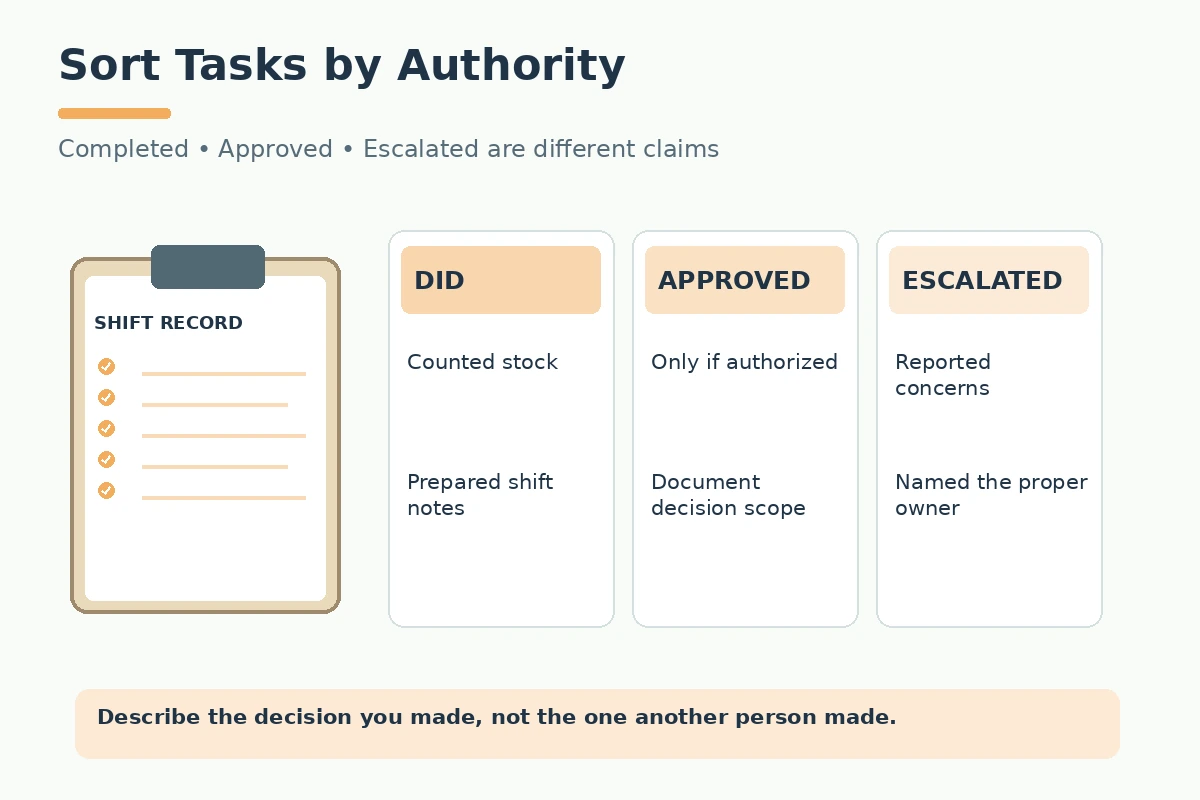
Restaurant work can move quickly, yet authority still matters. A host may direct guests to another table, a shift lead may escalate a complaint, and a general manager may approve staffing or a budget within company policy. When writing the resume, identify who decided and who implemented. The sentence “Approved staffing changes” is different from “Suggested coverage adjustments for manager approval.”
For inventory work, separate counting from ordering, and ordering from contract negotiation. For safety, separate noticing a concern from making a legal determination. If the posting emphasizes certain actions, use the employer’s terminology only when your own duties genuinely match it.
Use a Layout That Survives a Fast Service-Day Scan
Keep the resume single-column, make employer names and promotions easy to find, and cluster skills that have concrete examples in the experience section. The page should show staffing, service, purchasing or safety evidence within a quick scan. Include hospitality software only if you actually used it; do not assume all point-of-sale systems function the same way.
Before sending, check for inconsistent dates, overstated financial authority, unexplained certifications and unverified metrics. A reader should understand what you managed, what you supported and what you escalated. That distinction is more credible than an attractive layout full of generic “excellent leadership” statements.
A Final Accuracy and Readability Checklist
Before sending the document, verify the exact target job, relevant evidence, accurate employer and training dates, and each credential or authority claim. Keep your contact details as selectable text. Use a file type the employer accepts, reopen the exported copy and confirm that important headings and dates remain next to their entries. A simple copy-and-paste text check can reveal obvious extraction problems, but it cannot certify the behavior of every applicant tracking system.
Avoid posting confidential customer, employee, passenger, vendor or employer records as resume evidence. All examples here are hypothetical editorial teaching examples. No template, font, column count or phrasing guarantees that a resume will be parsed correctly or that an employer will interview or hire you. A helpful resume is a truthful, easy-to-find record of relevant work—not a way to manufacture a better history.
How We Research Resume Layout Advice
Our approach compares the primary guidance in Source 1, Source 2 and Source 3, distinguishing general layout recommendations from occupation-specific responsibilities. The source guidance explains typical practices and tasks rather than guaranteeing an outcome for an individual application. Dates, achievements, roles and credentials in examples are not representations of a real applicant or employer.
Sources were checked on October 29, 2026. We did not run a live employer-specific ATS test, and readers should follow the instructions of the actual posting. JobAsk maintains a separate affiliate disclosure; no paid partnership, employer endorsement or placement guarantee is claimed for this article.
Related Guides
- Flight Attendant Resume Format: Put Safety, Service, and Training First
- Tell Me About Yourself for Restaurant Manager Interviews: Shifts and Service
- Project Manager Resume Summary: Explain Scope, Delivery, and Your Role
- Restaurant Server Resume Summary: Show Order Accuracy and Guest Follow-Up
- Bartender Resume Format: Highlight Service, Inventory, and Safe Practices
Use the job title actually held. Explain leadership responsibilities without claiming a different formal position.
Yes, if they are genuinely earned and current where necessary. Include the credential name and issuer; follow the employer’s requirements.
Describe counts, logs, ordering support and exceptions you handled. Never invent an inventory savings figure.
Yes. Show the employer once if convenient but give distinct titles and accurate date ranges so progression is clear.
Briefly state the type of issue, your role and the proper handoff or response, without revealing private customer details or claiming decisions you could not make.