
Quick answer: If you have a long career history, the most useful resume format is the one that quickly shows how your experience solves the employer’s current problem. A reverse-chronological structure with a focused summary, recent skills and selected earlier accomplishments is a reasonable starting point. You do not have to list every project you ever touched, but you should never falsify employment dates or qualifications to look younger.
No resume design can eliminate age bias or guarantee an interview. The US Equal Employment Opportunity Commission explains that the federal Age Discrimination in Employment Act covers applicants and employees age 40 or older in covered employment settings. This article concerns presentation of truthful experience, not individualized legal advice or a way to conceal eligibility information an employer legitimately requires.
Lead With the Work You Can Do Now
Read the target posting and identify two or three present-day priorities: perhaps leading a team, coordinating suppliers, improving records or delivering service. Put directly related achievements near the top of the page, using current role terminology when it is accurate. Avoid opening with generic labels such as “veteran professional” or a declaration of a precise number of years unless the duration truly matters to the role.
A summary can work when it names real work, tools and scope rather than self-praise. For example, a candidate who recently implemented a scheduling process could describe the process and their contribution without inventing an improvement percentage. If a claim depends on confidential company records, use a description you can support and share appropriately.
Decide Which Roles Need Detail
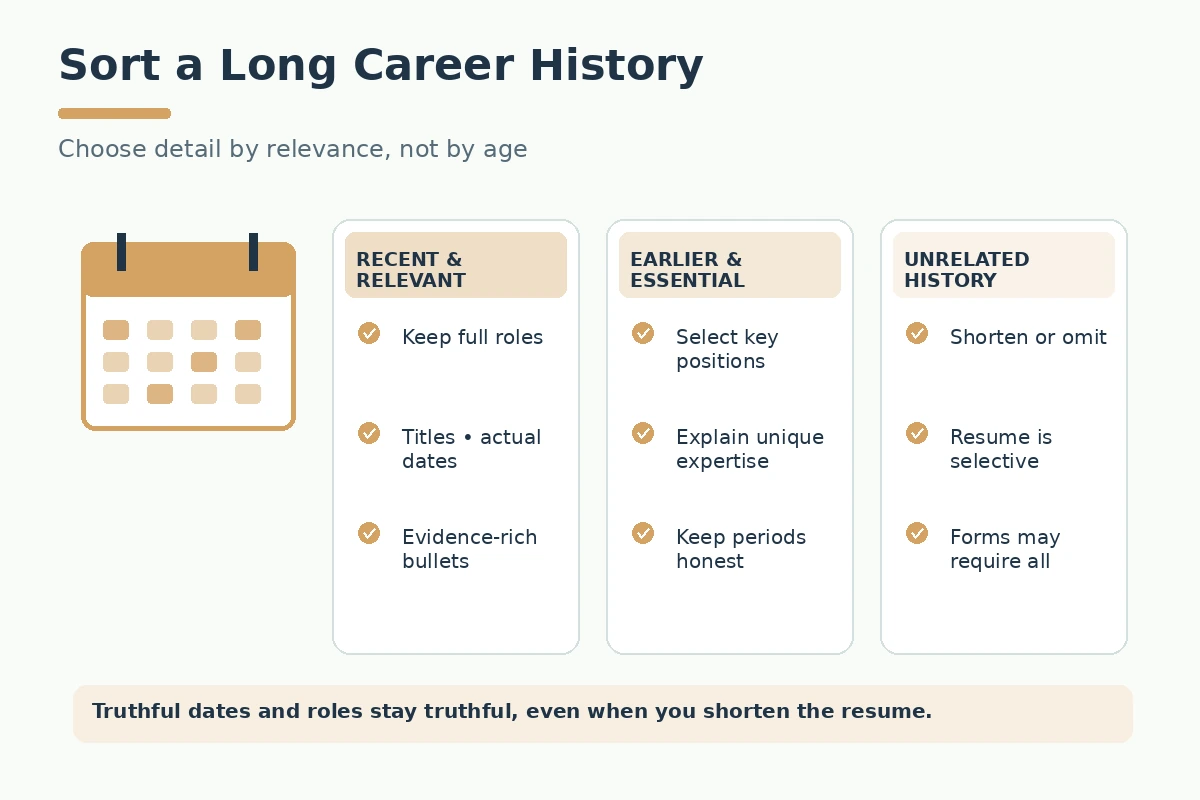
Use three editorial groups. Recent, closely related roles typically deserve full dates, titles and evidence-rich bullets. Older roles that establish a specialized credential or important experience may deserve shorter treatment. Unrelated history can often be omitted from the resume, provided the application does not separately require a complete employment record. Your resume and a formal work-history form serve different purposes.
Keep roles you do include in a clear sequence. Do not disguise long positions with a misleading “selected experience” label that suggests continuous employment where dates show otherwise. If an earlier credential is important, state it accurately and check that any license remains valid before describing it as current. Avoid placing expired credentials in an active-certification list.
| History category | Recommended treatment | Important limit |
|---|---|---|
| Recent relevant role | Title, actual dates and selected results | No invented business metrics |
| Older role essential to target | Shorter entry or focused accomplishments | Keep its genuine period clear |
| Unrelated older job | Omit if not required for this resume | Answer formal history questions accurately |
| New training | Actual course, project and date if helpful | Do not call practice licensed or paid work |
Show Recent Learning With Verifiable Detail
A common concern is whether an applicant can use the tools required for the job today. The resume should answer with proof rather than defensiveness. Name a software workflow, training exercise or updated process you actually used, including its context. A course completion belongs in a training section; it is not the same as experience administering a production system.
An illustrative statement might say, “Updated a volunteer team’s scheduling spreadsheet and wrote instructions for new users.” It should be labeled volunteer work if that is what it was. If the candidate took a spreadsheet course but did not deploy a real schedule, the wording should say “completed coursework in…” instead. This precision protects the applicant from questions their resume cannot support.
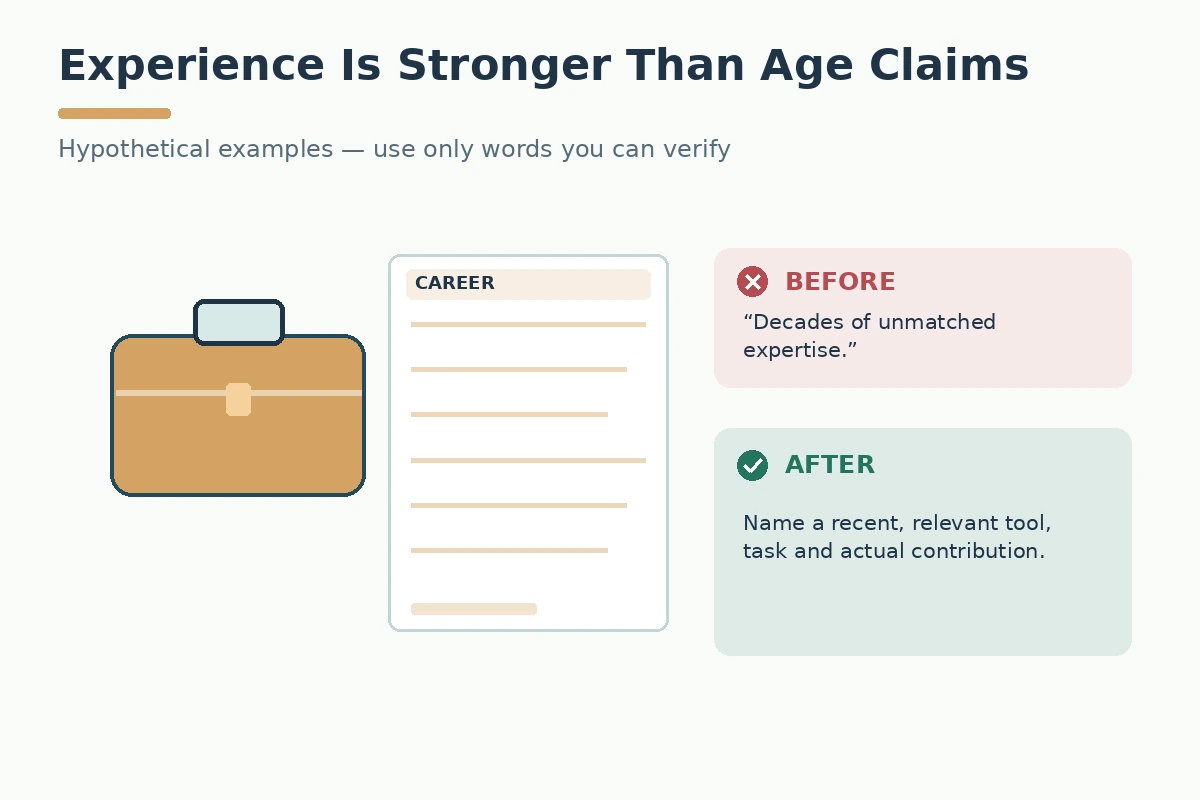
Before (not reliable): “Seasoned expert with decades of unmatched experience, skilled in every modern platform.” After (hypothetical, use only if accurate): “Coordinated supplier schedules and recently rebuilt a shared tracking process for a volunteer program.” Do not copy either line into an actual resume without checking your own facts, roles, dates and permissions.
Handle Dates and Education Honestly
University degrees may appear without a graduation year when the year is not relevant and the application does not request it. Employment entries that you choose to show still need enough dates to make their sequence understandable. Do not invent start dates, move an older job forward, or delete a month from a required work-history field. Check the employer’s instructions for what must be disclosed.
For a hypothetical professional with ten positions across several decades, a reasonable approach may include a detailed set of recent roles and a short “Earlier relevant experience” line describing selected positions. If an older job is the central proof for the new position, however, it may deserve fuller detail regardless of age. Relevance, not a fixed cut-off year, should drive the decision.
Review for Respect, Clarity, and Accuracy
The strongest layout will not hide a vague claim. Replace “managed everything for thirty years” with truthful detail about work scope, decisions you owned and responsibilities you shared. Distinguish supervising a team from simply helping train a colleague. Avoid unsupported statements about being faster or more adaptable than younger coworkers; describe your specific actions instead.
Check that your resume uses standard headings and a readable font, includes current contact information, and can be understood in plain-text order. If you suspect unlawful age discrimination, separate the employment concern from the resume-editing task and consult appropriate official guidance. Your formatting decisions should help a reader understand your qualifications, not imply that bias is your responsibility to prevent.
A Final Accuracy and Readability Checklist
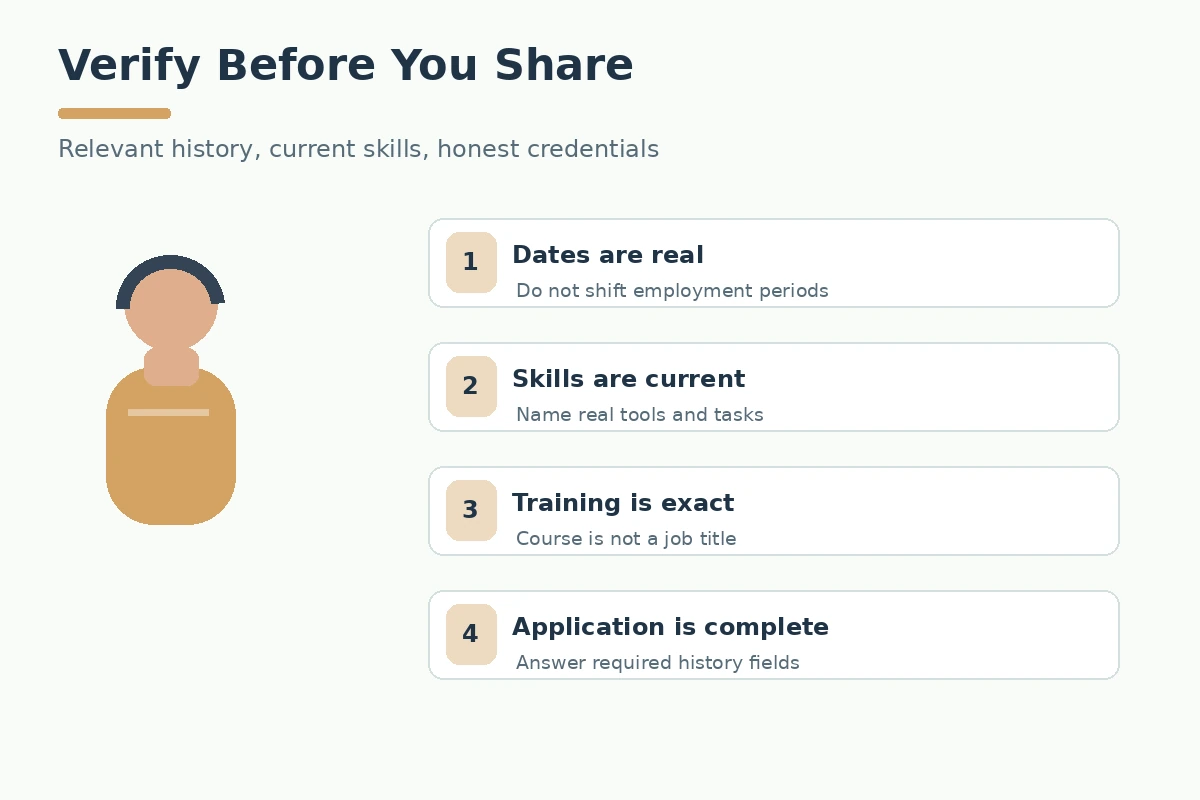
Before sending the document, verify the exact target job, relevant evidence, accurate employer and training dates, and each credential or authority claim. Keep your contact details as selectable text. Use a file type the employer accepts, reopen the exported copy and confirm that important headings and dates remain next to their entries. A simple copy-and-paste text check can reveal obvious extraction problems, but it cannot certify the behavior of every applicant tracking system.
Avoid posting confidential customer, employee, passenger, vendor or employer records as resume evidence. All examples here are hypothetical editorial teaching examples. No template, font, column count or phrasing guarantees that a resume will be parsed correctly or that an employer will interview or hire you. A helpful resume is a truthful, easy-to-find record of relevant work—not a way to manufacture a better history.
How We Research Resume Layout Advice
Our approach compares the primary guidance in Source 1, Source 2 and Source 3, distinguishing general layout recommendations from occupation-specific responsibilities. The source guidance explains typical practices and tasks rather than guaranteeing an outcome for an individual application. Dates, achievements, roles and credentials in examples are not representations of a real applicant or employer.
Sources were checked on October 29, 2026. We did not run a live employer-specific ATS test, and readers should follow the instructions of the actual posting. JobAsk maintains a separate affiliate disclosure; no paid partnership, employer endorsement or placement guarantee is claimed for this article.
More Resume and Cover Letter Guides
- Combination Resume Format: Pair a Skill Summary With Dated Proof
- One-Page Resume Layout: Cut Clutter Without Losing Job-Relevant Proof
- Relevant Coursework on a Resume: Choose Classes That Prove Job Skills
- How to Write a Resume That Shows Relevant Work Clearly
- Relevant Coursework on a Resume: Select and Explain the Right Classes
Not as an automatic rule. A clear reverse-chronological or carefully combined format often makes actual experience easier to verify; choose what suits the role.
Usually a resume is selective, but an application may request a complete work history. Always answer required fields truthfully.
Often yes when it is not relevant and the employer does not require it. Never alter a year or misstate the degree itself.
Use a recent, truthful course or work example with the tool and task. Do not present a practice exercise as professional deployment.
The law prohibits specified forms of discrimination in covered circumstances, but no resume format guarantees an outcome. Consult the EEOC or a qualified adviser for an individual legal issue.