
A language can be a valuable resume skill, but a confident label should not be a guess. Speaking comfortably with family, reading professional documents and drafting customer replies are different abilities. The University of Georgia Career Center specifically advises applicants to describe language proficiency honestly and not claim fluency they cannot demonstrate. This JobAsk guide introduces a four-skill self-check that is a writing aid, not a language test or official proficiency scale. Every workplace exchange described below is fictional; the article does not award language certificates or promise a bilingual job.
Decide whether the language matters for the role
Begin with the actual employer’s requirements. Some positions involve occasional conversation with visitors, while others need technical writing, simultaneous interpretation or handling sensitive customer information. If a role requires a specified professional proficiency level or credential, follow the application instructions; a self-assigned resume label cannot replace a mandated test. If languages are not relevant to the target job, a brief Languages line may be sufficient or may be omitted. Do not use a language claim to conceal a more important qualification gap.
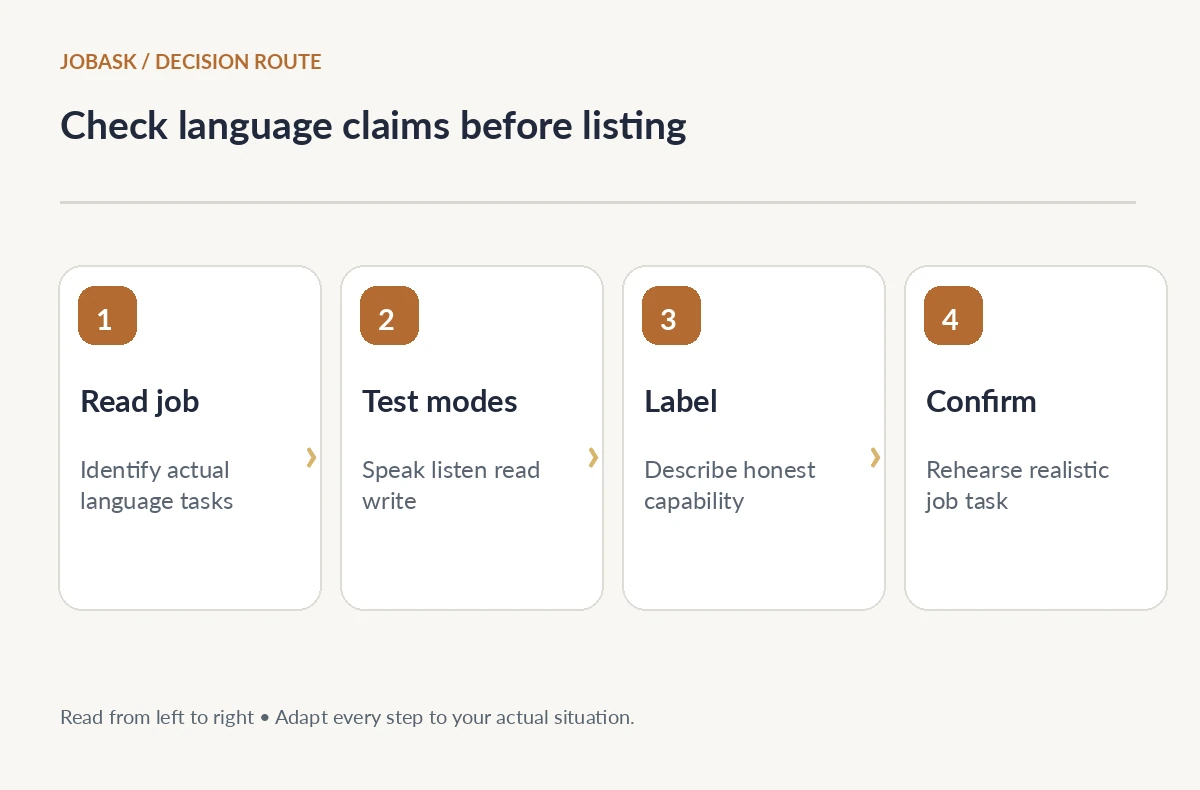
Read the posting’s verbs closely: explain, translate, prepare reports, take phone calls or review correspondence. Those activities do not have identical skill requirements. A hypothetical customer desk may ask someone to greet visitors, while a bilingual caseworker role may require accurate written documentation. The first does not imply competence for the second. Write down which communication modes the job truly uses before choosing a level. Do not assume that being raised around a language is equivalent to professional reading or writing fluency.
Assess speaking and listening separately
Ask what you can currently do in an ordinary unscripted conversation. Can you understand normal-speed questions, request clarification, explain a procedure and recognize when you need an interpreter or help? Practice with a willing partner in a non-sensitive setting, not by impersonating a professional language examiner. Listening comprehension and spoken response may differ. Someone can follow familiar topics well but struggle to explain technical instructions under pressure; a resume that says only “fluent” obscures that practical boundary.
Make a four-row private evidence note for speaking, listening, reading and writing. For each, record a realistic task you can perform and a task that still requires support. In a fictional example, a person can discuss appointment times and understand routine questions but cannot interpret medical instructions. A prudent resume might indicate conversational speaking rather than unrestricted professional proficiency. Do not describe hypothetical exercises as client service. Reassess your abilities periodically; practice can improve competence but does not create an official credential by itself.
Evaluate reading and written communication independently
Reading familiar email messages is not the same as reviewing contracts, technical specifications or regulatory text. Writing short informal replies differs from drafting accurate client reports. Test yourself using material you have permission to use, and consider whether you can identify uncertainties instead of guessing. If you rely heavily on translation software, acknowledge that in your private assessment before claiming independent writing ability. Avoid confidential samples or clients’ personal data in a portfolio or practice exercise.
An imaginary applicant might be able to read general Spanish news and write short scheduling messages but lack the vocabulary for legal documents. That is a useful distinction, not a failure. The resume should convey the capability relevant to the actual role, not imply everything the applicant might someday learn. Keep text concise, such as “Spanish — conversational speaking; intermediate reading,” only if the individual can substantiate those labels. If an employer requests a recognized framework or assessment score, provide the real result with the awarding body and date.

Choose proficiency wording you can defend
The University of Georgia lists terms such as elementary, intermediate, fluent and native as possible descriptions while stressing honesty. These labels are not universally standardized across employers; two people may interpret “intermediate” differently. Use them with caution and prefer an accurate explanation of specific business tasks where clarity matters. “Native” describes a personal language background, not an automatic guarantee of professional translation expertise. Avoid “perfect bilingual” and similar slogans that claim too much while saying little.
If your proficiency differs by mode, separate it. For example, an invented line could read “French — professional reading; conversational speaking,” but it is a formatting illustration only. Another applicant may genuinely be comfortable with verbal conversation yet need writing assistance. Never paste a template level without self-testing. When an employer uses requirements such as ILR, ACTFL or CEFR, do not invent equivalencies or scores. Seek the employer’s stated definition and show only documented assessments you have taken.
Place language information where it can be found
Use a simple Languages or Additional Skills heading, with the language name and concise level statement on one line. If a language is essential to the job, it may deserve a prominent skills line near the top, but it still should be supported by actual proficiency. A complex graphic meter with stars or percentage bars is easy to misunderstand and cannot explain reading versus speaking. Plain text is more accessible and easier for both humans and varied application systems to interpret.
If your language knowledge was essential to work you actually performed, a real experience bullet may give better evidence than a bare label. For a hypothetical volunteer, “Explained event directions to Spanish-speaking guests” would be relevant only if that genuinely happened and the person can discuss what was communicated. Do not upgrade basic greetings into professional interpreting. Follow the employer’s requested resume format, and avoid sharing transcripts of private conversations to prove language use. The goal is clarity, not a theatrical proficiency badge.
Check your claims before a multilingual interview
Rehearse one realistic task from the posting: explain an ordinary process, summarize a short document or ask a clarifying question. Use consented practice with non-sensitive content and have a capable speaker point out ambiguity if possible. A practice partner’s feedback is not an accredited assessment. Identify terms you do not know and decide whether the proposed role requires that vocabulary now. If the job involves health, safety, legal or financial communication, the stakes may require formal standards and supervised training rather than casual self-rating.
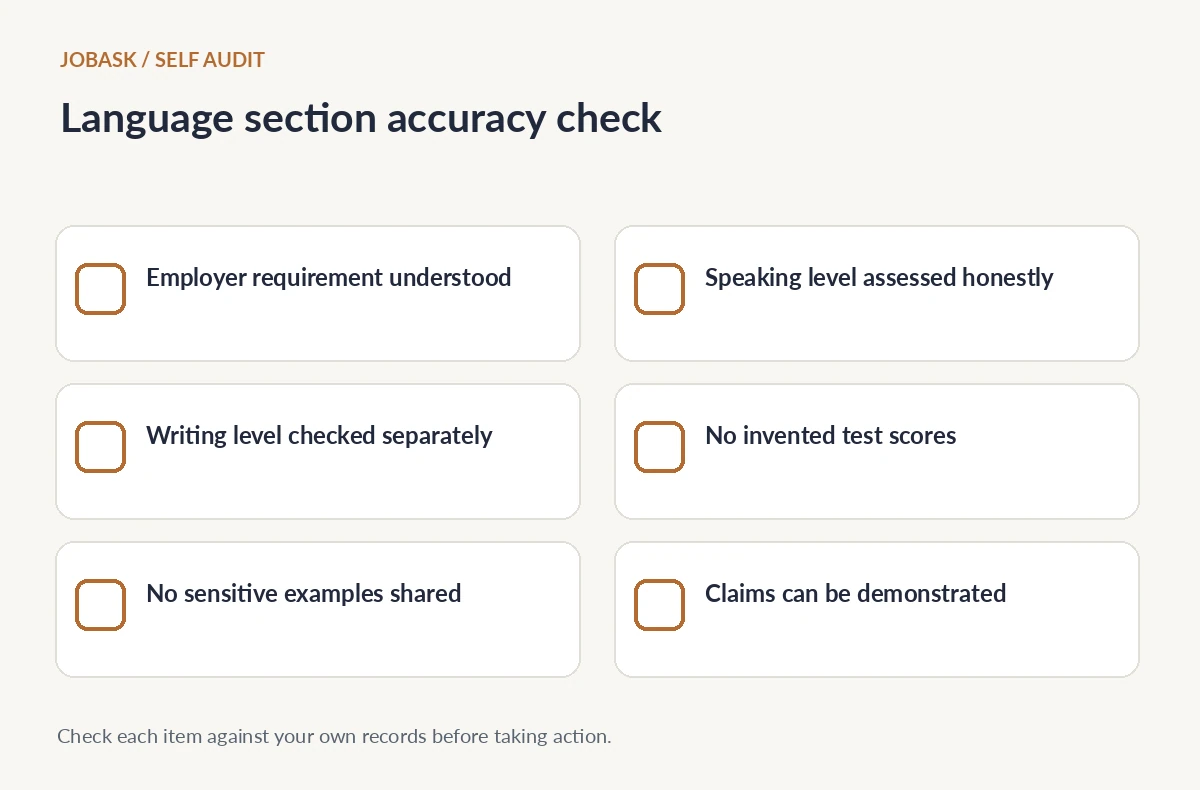
Before submitting, check that all written labels match your current capability, that no scores or certificates have been invented, and that an interviewer could reasonably verify your statement. You may decide to list only one skill or to leave out an irrelevant language entirely. This is not hiding your identity; it is making a job document concise. Language proficiency may expand the tasks you can undertake, but a resume label cannot ensure a role or replace an employer’s required assessment. Our walkthrough on how to list language proficiency on a resume with honest skill levels sets out each step.
| Situation | Practical next step | Important limit |
|---|---|---|
| Comfortable with routine conversation | State conversational speaking | Do not imply professional translation |
| Can read technical material only with tools | Describe reading limits honestly | Do not claim independent mastery |
| Employer requires a certified level | Provide real assessment details | Never invent CEFR or other scores |
| Language not relevant to duties | Use a short optional line or omit | Prioritize demonstrable job requirements |
How We Research and What Remains Unverified
We used the University of Georgia career guidance on honest language claims with CareerOneStop formatting and education context. The four-mode worksheet is an original self-review aid, not a certified assessment, and its task scenarios were invented as examples. Public topical search results and the listed source pages were reviewed on October 19, 2026.
Sources reviewed October 19, 2026: Source 1 — University of Georgia Career Center urges clear and honest foreign-language proficiency labels and cautions against unsupported fluency. CareerOneStop discusses how qualifications from education and training should be represented accurately. CareerOneStop resume formatting guidance encourages readable sections and ordinary text labels.
Affiliate disclosure for how to write language proficiency in resume: the resources linked in this guide are editorial sources, not verified paid endorsements or approved JobAsk partnerships. This guide contains no affiliate links. Read the JobAsk affiliate disclosure before considering a commercial service. Verify current conditions with the organization itself.
More Resume and Cover Letter Guides
- Research Experience on a Resume: Show Your Actual Contribution
- Entry-Level Resume Summary Without Paid Experience: Use Project Evidence
- Electrician Resume Summary: Show License Level and Verified Work Scope
- Family Business Experience on a Resume: Describe Real Duties Honestly
- Projects on a Resume: Describe School, Personal, and Team Work Clearly
No. Employers may interpret it differently; use it only when genuinely defensible.
Yes. Separate them when the difference matters for the job.
You may when relevant; it does not alone prove specialized professional interpreting ability.
You can informally self-assess, but do not present an unearned score as certified.
Plain-language levels and task evidence are generally easier to understand.