
Before accepting a seasonal job offer, write down the intended start date, expected last workday, peak-period hours, and the process for changing or extending the assignment. Seasonal hiring covers many settings, from guest services and retail to outdoor operations. The word “seasonal” alone does not tell you whether the role ends on a fixed date or when the business no longer needs extra coverage.
For many temporary assignments, the exact duration depends on the role and employer. Do not assume a seasonal position converts to permanent employment. Ask who makes extension decisions, when you might hear about them, and what the last scheduled shift and final handoff ordinarily look like. DOL’s SeasonalJobs portal documents temporary and seasonal opportunities, but it is not a universal standard for every privately advertised seasonal position.
Identify what the written offer actually promises
Start with the actual offer and any referenced policy or schedule. Highlight the role title, employer, reporting contact, start date, work location, regular hours, and conditions mentioned in the document. Separately record anything said in an interview that was not confirmed. Where documents disagree, ask for one clear answer before you sign or send an unqualified “I accept.” A warm conversation is helpful, but a reliable decision depends on the terms the employer confirms.
Do not rely on a generic acceptance template without checking who has authority to answer questions. The recruiter may coordinate the process; the manager may know the schedule; another department may handle onboarding. Keep your request short and specific. If the issue changes what you are agreeing to, ask how it will be documented, rather than treating a casual message as an automatic amendment.
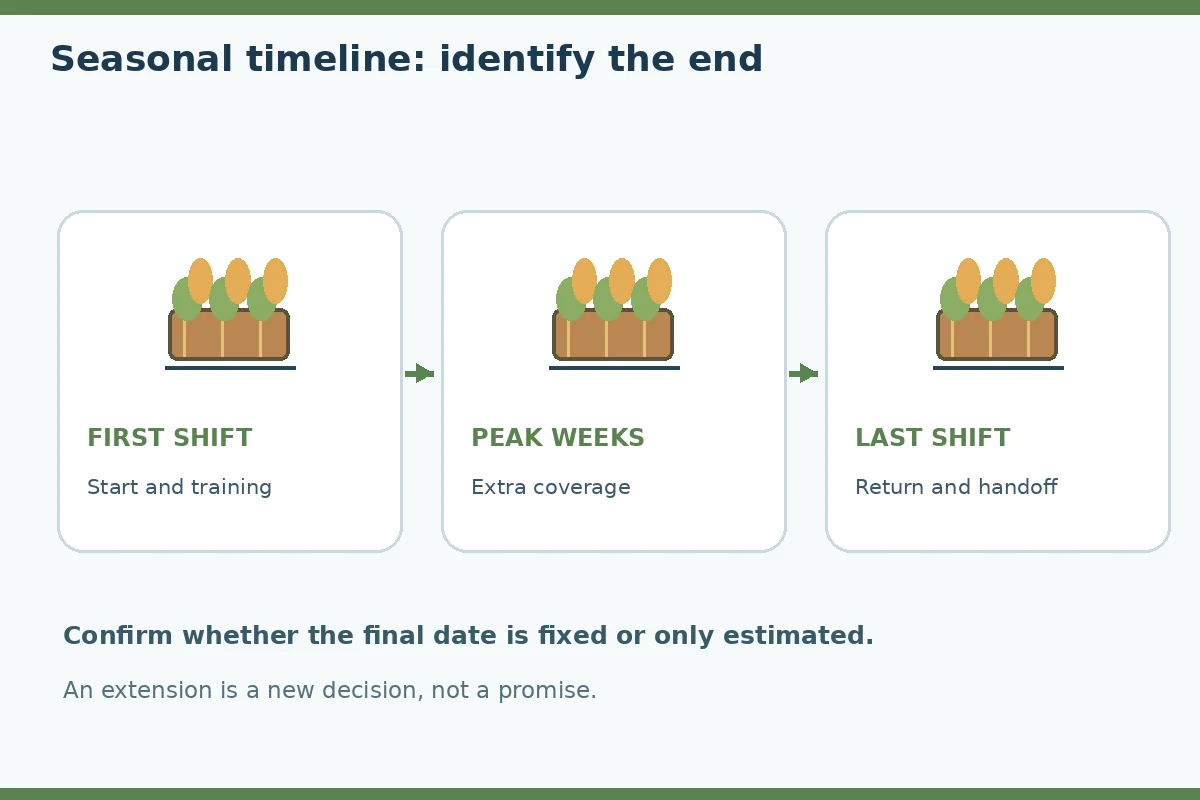
Five offer details to confirm for this position
Period of work. Ask: “Is there a firm last date, estimated duration, or project-based end point?” Do not describe an estimate as a guaranteed contract term. Record the answer beside the corresponding line of the written offer. If two people describe the rule differently, follow up with a precise question rather than guessing which explanation governs.
Peak schedule. Ask: “Which weeks or dates require early starts, weekends, or additional coverage?” Check holiday and peak weeks against existing obligations. Record the answer beside the corresponding line of the written offer. If two people describe the rule differently, follow up with a precise question rather than guessing which explanation governs.
Worksite and duties. Ask: “Will work happen at a single location or change between events and sites?” Confirm transport needs and any tasks that require specific training. Record the answer beside the corresponding line of the written offer. If two people describe the rule differently, follow up with a precise question rather than guessing which explanation governs.
Extension process. Ask: “Who decides about staying longer, and when would they tell employees?” An option to apply is not a guaranteed permanent job. Record the answer beside the corresponding line of the written offer. If two people describe the rule differently, follow up with a precise question rather than guessing which explanation governs.
Exit and records. Ask: “What equipment, keys, rosters, or work documents need to be handed back?” Ask how the manager confirms the final date and return procedure. Record the answer beside the corresponding line of the written offer. If two people describe the rule differently, follow up with a precise question rather than guessing which explanation governs.
Make a simple comparison sheet with four columns: what the posting described, what the written offer says, what the employer clarified, and whether the final arrangement works for you. This helps distinguish a real condition from a preference or an unconfirmed possibility. You do not need to send this private comparison sheet to the employer. It is a decision aid for you to make an informed response.
Consider realistic scenarios before saying yes
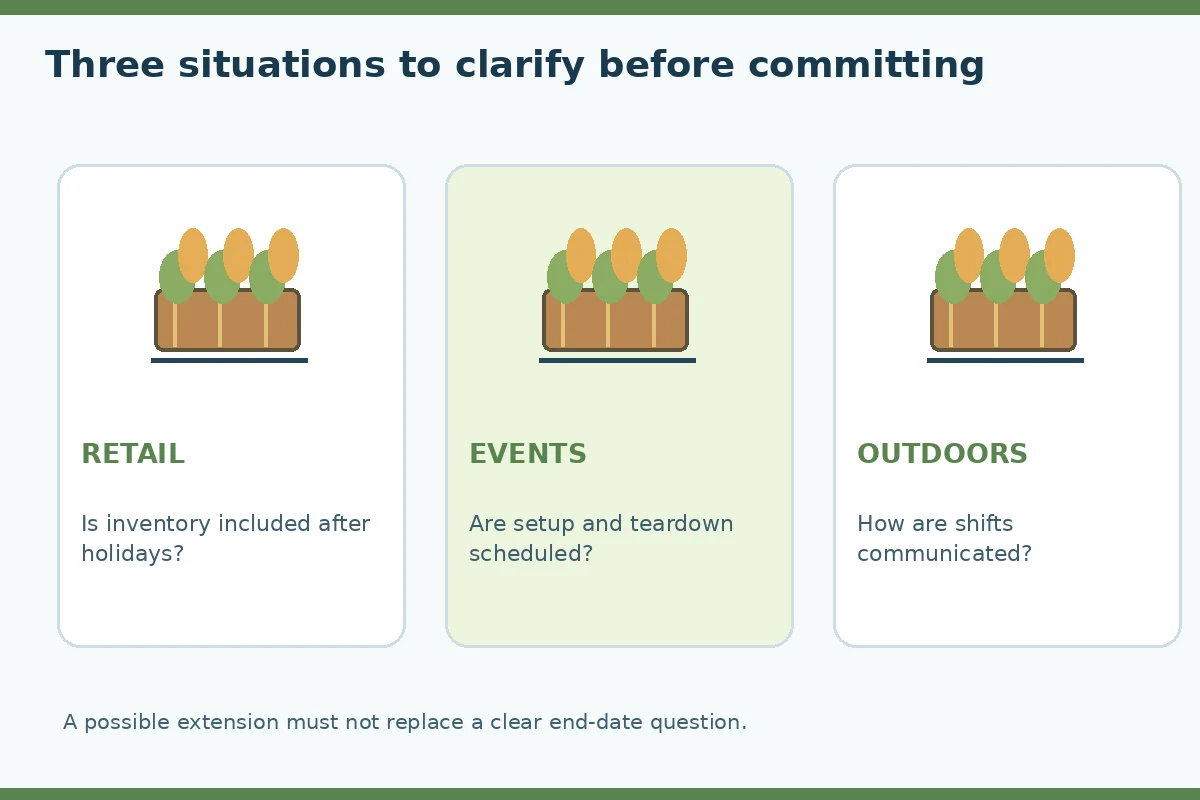
Holiday retail assignment. An offer starts before a sales peak but does not specify the last shift. Ask whether the role ends after inventory, after the holidays, or on a particular calendar date. This is a hypothetical situation for planning purposes, not an account of a real employer or worker. The point is to test the arrangement against specific facts rather than rely on a broad promise.
Event staffing for a festival. The organizer needs setup and teardown shifts around the main event. Confirm whether the agreed dates include travel, training, and post-event cleanup before making a commitment. This is a hypothetical situation for planning purposes, not an account of a real employer or worker. The point is to test the arrangement against specific facts rather than rely on a broad promise.
Seasonal grounds crew. An outdoor operation may adjust work when weather or demand changes. Clarify the planned season, safety training, reporting location, and communication process; do not assume every shift is weather-independent. This is a hypothetical situation for planning purposes, not an account of a real employer or worker. The point is to test the arrangement against specific facts rather than rely on a broad promise.
Use a clarification email before accepting
The following message is fictional and illustrative. It is deliberately not a binding acceptance: it gives the recruiter a chance to confirm material details first. Replace bracketed details with your own facts and send only to a verified hiring contact. If the offer deadline is close, ask about timing instead of assuming the deadline will be extended.
Subject: Questions about the [position] offer
Thank you for offering me the seasonal [position] role. I am interested in helping during the upcoming busy period.
Could you confirm the expected start date, the planned final shift or approximate assignment end, and whether the schedule includes required weekends, setup days, or closing work?
I would also appreciate knowing how any extension would be discussed and what the end-of-assignment handoff involves.
With those details confirmed, I can give you a clear acceptance decision by [agreed date]. Thank you again.
The illustrative email separates a planned assignment end from a possible extension. It avoids suggesting a permanent position was promised. If the employer supplies a revised schedule or written document, compare dates and duties before you send your acceptance.
If the recruiter answers only one question, send a concise follow-up listing the remaining items. Avoid opening unrelated negotiations unless they genuinely affect the decision. If the answer changes a core term, request the final text or written confirmation before accepting. Keep copies of the final version, the date of your decision, and the communication channel used.
Separate clarification, acceptance, and onboarding
An acknowledgment such as “Thank you, I received the offer” is not the same message as “I accept the offer for [role], with [confirmed terms], starting on [date].” Ask unresolved questions first. After reviewing the response, give a clear decision according to the employer’s instructions. Only then work through onboarding tasks such as account setup, training schedules, and forms in the verified employer system. Do not imply that you have already accepted when your response is still conditional.
When the decision is positive, reference the correct job title and start date, and express appreciation without adding new conditions by accident. When the offer still has a problem, negotiate that specific matter or decline courteously. If a signed document is requested, check that you are using the final copy and follow the authorized submission channel rather than attaching a draft containing conflicting terms.
Watch for risky promises or missing boundaries
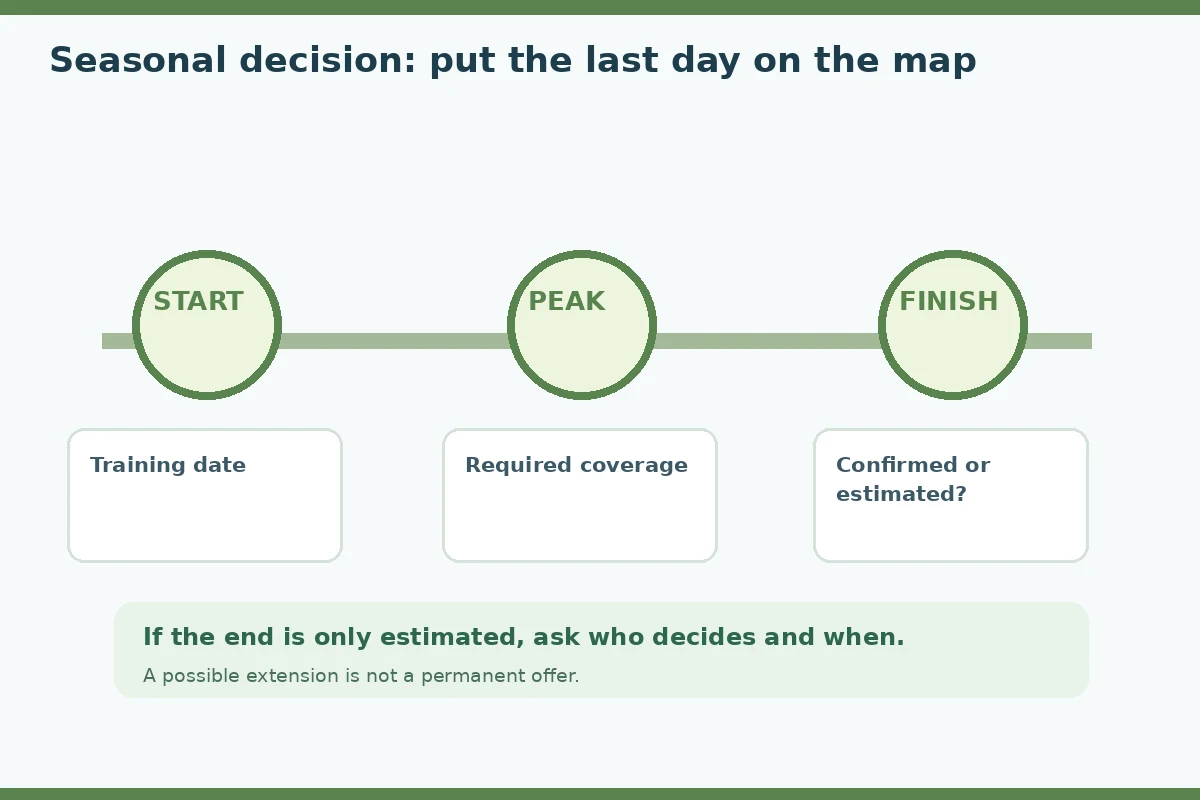
Keep a copy of the offer and the seasonal dates you accepted, especially if your next classes or another job begin immediately afterward. If the recruiter says the position is permanent despite a temporary written offer, request clarification; do not represent an unwritten possibility as a commitment.
Verify the employer using a company website or phone number you find independently when the offer arrived unexpectedly. Fraudsters may impersonate real recruiters and demand payment for equipment, training, or a supposed processing fee. Do not send money to obtain a job and do not treat an emailed check as safe funds to forward. The Federal Trade Commission documents fake-offer and fake-check schemes; a polished logo or urgent deadline does not prove the contact is genuine.
Do not provide passwords, bank account details, or government identification documents through an unverified chat or unsolicited form. A legitimate hiring process may involve sensitive paperwork at an appropriate stage, but you should understand who is requesting it, why, and through which employer-controlled channel. Where you are uncertain, contact the organization using public contact information you found yourself.
Keep a practical acceptance decision record
Use a small checklist with the offer version and date, your clarified questions, the names or roles of the people who responded, and the decision deadline. Mark each condition “confirmed,” “not applicable,” or “still unresolved.” If any unresolved point is central to your schedule, location, training, or ability to perform the job, do not bury it in a polite acceptance. Ask about it or decide not to take the offer.
An offer may be a very good career move even if it has tradeoffs. The goal is not to demand perfect certainty about every future possibility, but to make sure the daily operating conditions are ones you understand and can follow. A realistic, properly documented expectation is more useful than a cheerful assumption that everything will somehow work out.
How We Research these offer decisions
We reviewed these primary resources on 2026-10-30: CareerOneStop guidance on evaluating employment offers; official topic guidance; official supplementary guidance; FTC warning about employment and equipment scams. CareerOneStop addresses schedule and workplace conditions as offer decisions. Topic-specific official sources establish the limited factual claims used here; fictional email language and scenario worksheets are editorial examples, not quotes from employers. We also compared proposed titles with the user-provided WordPress listing and local production inventory. Private unpublished WordPress entries cannot be independently ruled out by a public search.
This guide is not personalized employment or legal advice and does not imply that every employer uses the same policy. Ask the particular employer to confirm material terms and consult appropriate professional advice if a contract presents an unusual issue. The affiliate disclosure describes site practices; no affiliate approval or paid partnership is asserted by this article.
Related Workplace Guides
- Accepting a Remote Job Offer: Confirm Location, Equipment, and Time Zones
- Accepting a Night-Shift Job Offer: Check Rotation, Training, and Handoffs
- Accepting a Contract Job Offer: Check the Assignment, Pay, and End Date
- After Accepting a Job Offer: A Practical Checklist Before Day One
- Accepting a Teaching Job Offer: Confirm the School, Assignment, and Next Steps
No. Employers may give a date, an estimated period, or an assignment linked to business demand. Ask which applies to the actual offer.
It can happen, but do not treat it as a promise unless the employer explicitly confirms a separate arrangement.
Clarify the peak schedule first and state any real unavailability; do not assume preferred dates off will be approved.
No. It is a DOL portal for certain temporary and seasonal opportunities; other employers also advertise seasonal roles elsewhere.
Ask about the final scheduled shift, any handoff, equipment return, and who provides final administrative instructions.