
Quick answer. After you have accepted a real job offer, keep the written confirmation, follow the employer’s official onboarding instructions, verify the agreed start date and reporting logistics, and plan any needed transition from your current responsibilities. Do not assume paperwork, screenings or first-day access are complete just because you said yes.
Confirm the Acceptance Record and Start Date
Save the employer’s written offer, your acceptance message and any instructions for a portal or signed document. Check that the final record identifies the role and anticipated start date consistently. If a later email contradicts the letter, ask the verified recruiting contact to reconcile the difference. Do not silently edit a signed form or treat a verbal promise as proof that a condition has been fulfilled. An accurate record helps when you are arranging a commute, relocation or notice to a current team.
Use a three-item record: “Accepted on,” “official start date,” and “remaining employer actions.” A fictional example might say “Acceptance confirmed by HR email; start date [date]; portal invitation pending.” The bracketed item is a placeholder, not an actual appointment. If the employer said an offer depends on a specified step, keep that condition visible in your plan without assuming what its legal effect is. Get individualized advice if the wording raises contractual questions.
Use Only the Employer’s Verified Onboarding Channel
Onboarding may involve forms, identity verification, employee systems, orientations or equipment requests, but employers vary in sequence and timing. Wait for instructions from a verified company contact or a known HR portal. If an unfamiliar message demands banking details immediately, independently confirm it before acting. The FTC warns that fake job offers can be used to obtain personal information or money. Never pay someone to “release” wages or deposit and forward funds from an equipment check.
Create a small task list with an owner and a due date: “Employer — send portal invite; candidate — review forms; HR — confirm reporting instructions.” Only populate dates actually given to you. Store sensitive forms in the permitted system, not as public email attachments or in a shared job-search spreadsheet. If a link expires or a portal shows a conflicting name, report it to the employer rather than using workarounds or an unverified replacement link.

Coordinate Your Current Commitments Carefully
If you are employed, think through what information is confirmed before announcing departure. Make a realistic plan to hand over ongoing projects, return equipment and communicate with your manager according to your actual workplace obligations. Do not rely on a universal “two weeks required” rule; notice practices, agreements and local laws can differ. For highly consequential terms, consult your own documents or qualified local guidance instead of using this general checklist as employment-law advice.
If you are finishing a course, caregiving arrangement or project, check whether the proposed start date leaves enough room for your responsibilities. You may need to coordinate a transition without giving unnecessary personal explanations. Avoid public announcements about a new employer before agreed communications or onboarding are sufficiently settled. A professional transition is mostly about precise dates, practical ownership and clear handoffs—not a dramatic goodbye message.
Ask for the First-Day Reporting Details
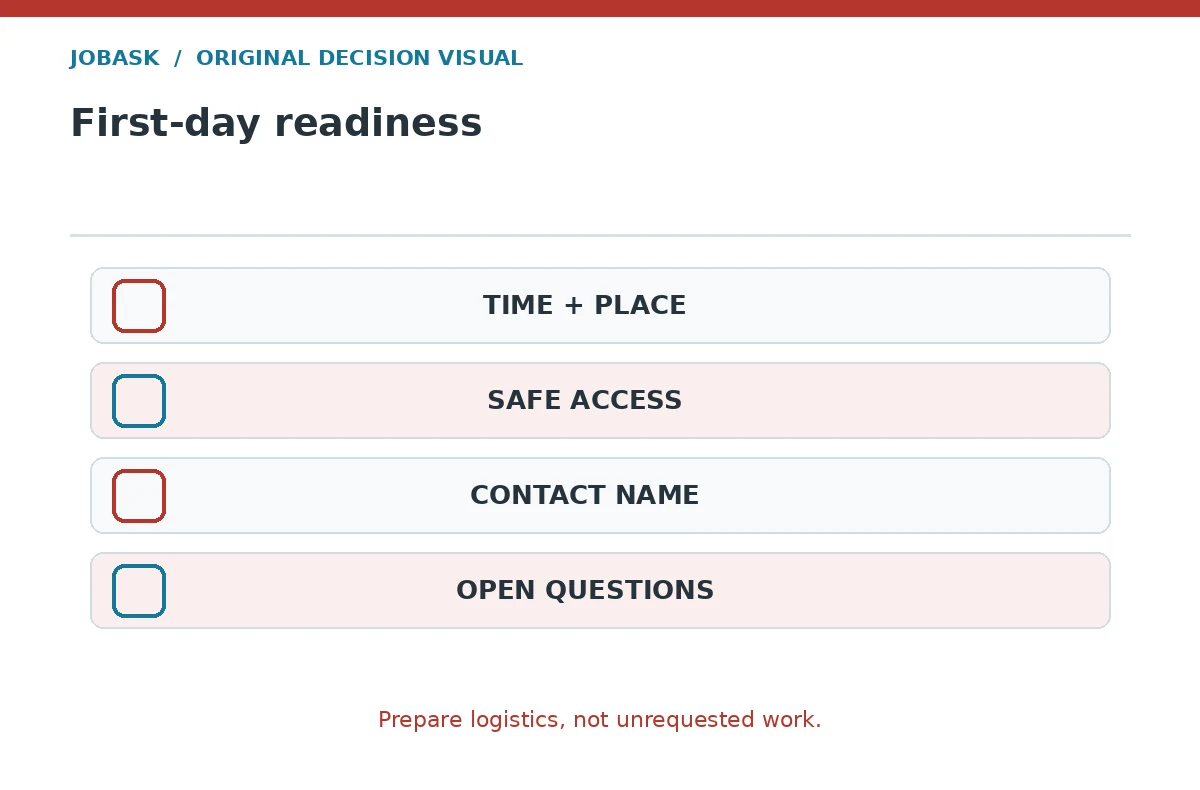
Before the start, confirm the location or remote login method, reporting time and time zone, supervisor or first-day contact, and any instructions about identification or equipment. A useful email is specific: “I am looking forward to starting on [date]. Would you confirm the reporting time, location and person I should ask for on arrival?” The example is hypothetical. If the employer already sent a complete orientation guide, read it rather than requesting the same details again.
For remote work, clarify how official accounts will be issued and which device policy applies. Do not install unknown software from an unsanctioned contact or pay in advance for equipment because a text message said reimbursement would follow. For on-site work, plan a reliable route and allow for ordinary travel delays. The objective is readiness, not pretending every organization operates on the same schedule or uses the same systems.

Set Up a Personal Pre-Start Checklist
Build a simple checklist divided into “waiting on employer,” “I can do now,” and “ask if unclear.” Employer tasks might include sending the onboarding link or supervisor details. Your tasks could include setting a calendar reminder, gathering non-sensitive documents required by the verified system, planning travel, and making notes about the job description. Unclear items are questions about training dates, location, and the first-day agenda. This prevents worry from becoming repetitive recruiter messages.
Assign realistic due dates from actual written instructions; do not invent a universal deadline for submitting tax forms or identity documents. Mark each item with a status: not requested, requested, submitted through official channel or confirmed complete. That distinction is more useful than a green checkmark you gave yourself after merely reading an email. If the company changes a detail, update your private record and ask for a written confirmation when the difference matters.
| Pre-start task | Owner and evidence |
|---|---|
| Written acceptance | Candidate + employer; saved confirmation |
| Onboarding access | Verified employer HR channel |
| Transition arrangements | Candidate; personal plan and real obligations |
| First-day logistics | Manager or HR; confirmed time and place |
Prepare for Work Without Overcommitting
Read the public information and job description you already have, and list two or three thoughtful questions for your new supervisor. You do not need to learn an entire internal software stack on unpaid personal time to prove that you belong. Avoid accepting freelance work or travel commitments that conflict with your agreed start and onboarding schedule. If an employer expects pre-start work, clarify whether it is voluntary preparation or an assigned activity and follow the relevant agreement and policies. Our guide to questions to ask before accepting a job offer and how to email them goes into more detail.
Consider a modest learning plan for the first week: understand team responsibilities, note how work requests arrive, and identify the correct person to ask for help. This is not a promise of a particular performance outcome or promotion. Wait until you are authorized before accessing confidential customer data or employer systems. The most helpful preparation often consists of knowing where and when to arrive, bringing what was requested, and showing up ready to listen.
Know How to Handle a Last-Minute Change
If the employer shifts the start date, ask what changed, what has been confirmed and whether you will receive revised documents. Do not announce a guaranteed start to another party until you understand the final arrangements. If the organization cannot provide a reliable contact or abruptly demands money, verify independently and consider whether the offer is legitimate. The FTC’s guidance on job scams is relevant even after a candidate receives a document that looks official.
If you are uncertain about an agreement, a condition or the consequences of leaving an existing job, obtain individual advice appropriate to the facts and local rules. This checklist is organizational guidance, not a substitute for professional legal, tax or financial counsel. Keep your communication factual and courteous. The entire pre-start stage works best when both sides know which actions are complete, which are still pending and who is responsible for the next update.
How We Research This Job Offer Decision
We cross-referenced university offer-acceptance advice with FTC warning signs and separated candidate tasks from employer-controlled onboarding steps. The ownership grid is an original planning device, and no start-date, form or employer process has been represented as universal.
Sources and Editorial Transparency for This Guide
Source pages checked October 20, 2026: www.career.berkeley.edu — source 1; www.career.berkeley.edu — source 2; www.indeed.com — source 3; consumer.ftc.gov — source 4. We link to these resources so readers can check the original guidance. This is general career communication guidance, not individual legal, financial or employment advice. For disclosures see the JobAsk affiliate disclosure. We have not claimed any affiliate approval for resources linked here.
Related Guides
- Last Day at Work Checklist: Close Tasks, Return Property, Keep Records
- When to Give Notice After Accepting a Job Offer: Check the Risks
- Thank-You Email After Accepting a Job Offer: What to Say Next
- Accepting a Part-Time Job Offer: Check Hours, Availability, and Shift Changes
- Before Accepting a Job Offer: Compare the Terms That Matter to You
Save your confirmation, follow the employer’s official acceptance instructions and list any onboarding steps not yet completed.
Review the actual offer, relevant conditions and your existing obligations before planning your transition; there is no universal rule for every situation.
Timelines vary. Ask the verified recruiting or HR contact for their process rather than assuming a fixed deadline.
Request clear written confirmation of the new plan and adjust your commitments only after you understand the change.
Do not send money or deposit and forward checks. Verify the offer through independent company contact and consult FTC scam guidance.