
A marketing coordinator cover letter should make your role in a campaign visible without suggesting you personally created every result. Coordinators may help manage calendars, briefs, assets, reviews, launch dates and reporting; the mix depends on the employer. Rather than repeat a broad claim of creativity, explain one handoff or quality check you owned. This guide distinguishes coordination evidence from marketing strategy and performance analysis. The sample campaign and letter are hypothetical. Do not claim an invented brand, audience size, conversion rate or campaign outcome as personal experience.
How to read the actual position before writing
Begin by asking whether this employer needs somebody to maintain a campaign calendar, produce materials or interpret results. These categories overlap in practice but are not interchangeable claims. Supporting an email launch is different from setting the budget or proving sales impact. Mark the handoffs you owned, the artifacts you can show and the data you are permitted to discuss. This page does not repeat the generic JobAsk cover-letter format article: it gives a bounded way to credit collaborators and explain coordination work without manufacturing marketing performance figures.
Identify which marketing work the role covers
A posting might emphasize editorial calendars, events, paid media, email production or reporting. Start by grouping its requirements into coordination, production and evaluation. Each group calls for different proof. Maintaining an approved social publishing calendar is coordination; drafting a newsletter is production; comparing campaign figures to a goal is evaluation. Explain what you actually owned instead of claiming you led the complete campaign when you supported only one stage.
Look for the language describing approval processes, partners and deliverables. If it names a tool you have not used, do not invent proficiency. You may instead describe a similar workflow in a spreadsheet or student organization. The letter should make one relevant connection to the specific opening, not present your resume as a list of every marketing channel you have encountered. The strongest match may be accurate handoffs, especially for junior positions.
Select a realistic campaign moment
A hypothetical student-club campaign needed an event post, email reminder and sign-up page ready on the same day. One volunteer maintained the content checklist, confirmed final copy with the event organizer and flagged a broken registration link before distribution. This is an invented illustration and has no claimed event attendance or revenue effect. In a real cover letter, the equivalent evidence would be work you can verify through your own files, dates or collaborators. For the fuller picture, see our administrative assistant cover letter guide.
If you contributed to a project only briefly, say which part you completed. A designer might have created the graphics, another person signed off on copy and you maintained the publishing checklist. That division of labor is a strength when described clearly: successful coordination depends on respecting handoffs. Avoid taking credit for a whole team’s campaign simply because your name appears on its planning document.
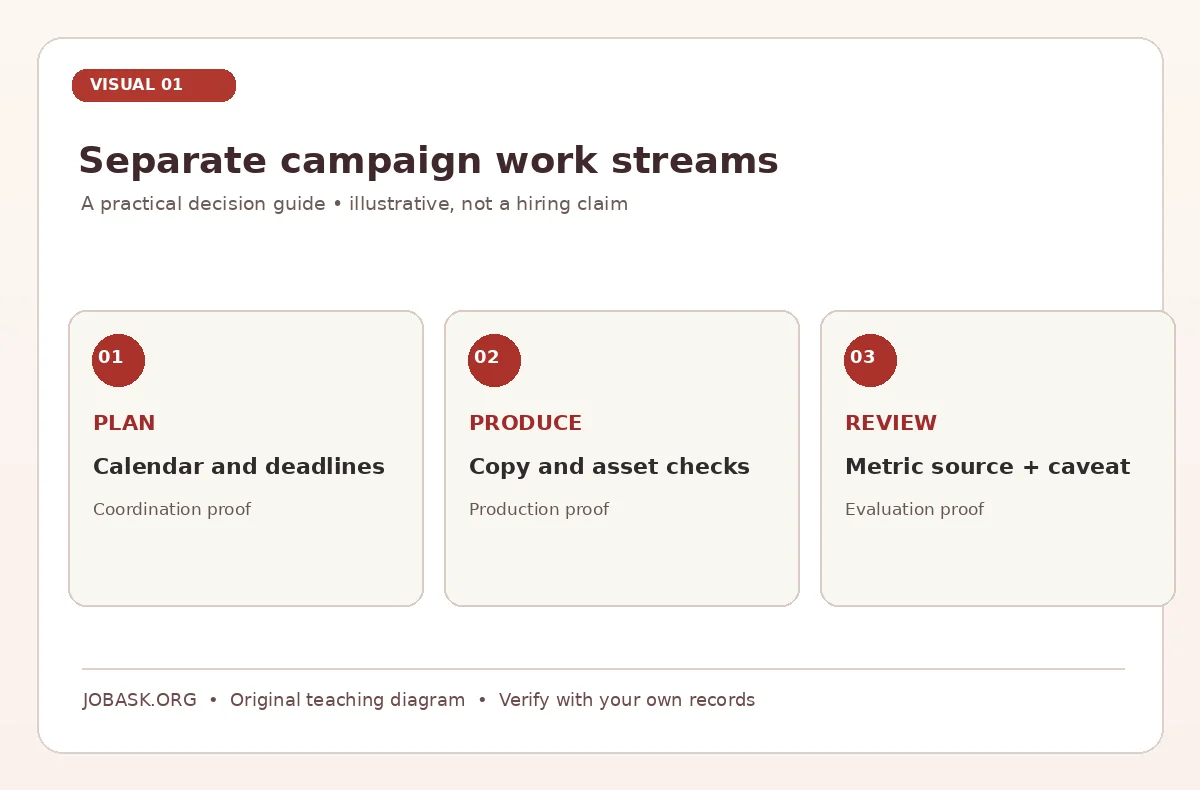
Show campaign planning as a repeatable process
Marketing coordinators are often judged by whether the right asset reaches the right reviewer at the right time. Describe how you organized drafts, tracked approvals, checked links and noticed blockers before a deadline. A simple spreadsheet can demonstrate this process just as well as a branded project-management tool when that is what you actually used. Your letter can briefly connect your method with the opening’s need for organized execution.
For example, you might explain that you maintained a list of asset owner, version, approval status and scheduled release. If that is theoretical rather than completed experience, mark it as a plan you would follow, not a past achievement. Do not write “I streamlined the production workflow” unless you know what changed. More concrete verbs—maintained, reviewed, flagged, confirmed—carry less ambiguity and permit useful follow-up questions.
Discuss measurement without fabricating outcomes
If you measured campaign results, state the metric, time frame and source, but only when you can verify those details. A class project may involve comparing clicks or survey responses; identify it as coursework rather than client consulting. Where you have no access to real performance data, demonstrate reasoning: define the campaign question, choose a relevant measure and explain a limitation. BLS describes analysis and reporting for market research analysts, but not every marketing coordinator is a data analyst.
A careful sentence might read: “For a hypothetical practice campaign, I would check whether the sign-up page links worked before evaluating registrations.” That is an intention, not a performance claim. Never insert a percentage lifted from an online sample letter. Describe what you can honestly interpret, what requires approval and what the results cannot prove. A practical campaign letter is credible because it avoids confusing correlation with your personal contribution.

Write for a particular team rather than any brand
Tailor one sentence to the organization’s actual published product, audience or channel if you have confirmed it. Avoid flattery based on a guessed brand mission. If the posting highlights coordination between design, copy and events, discuss the communication step that prevents missed approvals. If it emphasizes social media, name a genuine content calendar or moderation experience instead. The aim is a precise reason for applying, supported by public information you have read.
Do not borrow an impressive-sounding example from a fabricated brand case study. Hiring teams can ask who owned the campaign and how the results were measured. Use source-backed public descriptions of marketing work for context but do not claim they describe this employer. Replace broad compliments such as “industry leader” with a neutral fact about the role that genuinely matters to you.
Rework a sample marketing cover letter
Hypothetical letter: “Dear Hiring Manager, I am applying for the Marketing Coordinator role. For a student-organized event, I maintained a checklist of outreach assets, collected approval on final copy and verified that the registration link worked before our announcement. My contribution was the publishing handoff, not the campaign strategy or budget. The role’s emphasis on timelines and cross-team coordination fits that experience. I would welcome the chance to learn your team’s tools and approval process. Thank you for considering my application. Sincerely, [Applicant Name].”
The sample contains no actual employer or results. Its purpose is to demonstrate honest ownership, not to prescribe identical language for every applicant. If you have an internship, cite the relevant work and keep team responsibilities accurate. If you have only coursework, name it as coursework. Also, if you produced measurable results, include only verified data, its context and a proportionate explanation of your involvement.

Check creative claims and final deliverables
Before submitting, compare job requirements with your example and ask whether the letter proves coordination, writing, analysis or a combination. Verify every brand, time frame, tool and outcome. Remove fake portfolio links and any unsupported statement about campaign impact. Look closely at adjectives such as strategic and data-driven: they are meaningful only when your action supports them. A short realistic letter is preferable to a crowded list of marketing buzzwords.
Review whether you have permission to share project details; internal campaign plans and personal data might be confidential. If you link a portfolio, make sure the link is public and belongs to you. Check spelling, employer name and job title. Finish with a courteous invitation to discuss relevant work, not a promise that your cover letter will raise conversions or secure an interview.
| Requirement | Example of genuine evidence | Boundary to preserve |
|---|---|---|
| Calendar management | Maintained status, owners and deadlines | Do not claim campaign leadership |
| Approvals | Verified correct draft and reviewer | Respect actual team roles |
| Campaign reporting | Explained a real measure and source | Do not fabricate ROI or clicks |
| Portfolio | Linked work you own and may share | Protect unpublished materials |
How We Research and What Remains Unverified
For the marketing-coordinator guide, we used BLS material on analysis and reporting only to clarify the adjacent analytical dimension—not to claim that all coordinators are analysts. UC Davis and Santa Clara provided guidance on tailoring and evidence-based examples; Miami supplied the requirement-matching practice. Original hypothetical briefs and assets avoid company-specific facts.
Research sources checked October 20, 2026: BLS discusses data collection, analyzing campaigns and converting findings into reports for market research analysts; these tasks can inform marketing evidence without implying every coordinator performs the same role. UC Davis explains that an effective cover letter connects a candidate’s own evidence to the employer’s stated needs. Santa Clara University recommends specific personal examples, revision and factual self-presentation in cover letters. Miami University’s career guidance connects selected job requirements with relevant examples rather than broad claims.
Affiliate disclosure for cover letter for marketing coordinator: these are editorial learning sources, not confirmed paid endorsements or approved commercial partners. This guide contains no affiliate links. Read the JobAsk affiliate disclosure and independently confirm third-party offers before considering a commercial service.
More Resume and Cover Letter Guides
- Marketing Coordinator Cover Letter: Link Campaign Work to Reliable Reporting
- Project Coordinator Cover Letter: Prove Handoffs, Tracking, and Escalation
- Event Coordinator Cover Letter With No Experience: Prove Planning and Handoffs
- Project Coordinator Cover Letter: Show Milestone Tracking and Clear Updates
- Social Media Marketing Cover Letter: Connect Content to Evidence
One verifiable campaign-planning, content handoff or measurement example aligned with the job description.
Yes. Name coursework or student activities clearly and distinguish them from paid client work.
Only when you have records and can accurately identify your contribution and the relevant measurement period.
No. Read the exact posting; some roles emphasize production, coordination, events or approvals over analysis.
Use a working public link to work you are allowed to share and explain your precise contribution.