
Entry-level public health jobs are not one uniform occupation. Community outreach workers, program assistants, data-support staff and health education specialists may work toward similar community goals but have different entry requirements and decision rights. A beginner should compare duties, supervision and local credentials before applying. BLS describes community health work as outreach and resource connection, whereas health education specialist roles commonly expect at least a bachelor’s degree. This article helps you pick a realistic starting route without claiming clinical or public health authority you have not earned.
Separate community outreach from professional specialist roles
Start by comparing community health worker, outreach assistant, program support assistant and public health office coordinator. Outreach work may include scheduling events, connecting community members to services, following approved materials and reporting observations. Health education specialist, epidemiologist and other professional roles can involve program design, analysis or advanced education. BLS indicates that health education specialists generally need at least a bachelor’s degree; community health workers commonly enter with a high school diploma and training, but requirements and state certification rules vary.
A job title can mislead. A “health educator assistant” may prepare approved handouts and attendance lists, while a “health educator” might design and evaluate interventions. Mark each vacancy with its exact entry requirements, client-contact expectations, travel or evening events, language needs and supervision. If the listing asks for professional credentials you do not have, consider adjacent program-support work rather than claiming that a weekend course grants professional status.
Choose an employer and the population it serves
Community health departments, nonprofit outreach organizations, hospitals and public health contractors may have different audiences and service models. Read whether the role supports vaccination outreach, nutrition education, maternal health programs, chronic-disease navigation or administrative reporting. Note where the work occurs: office, clinic reception, neighborhood events, schools, or multiple locations. A schedule labeled full time may still involve weekend events or travel; verify those requirements.
Research the actual employer and program before tailoring your application. A credible position should identify a department or organization and a clear function, not just “help people remotely for excellent pay.” Keep a short evidence card: target population, services delivered, type of records handled, supervisor, training and who is responsible for clinical decisions. This is more useful than memorizing a list of public health job titles.
Know the difference between support and medical advice
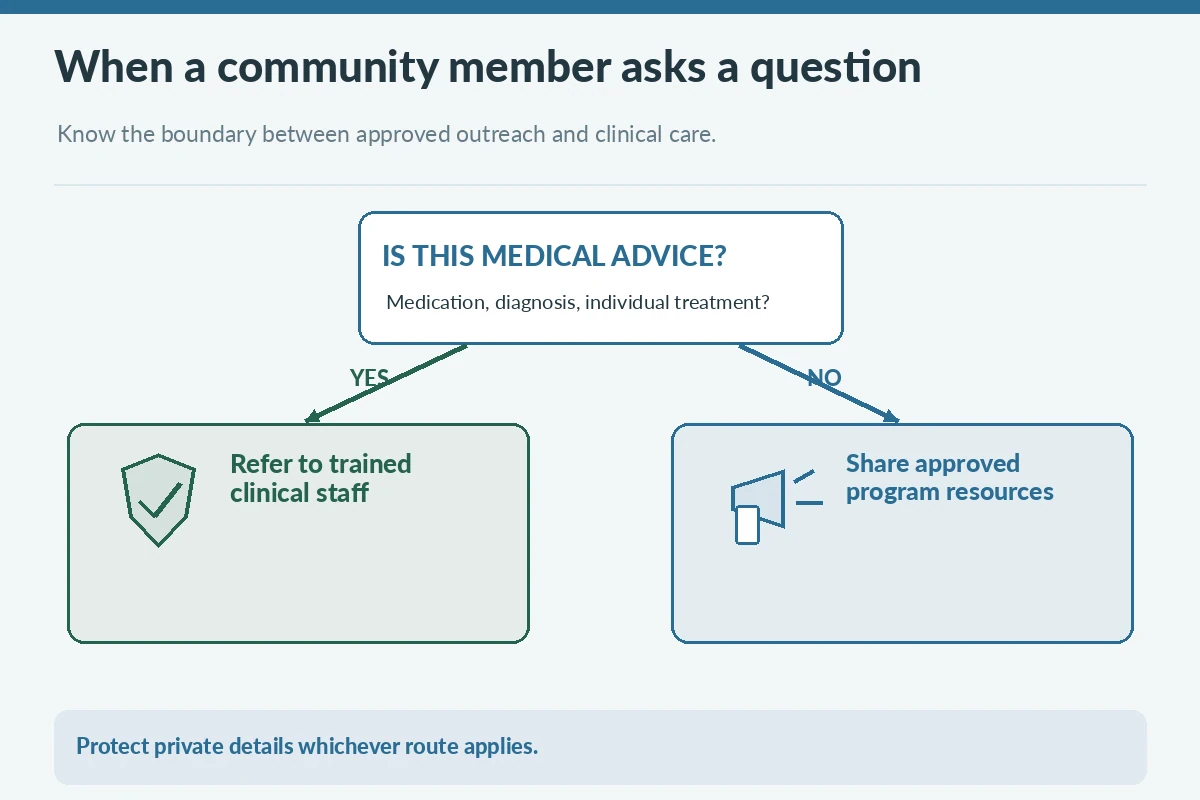
An entry-level outreach worker can communicate approved information, help people find services and document referrals. That does not authorize an individual to diagnose a condition, interpret medical test results or create medical recommendations. A safe workflow is to listen to the question, share approved resources within training and refer clinical or urgent matters to qualified professionals using the organization’s established route.
For example, at a hypothetical neighborhood event a resident asks whether a medication should be stopped. The appropriate beginner response is not a personal treatment plan. Explain that the worker cannot advise on medication decisions and route the question to a licensed care team or approved clinical resource. In a resume, describe “distributed approved health materials” rather than “counseled patients medically” if your actual experience was community outreach.

Build evidence from events, records, and community service
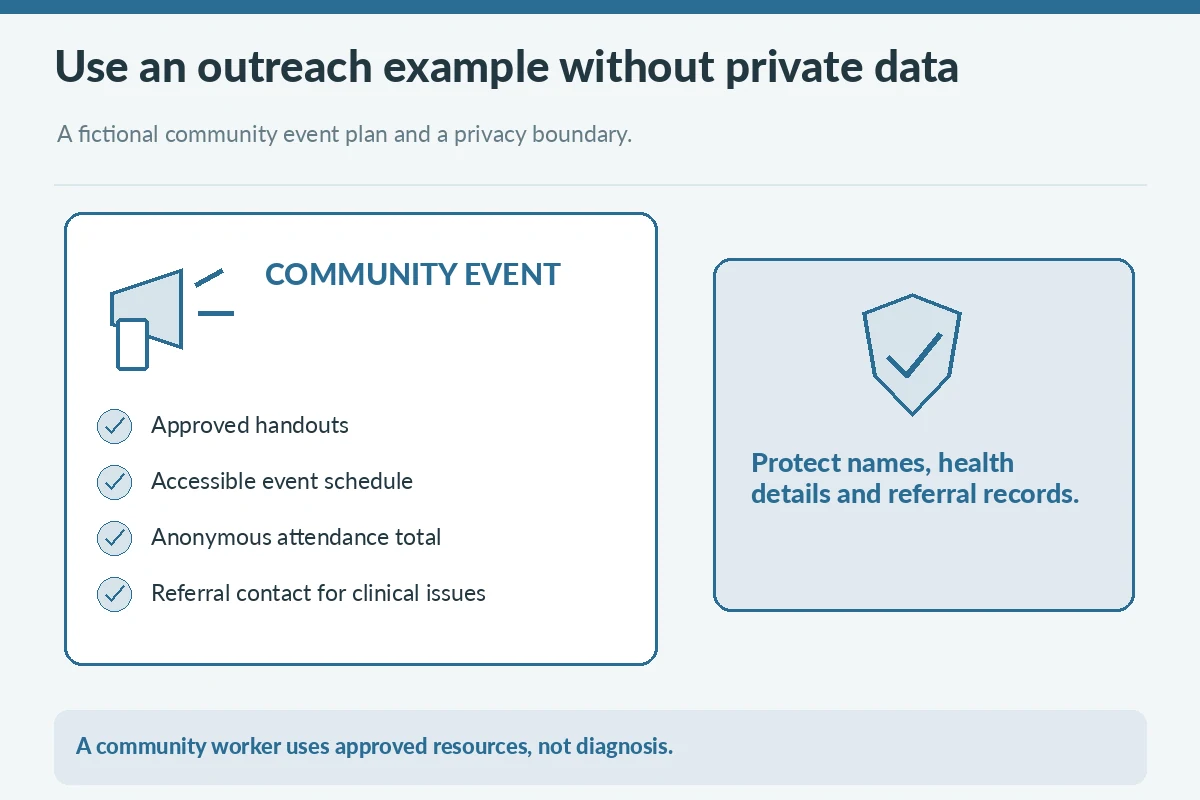
Transferable experience may include coordinating a school food drive, preparing multilingual event information, maintaining volunteer attendance records, checking forms for missing fields or organizing accessibility accommodations. Focus on the task and your part: “Prepared 40 participant packets using an approved checklist and escalated missing consent forms to the coordinator” is an illustrative style, not a result to claim unless it really happened. If you have no such experience, run a clearly labeled fictional event-planning exercise.
A portfolio can show an event timeline, a mock outreach flyer using general public information, or an anonymized participation tracker. Do not publish names, health information, contact lists or images of clients from a clinic or nonprofit without a lawful basis and appropriate permission. In an interview, explain how you handled consent, uncertainty and referral boundaries instead of overstating how much health knowledge you possess.
Check state training and certification separately
BLS reports that some states require certification for community health workers. Employer requirements may also include language skills, a driver’s license, relevant coursework, background screening or an approved training pathway. These are not interchangeable. A public health degree can help for some roles, but it does not replace a required license, and a community health worker credential is not automatically permission to provide clinical care.
Open the job posting and highlight every required qualification. Then verify any credential with the appropriate state health or professional board, if applicable. A posting for a health education specialist may have a different education expectation from an outreach assistant. If you are still in training, use the exact phrase “in progress” and a truthful completion date, rather than using the credential acronym as though it has already been awarded.
Write an application that fits the program’s task
For a program assistant, lead with reliable scheduling, documents, communication and event support. For outreach support, lead with respectful communication, knowledge of available community resources and careful handling of referrals. A hypothetical opening sentence could be: “I am interested in the Outreach Assistant position because I have experience coordinating volunteer events and using approved information to guide participants to services.” Replace the example with an action you actually performed.
Choose two job requirements and show one concrete action for each. Explain your exact role in group projects: an attendance spreadsheet you maintained, an outreach calendar you helped schedule or a flyer you revised following supervisor feedback. Do not invent impact metrics, patient outcomes or public health credentials. If the employer wants a writing sample, use a public-source practice piece rather than a private program document.
Ask about supervision, privacy, and reporting
Useful questions include: “Who approves outreach materials?” “What questions must be referred to clinical staff?” “Which client details should be recorded, and in what system?” and “Is evening or field work expected?” In some programs the new hire follows an existing script; in others the assistant helps draft materials for review. That difference affects training and job fit.
Clarify how the organization measures success without confusing activity counts with health outcomes. Attendance, completed outreach contacts and timely referral logs may be valid operational evidence. A beginner usually should not promise reduced disease rates based on a small event. Ask who evaluates the program and how privacy is protected in attendance, survey and referral records.
Avoid misleading vacancy claims and keep a useful tracker
Check health department and nonprofit career pages from independently confirmed domains. FTC guidance warns against unsolicited recruiting messages and demands for money. An authentic program may ask for a background check through a defined hiring process, but do not send government IDs, medical records or banking details to an unverified messenger. A paid certification package sold by an unknown recruiter is not proof of a job.
Track the role title, audience, certification rule, application channel and interview follow-up. Review whether the posting actually needs a specialist or a support worker. Building this comparison across several openings usually produces a more accurate shortlist than applying to every vacancy labeled public health. It also gives you a useful set of questions for networking or an informational interview with the program team.
| Role or task | What to verify | Boundary to respect |
|---|---|---|
| Outreach assistant | Events, referrals, approved materials | Send clinical questions to qualified staff |
| Program support | Schedules, forms, reporting | Protect participant records |
| Health education specialist | Program design and education | Verify degree and credential requirements |
How We Research Entry-Level Job Routes
We checked the occupational scope in public O*NET and U.S. Bureau of Labor Statistics resources or the relevant credential and safety authority, then compared the topic with the supplied JobAsk WordPress post inventory and recent draft batches on 2026-11-05. Job descriptions vary by employer, location and training pathway. Illustrative projects, questions and resume lines in this article are examples, not actual employer outcomes, openings or guaranteed placement results. For information about commercial relationships, read the JobAsk affiliate disclosure.
Primary sources reviewed 2026-11-05: U.S. Bureau of Labor Statistics — BLS describes community health worker duties, training and varying state certification.; U.S. Bureau of Labor Statistics — BLS describes health education specialist educational expectations.; O*NET OnLine / U.S. Department of Labor — O*NET describes health education program functions and occupational scope.; Federal Trade Commission — FTC documents fake recruiting texts and payment requests; a job seeker should verify an employer independently.. These references describe occupational expectations or safety guidance, not current open vacancies or permission to perform regulated tasks.
Related Job Search Guides
Some outreach and program support roles accept other education and relevant experience. Specialist occupations may have specific degree expectations; read each posting.
No. The role often connects community members to resources and supports programs; it is not automatic authority to diagnose or prescribe.
Requirements vary. BLS notes that some states require certification. Verify the rule for the state and employer.
Careful event coordination, respectful communication, accurate records, multilingual outreach when genuine, and evidence of confidentiality are useful for many support openings.
Use verified health departments, hospitals and nonprofit employer career pages; compare audience, supervision, training and schedule before applying.