
Entry-level sterile processing technician jobs involve carefully controlled cleaning, preparation, sterilization, storage and distribution of reusable instruments in healthcare facilities. The work affects patient safety and requires training, equipment-specific procedures and documented checks. O*NET groups these jobs under medical equipment preparers; CDC publishes sterilization guidance. HSPA’s CRCST certification has a specific examination and hands-on experience requirement, so a course completion certificate is not automatically CRCST certification. This guide helps you compare trainee postings, understand supervised tasks and verify credentials without assuming a beginner can release surgical instruments independently.
Identify trainee jobs and the sterile processing department
Search for sterile processing technician trainee, central service technician, sterile processing assistant, instrument processing technician and central supply technician. Read whether the employer requires CRCST at hire, permits certification within a stated period or provides supervised training. Job titles vary, and not every sterile supply role includes instrument reprocessing. A central supply clerk may focus on inventory and deliveries while a sterile processing technician works with specified reprocessing equipment and instruments.
O*NET describes medical equipment preparers as workers who clean, sterilize, inspect and prepare medical equipment. It lists tasks such as checking supplies, recording sterilizer results and assembling trays. These are occupational examples, not a universal permission for an untrained worker to do each task. A candidate should ask for the site’s training protocol, the functions a new hire may perform, the assigned educator and how competence is documented.
Understand the sequence without treating it as a DIY instruction
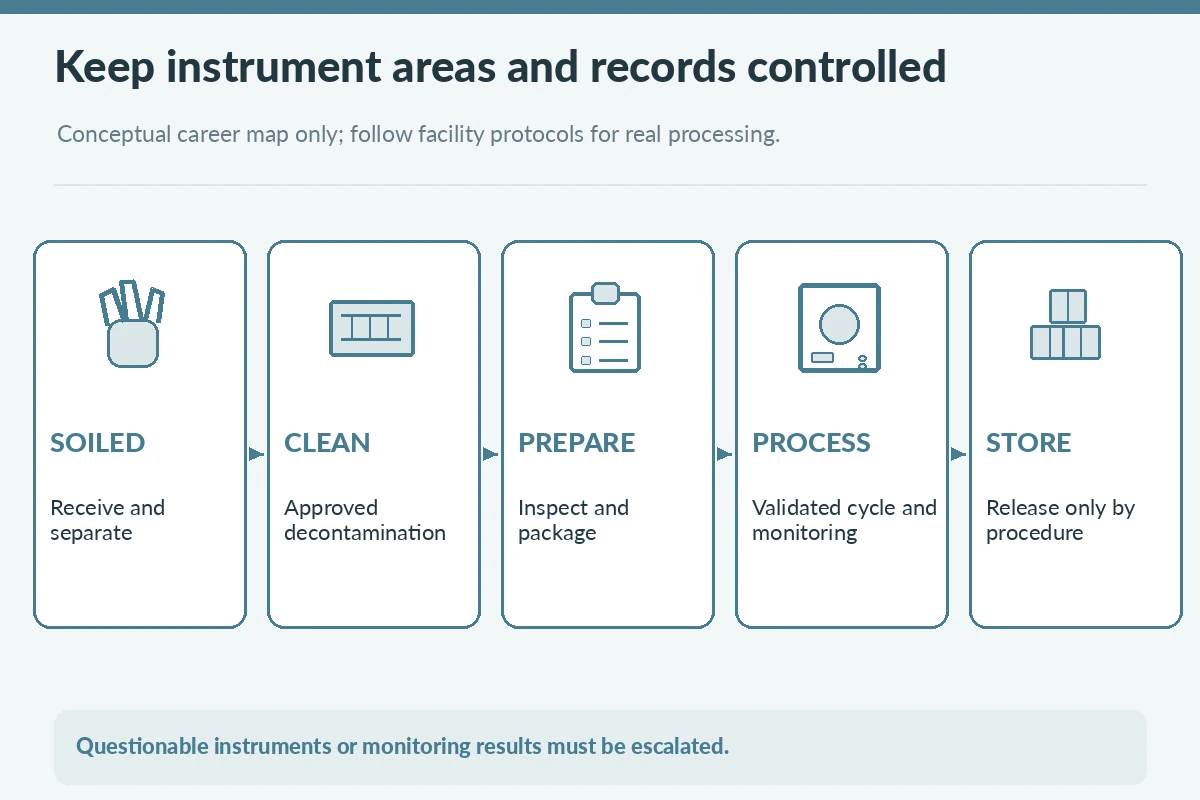
Sterile processing typically has controlled stages including receiving used items, decontamination, inspection, assembly, packaging, the facility’s validated processing cycle, monitoring, storage and distribution. CDC emphasizes proper cleaning before high-level disinfection or sterilization and adherence to device and equipment instructions. Actual processing steps, chemicals, cycle selections and monitoring decisions must follow the facility’s approved procedures and manufacturer instructions; a general career guide is not a work instruction.
In an interview you can describe the importance of separating contaminated and clean workflows, recording the outcome of required checks and not releasing questionable instruments. You should not claim that a familiar cleaning method or an online video qualifies you to process reusable surgical devices. Beginners should know how to stop, label and escalate when a package, test result or instrument condition does not meet the facility’s documented criteria.
Check CRCST hours and provisional wording carefully
HSPA explains that CRCST requires passing its examination and 400 hours of hands-on experience. It allows provisional certification for a person who passes the exam before completing the hours, but those hours must be documented within six months under its current rules. The provisional path does not waive the experience requirement. The certification’s specific experience categories and supervisor documentation are described by HSPA; do not substitute an arbitrary class certificate or self-recorded log.
If a posting mentions CRCST, ask whether it requires full certification at hire or considers candidates pursuing it. A candidate who has passed the exam but has not completed verified hours should state the provisional status accurately. Never write “CRCST certified” if the required status has not been awarded. Check current HSPA guidance and any applicable local registration, licensing or employer rules before spending money on training.
Distinguish employer training from outside course advertising
A legitimate training path should explain where practical experience happens, who supervises it and whether the employer can document the hours needed for the chosen credential. HSPA states that it does not provide placement services and that the applicant is responsible for arranging qualifying hands-on hours. This matters when a private course implies that paying tuition automatically secures clinical access or an endorsed certification.
Before enrolling, ask whether the course provides classroom instruction only or includes a confirmed supervised department placement. Verify its claims directly with the credential issuer and potential employer. An academic completion certificate may demonstrate study, but it does not replace CRCST examination, documented experience or workplace competency checks. Treat placement guarantees, inflated wages and urgent payment demands as claims needing independent verification.

Show relevant evidence without claiming sterile competence
For someone entering from food service, manufacturing or cleaning, useful transferable evidence includes following written procedures, correct labeling, inventory tracking and reporting equipment problems. These are not equivalent to sterile instrument processing, but they can demonstrate reliable habits. A hypothetical resume example is: “Maintained traceable supply records, identified damaged packaging and reported exceptions to a supervisor under established procedures.” Use that only if it describes actual work.
For practice, create a fictional inventory log that records item ID, location, status and escalation owner without including patient details or actual sterilizer data. Do not publish facility instrument photos, process parameters or internal logs without authorization. Interviews can also test whether you are willing to seek help when a required indicator or record is missing; that answer is more credible than pretending you could troubleshoot independently with no training.
Ask about PPE, hazards, and stop-work procedures
An entry-level posting should allow questions about required protective equipment, training for sharps and biological hazards, segregation of work areas and what happens when a load or instrument fails inspection. The CDC recommends that reprocessing programs use appropriate training, monitoring and quality controls. Details belong to the employer’s trained staff and policies; this article does not provide chemical handling instructions or equipment operating settings.
Questions to ask: “What supervised competencies must I complete before handling instruments independently?” “How are incorrect or questionable results quarantined?” “Who signs off training?” and “What is the shift and call coverage?” A beginner should never be pressured to bypass the established reprocessing protocol or conceal a failed check. Patient safety is more important than appearing fast.
Compare shifts, hospital expectations, and advancement
Sterile processing teams may support operating rooms and other departments with demanding schedules. Some openings require evening, overnight, weekend or rotating coverage. Check standing or lifting requirements, controlled-area access and whether there is a dedicated trainer. A trainee job with clear skills assessment may be more suitable than a posting that expects independent cycle release from the first week.
Career advancement can involve broader instrument sets, quality documentation, specialized credentials or leadership responsibilities, but not every employer offers the same pathway. Ask about the expected timeline to complete the practical experience requirement and whether that schedule is feasible. Do not assume that obtaining an online certificate guarantees a job, a particular schedule or a promotion.

Apply through verified employers and record requirements
Use verified hospitals, surgery centers and healthcare employer career pages. FTC warnings about job scams apply even to clinical-adjacent jobs: be careful about unofficial recruiters who demand payment or sensitive identity files before a legitimate hiring process. A real organization should explain its role requirements and provide an established way to ask about credential verification, supervised experience and training.
Maintain an application tracker containing job title, facility, required credential status, training, shift, safety expectations, earliest start and actual hiring contact. Save exact copies of the qualifications listed when you apply. If you lack the required hands-on hours, be transparent and ask whether the employer supports a trainee route. A safe application emphasizes attention to process and willingness to learn under supervision, not unsafe promises of independent instrument handling.
| Role or task | What to verify | Boundary to respect |
|---|---|---|
| Trainee posting | Supervision and instrument training | No unsupervised procedure claims |
| Provisional CRCST | Passed exam, hours not yet documented | HSPA six-month hours rule |
| Full CRCST | Exam and approved hands-on hours | Verify current credential status |
How We Research Entry-Level Job Routes
We checked the occupational scope in public O*NET and U.S. Bureau of Labor Statistics resources or the relevant credential and safety authority, then compared the topic with the supplied JobAsk WordPress post inventory and recent draft batches on 2026-11-05. Job descriptions vary by employer, location and training pathway. Illustrative projects, questions and resume lines in this article are examples, not actual employer outcomes, openings or guaranteed placement results. For information about commercial relationships, read the JobAsk affiliate disclosure.
Primary sources reviewed 2026-11-05: O*NET OnLine / U.S. Department of Labor — O*NET describes medical equipment preparer tasks and relevant job titles.; Centers for Disease Control and Prevention — CDC details controlled cleaning, monitoring, and reprocessing safety recommendations.; Healthcare Sterile Processing Association — HSPA explains CRCST examination, 400-hour practice requirements and provisional status.; Federal Trade Commission — FTC documents fake recruiting texts and payment requests; a job seeker should verify an employer independently.. These references describe occupational expectations or safety guidance, not current open vacancies or permission to perform regulated tasks.
Related Job Search Guides
Some employers post trainee roles, while others require certification at hire. Check each posting and the facility’s training policy.
No. HSPA requires the exam and documented hands-on experience to receive full CRCST status.
Under HSPA rules, someone who passes the exam before finishing the required 400 hours may be provisional, with a deadline to document the hours.
Not without clear authorization. Use fictional inventory examples instead and protect facility and patient information.
Ask which tasks require direct supervision, how competence is documented and who must handle questionable instrument or monitoring results.