
A strong job fair application email identifies the real vacancy or approved hiring contact, supplies one verifiable example, and makes the next step clear. The useful detail for this situation is a conversation-to-application checklist distinguishing a thank-you note from the formal application the recruiter requested. Do not treat an email as a substitute for an application portal if the posting requires one. Read the instructions before sharing documents or personal information.
Choose the correct application channel first
Before writing, open the employer’s own posting, save the official role title, and note the submission method. For a job fair attendee, different messages may be needed for a published vacancy, a verified recruiter reply, and a general inquiry. These are not interchangeable. An email may accompany an application, ask one specific process question, or serve as the application only when the employer explicitly says to email it. Keep a copy of the announcement so you can explain exactly why you contacted the organization.
Prepare a simple four-part check: write what was said, confirm contact, check opening details, submit and follow up. If the posting lists a closing date or required documents, follow those directions. Do not include an unrequested government ID, bank account number, or private records. The FTC has documented scams in which people impersonate recruiters and ask for sensitive information before a legitimate hiring process. Verify the recipient through a known official channel rather than relying only on the address supplied in an unexpected message.
Reconstruct the actual conversation before writing
Immediately after a job fair, write down the employer, recruiter name if supplied, job title, one detail discussed, and any next step that was promised. A generic “Great talking to you” message is easy to forget. A useful email identifies the precise conversation, for example a question about shift handoffs, training, or team responsibilities. Only mention details you actually heard, rather than attributing statements to a recruiter you cannot verify.
If you did not get a business card, use a recruiter contact listed through the event organizer or employer rather than guessing someone’s address. Some event representatives intentionally do not distribute direct emails. In that case, the appropriate next step may simply be to apply through the employer’s website and record the interaction for a future interview. Never imply that a short encounter guaranteed a referral or invitation.
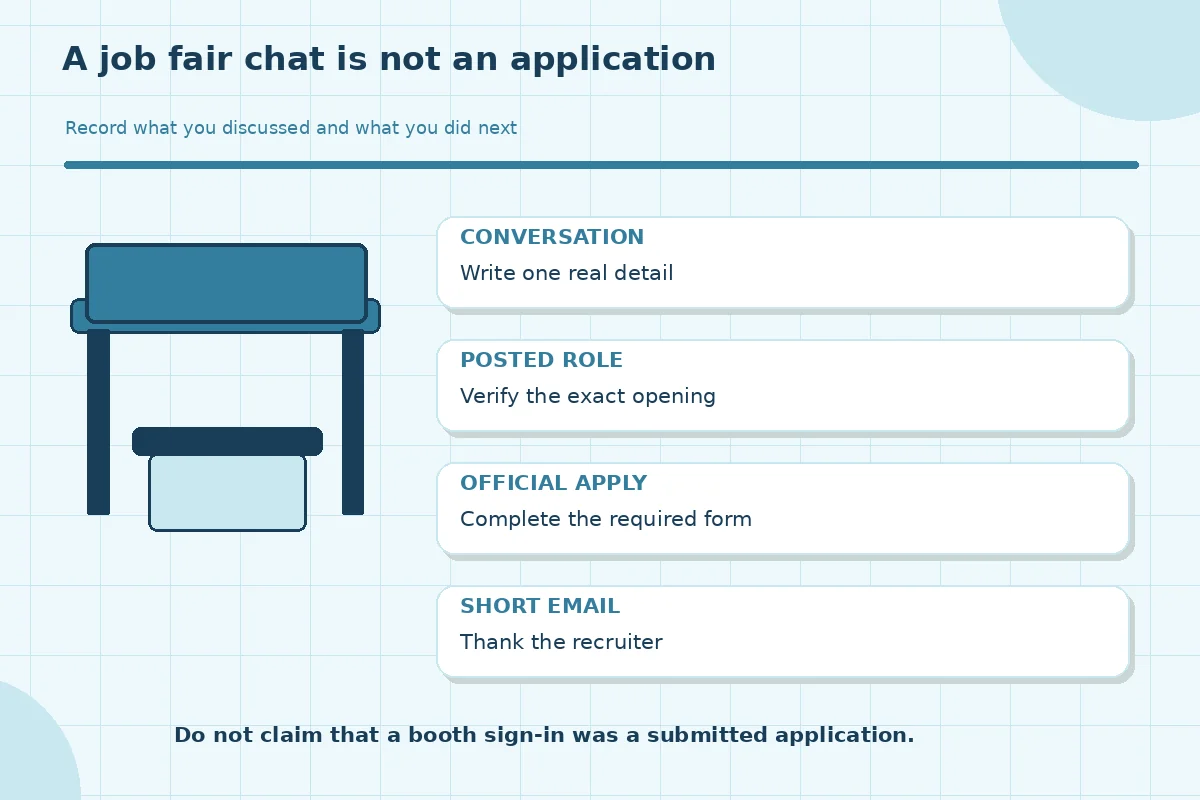
Distinguish a thank-you note from a formal application
University career centers recommend following up after a fair and applying to relevant openings. The email reminds the contact of the conversation; it usually does not replace an application submitted through the employer’s defined process. Check whether the job was already posted, whether the recruiter handed out an approved link, and whether the event used an application kiosk that actually submitted a record.
If the recruiter said “apply online,” submit the official form before writing “I applied.” A sign-in sheet or QR code at a booth may be for event attendance only; it does not necessarily create a job application. If you are unsure, check the careers portal for a confirmation or ask a narrow question about the next step. Do not resubmit your personal information to a link that looks unrelated to the real employer.
Adapt a short email example without inventing experience
Here is an illustrative message to adapt, not a real applicant record. Subject: Thank You — Career Fair / Laboratory Assistant Opening. Hello Recruiting Team, Thank you for speaking with me at Thursday’s campus career fair about the laboratory assistant opening. Your explanation of the sample logging and shift handoff tasks was useful. In a supervised class lab project, I maintained a clear sample log and documented discrepancies for review. As you suggested, I submitted the official application for the opening on your careers page. Please let me know if any additional public application materials are needed. Thank you again for your time. The example is deliberately modest: it identifies a role, gives one concrete contribution, and ends with a clear next step. Replace every date, title, skill and attachment statement with information you can defend. Never claim to have submitted a form unless you completed it.
A useful quality test is to compare two sentences. Too broad: “It was great meeting you. Please hire me for anything.” More accountable: “Thank you for discussing the laboratory assistant opening at Thursday’s campus fair. I applied through the careers page as you advised.” The latter contains a detail a recruiter can check or ask about. If your own history differs, do not copy the stronger sentence literally. Use the same structure—specific circumstance, truthful action, realistic boundary—to describe what you have actually done.

Write a note with one memorable point and one relevant example
The email can fit into three concise parts: identification of the event, a genuine detail from your discussion, and the next action taken. For example, if a recruiter discussed record accuracy, mention a verified example of tracking or checking work. Your subject line should connect the event and specific role. Use a professional sign-off that includes your name and a contact method already present in your application.
A hypothetical message might read: “Thank you for discussing the laboratory assistant opening at Thursday’s campus fair. Your explanation of the sample-logging process helped me understand the role. I completed the official application as suggested and would be glad to discuss my supervised lab experience.” Replace the event and work details with your own truth. Never disclose actual research participant data or institutional records in an email example.
| Message element | What to include | What to avoid |
|---|---|---|
| EVENT NOTE | Write what was said | Guessing the posting |
| REAL CONTACT | Confirm contact | Promising a role |
| POSTED ROLE | Check opening details | Invented credentials |
| APPLY + THANKS | Submit and follow up | Replacing required forms |
Handle resumes, links, and timing carefully
If the recruiter explicitly requested a resume by email, attach the correct file and make sure it opens. If the employer requires an application portal, do not attach a second resume automatically. Check that your email address, portfolio link, and name are consistent across the resume and application. Avoid attaching sensitive documents such as licenses with identifying numbers or personal ID scans unless a legitimate process later requires them.
Send your follow-up while the meeting notes are fresh, but follow any timing instructions the recruiter gave. There is no magic hourly window that guarantees attention. Some recruiters meet many candidates and cannot respond to every message. A lack of reply does not confirm or reject your formal application. Watch the official status channel and avoid sending repeated identical notes to everyone who attended the employer’s booth.
Make a next-step record rather than a promise
Track the job-fair date, employer, contact source, exact vacancy, official application date, and any promised response. The tracking record helps you avoid mistakenly saying that you submitted an application when you only spoke to someone. If a recruiter introduces you to another employee, ask permission before using that person’s name as a referral. One conversation does not authorize claiming a personal recommendation.
Before sending the final email, read it for accuracy: Did you talk to this specific person? Is the role still open? Have you completed the required step? Is the claim about your experience demonstrable? A well-written follow-up thanks the recruiter, preserves the detail that mattered, and leaves the actual hiring process in the employer’s hands.

Make a final email check before sending
Read the subject line and message on a narrow screen, where long paragraphs are difficult to scan. Verify the exact title, the recipient, your dates, and the files you mention. A useful subject for this example is “Thank You — Career Fair / Laboratory Assistant Opening” only after replacing illustrative details with the real posting. Check that your signature uses contact information you are comfortable sharing. Add the recipient last to prevent an accidental early send.
If the employer’s instructions are incomplete, consider this narrow question: “Is there another official step after the application I submitted?” Do not send multiple versions of the same question to several employees. Save the message and any official receipt separately from unrelated applications. The principle is simple: be easy to identify, honest about your contribution, and careful about which action has actually been completed. That makes the email useful to the reader and to the receiving hiring team without promises of an interview or an offer.
How We Research Job Application Emails
JobAsk compared this topic with the supplied WordPress title inventory and the project’s prior draft batches, then reviewed current public guidance from CareerOneStop, career centers, and relevant consumer agencies on November 7, 2026. Illustrative emails use fictional applicants, job titles, and requisition numbers. None is a live vacancy or proof of a hiring outcome. Employer-specific instructions always govern. Please review the affiliate disclosure for information about site relationships.
Source: cloudfront.careeronestop.org — CareerOneStop explains that an email body can serve as a cover letter when an employer specifically requests emailed application materials.
Source: consumer.ftc.gov — FTC warns about impersonated recruiters, requests for financial information before hiring, and other job-email scam signals.
Source: cloudfront.careeronestop.org — CareerOneStop recommends noting recruiter details at job fairs and following up with a specific thank-you and next-step question.
Source: career.berkeley.edu — UC Berkeley Career Engagement advises a tailored thank-you after the fair, applying for the role, and notifying the recruiter once the formal application is completed.
Source: careerservices.fas.harvard.edu — Harvard’s 2026 career-fair guidance discusses collecting recruiter contact information and applying to matching openings after the event.
Related Job Search Guides
You may send a brief, relevant thank-you to a legitimate contact who shared details. Make clear that the formal application was completed online.
Use verified employer or event contact information; do not invent a name or guess a personal address.
Usually not when the posting requires a portal or another specific route. Follow the employer’s instructions.
Attach it if requested. Otherwise prefer the formal application route and avoid unnecessary duplicated files.
Name one actual topic you discussed and one action you took afterward. Do not claim a referral or recommendation that was not given.