
Remote job application email: A strong remote job application email identifies the exact opening, states one verifiable reason you fit, and addresses any location or time-zone restriction in the posting. It should not volunteer Social Security numbers, banking details, identification scans, or payment information. First verify that the opening exists on an official employer channel; then send only the materials the employer requested.
Check remote eligibility before writing the message
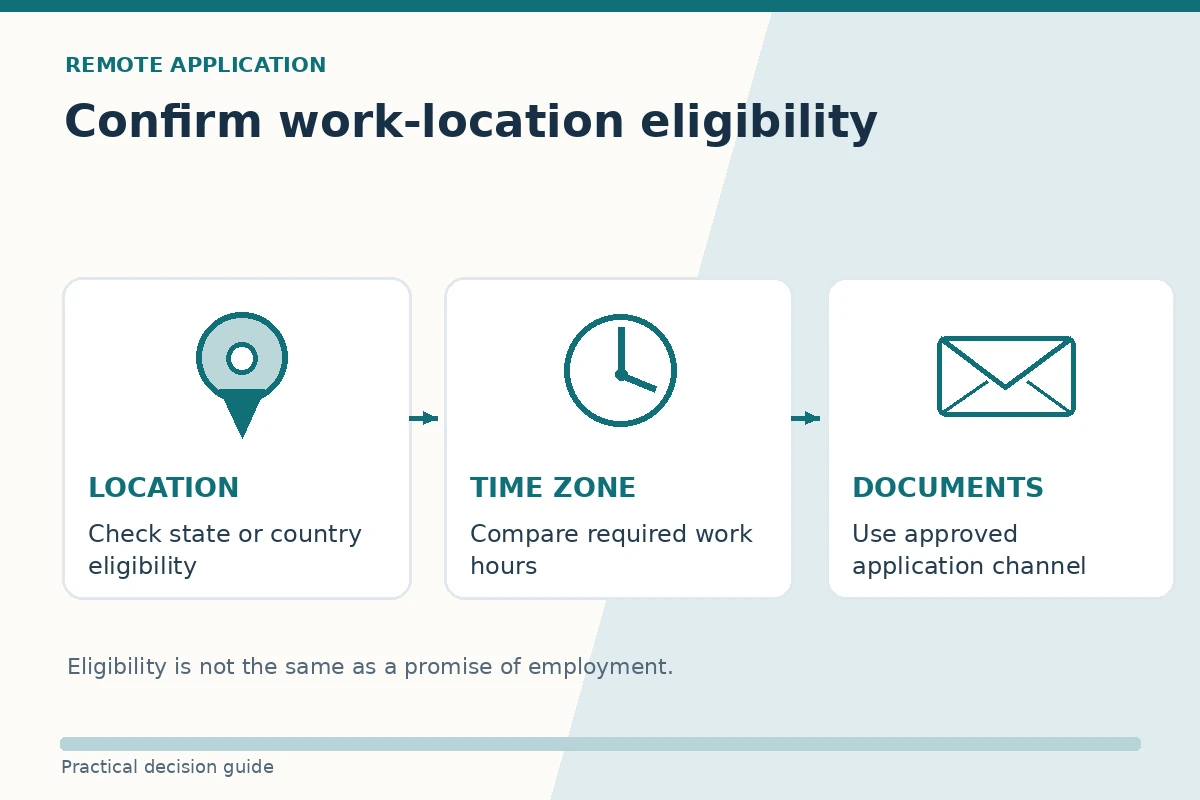
Remote does not automatically mean work from anywhere. The posting may restrict applicants to certain states, countries or time zones for employment, licensing, support coverage or operational reasons. Read the location field and the entire schedule section before you claim availability. If the posting says “United States only,” do not interpret this as permission to work from another country while traveling. If eligibility is unclear, ask the employer through its legitimate published contact route.
Translate the schedule into the time zone where you actually live. A role covering 9 a.m. to 5 p.m. Eastern Time can demand different local hours for applicants elsewhere. If the employer requires occasional onsite training or a particular network setup, check that obligation too. You can mention a confirmed fit in one short email line, but do not promise constant availability or equipment you have not verified.
Write a subject line that survives a busy inbox
Follow a prescribed subject format exactly, including reference numbers when provided. Otherwise, use the role title and your name: “Remote Support Associate Application — [Full Name].” A subject like “Available immediately!” makes the recruiter hunt for the relevant opening. Avoid adding claims such as “fully certified” or “experienced manager” unless your resume supports them. The subject should help an authorized recipient identify the vacancy and your attachment, not sell an invented outcome.
Use the employer’s stated application channel. Some listings require a portal even when a recruiter has an email address. In that case, submitting an unsolicited resume by email may not create a formal application. If a verified recruiter explicitly requests an email after a portal submission, say you submitted the form and attach a document only if invited. Keep a note of the actual submission confirmation; an outgoing email alone is not proof that the employer received it.
Connect actual remote tasks to the job description
Pick a task that answers a requirement: documenting customer requests, updating a shared tracker, explaining problems clearly, or working from written instructions. Mention where you learned it, such as an in-person role, volunteer project or remote assignment. A person who has never worked remotely can still explain how they keep accurate notes and manage deadlines, but should not call that a record of remote employment. Show the transfer without relabeling past jobs.
For example, “I maintained a shared request log and passed unresolved cases to the next shift” describes a checkable activity. “I guarantee 24/7 support from any location” is an unsupported promise. If the job deals with confidential information, do not send samples containing prior employer or customer data. A short anonymous workflow description is enough to establish the skill without breaching someone else’s access rules.
Use an example email built for remote applications
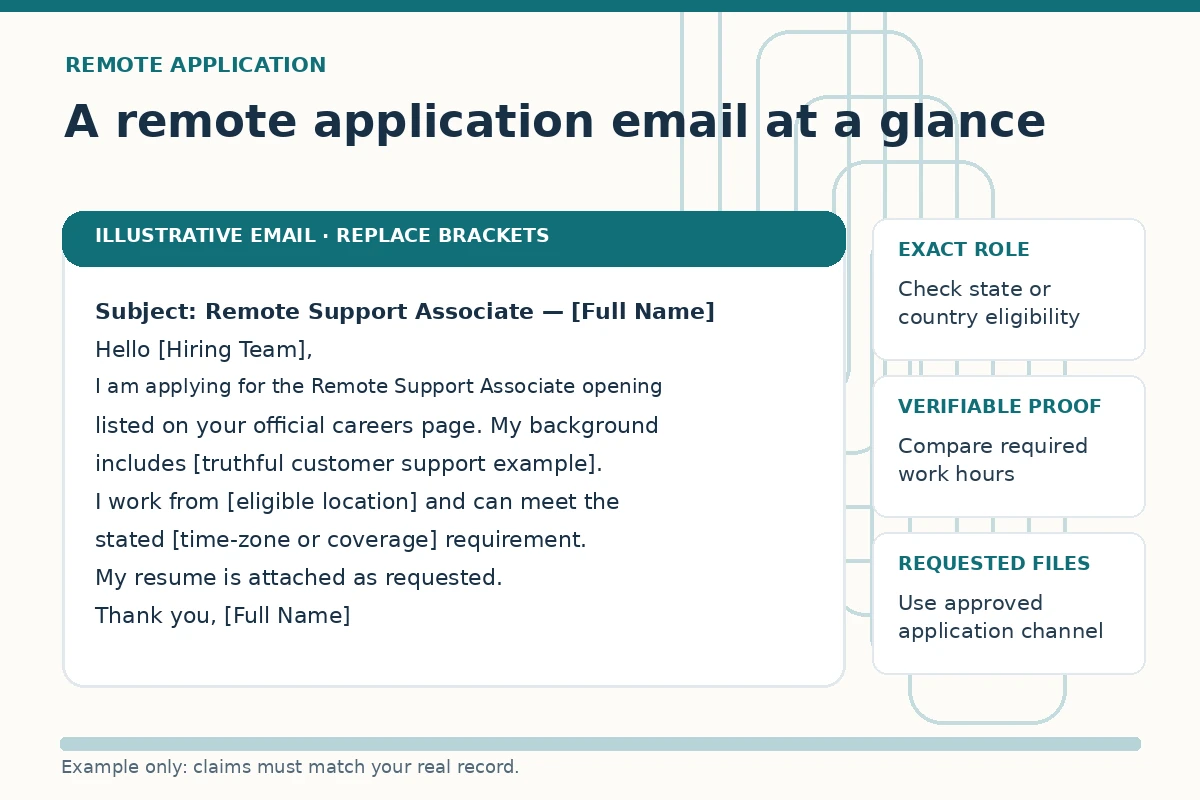
The illustrative email below assumes the employer allows email applications and the candidate truly meets the stated work-location requirement. Replace every bracketed item and verify the posting first. Subject: Remote Support Associate Application — [Full Name]. Message: Hello [Hiring Team], I am applying for the Remote Support Associate role listed on your careers page. In [relevant role or project], I documented requests and coordinated follow-up with [authorized team]. I am based in [eligible location] and can work the [stated time-zone coverage] schedule. I have attached my resume as requested. Thank you for considering my application. [Full Name].
If the posting does not give a schedule, omit the precise availability claim rather than invent one. If you need an accommodation or want to discuss a sensitive personal circumstance, you generally do not have to explain it in an unsolicited application email. Use the designated hiring process when appropriate. The point of this short note is to establish role, evidence, location fit and submission clarity, not to negotiate employment terms before anyone has responded.
Verify the recruiter and keep attachments limited
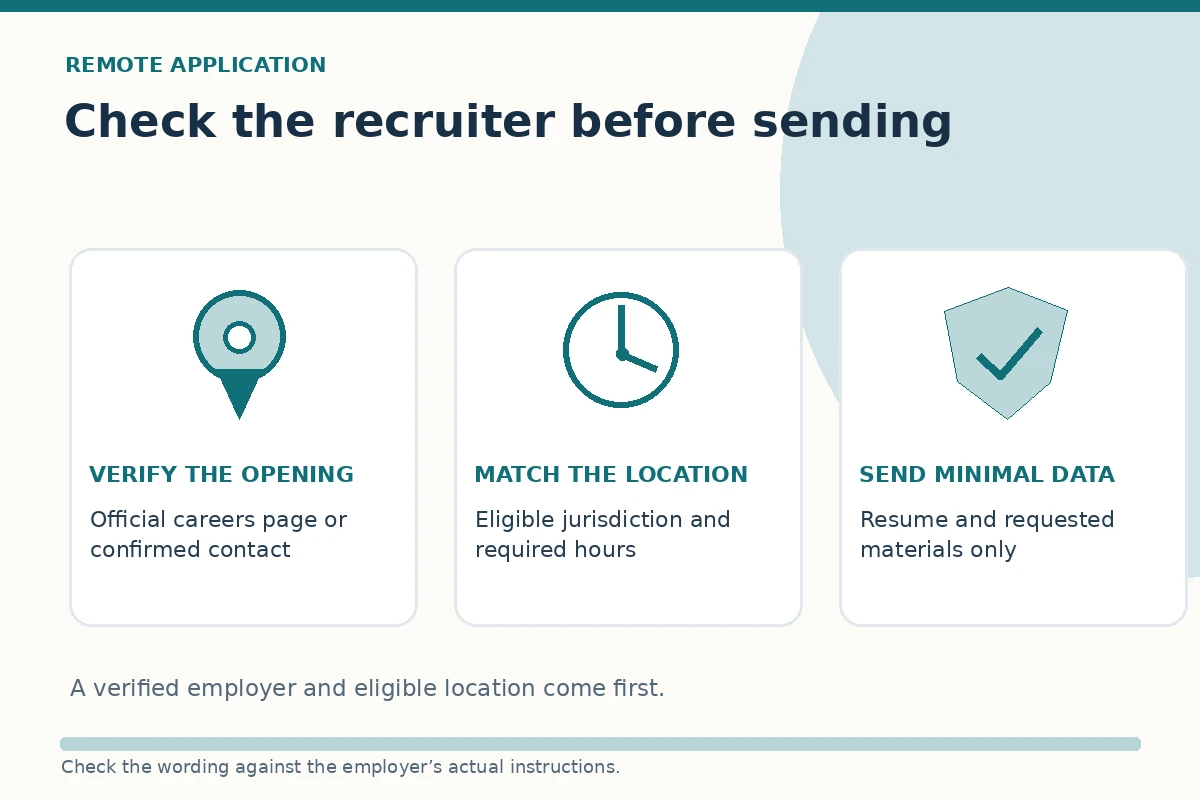
Check the company’s official careers page independently instead of trusting a link in a message or an impressive logo. The FTC warns about fictitious work-from-home recruiters who ask for private financial details, buy-in fees or payments for equipment. A personal email address alone does not prove fraud, and a company-looking domain alone does not prove authenticity; confirm the person and the vacancy through a known legitimate company contact. Stop if payment or identity documents are demanded as a condition of an initial email application.
Send a readable resume in the format requested. If no format is specified, a PDF is often convenient, but some employers require a Word file, text pasted into a form, or a particular naming convention. Open the attachment after export and make sure its version matches this job. Do not attach unsolicited passwords, identification, transcripts or work samples. The best practice is to send the least information needed for the stage you are in.
Know what to do after the email leaves your outbox
Record the date, role, official employer link, contact channel and any application number. Look for a portal confirmation where the employer provides one. An automated bounce or wrong-address error is a reason to correct the address after checking the official listing. A lack of immediate human reply is not evidence that your application failed; employers handle submissions in different ways. Avoid sending repeated copies merely to test whether the inbox works.
If you need to follow up, respect the timeline stated in the posting. If there is no timeline, allow a reasonable interval, then use one concise inquiry through the designated route. Never claim the recruiter already reviewed your materials without confirmation. Keep the email and attached resume available so that you can explain exactly what you submitted when the employer contacts you.
How We Research Job Application Emails
We reviewed University of Minnesota guidance on sending job applications by email and University of San Francisco career-service guidance for submission instructions, concise subjects and attachments. For this scenario, we also checked the relevant occupation, verification, or employment-safety material listed in the article sources. All email examples are fictional and illustrative: they do not confirm a real vacancy, a candidate’s qualifications, or employer acceptance.
Employers and licensing bodies may set additional rules that a sample cannot replace. Review the exact posting and current official requirements. No referral, employer partnership or affiliate arrangement is implied. See our affiliate disclosure for the site’s policy.
Related Job Search Guides
Only if the employer truly allows it and you can satisfy location, tax, schedule and work authorization requirements. Do not infer global eligibility from the word remote.
Mention only equipment or connectivity requirements explicitly relevant to the posting and already confirmed. Do not promise a secure setup you cannot demonstrate.
Verify the recruiter independently. Do not send financial details or pay fees as part of an initial application email; FTC identifies such demands as scam warnings.
Not necessarily. Follow the official application instructions; a direct email may supplement but not replace a required portal submission.
Use truthful evidence of accurate documentation, written communication, deadlines and handoffs from school, volunteering or onsite work.