
A strong seasonal job application email identifies the real vacancy or approved hiring contact, supplies one verifiable example, and makes the next step clear. The useful detail for this situation is a date-first email framework separating firm availability, negotiable shifts, and questions about end dates or training. Do not treat an email as a substitute for an application portal if the posting requires one. Read the instructions before sharing documents or personal information.
Choose the correct application channel first
Before writing, open the employer’s own posting, save the official role title, and note the submission method. For a seasonal applicant, different messages may be needed for a published vacancy, a verified recruiter reply, and a general inquiry. These are not interchangeable. An email may accompany an application, ask one specific process question, or serve as the application only when the employer explicitly says to email it. Keep a copy of the announcement so you can explain exactly why you contacted the organization.
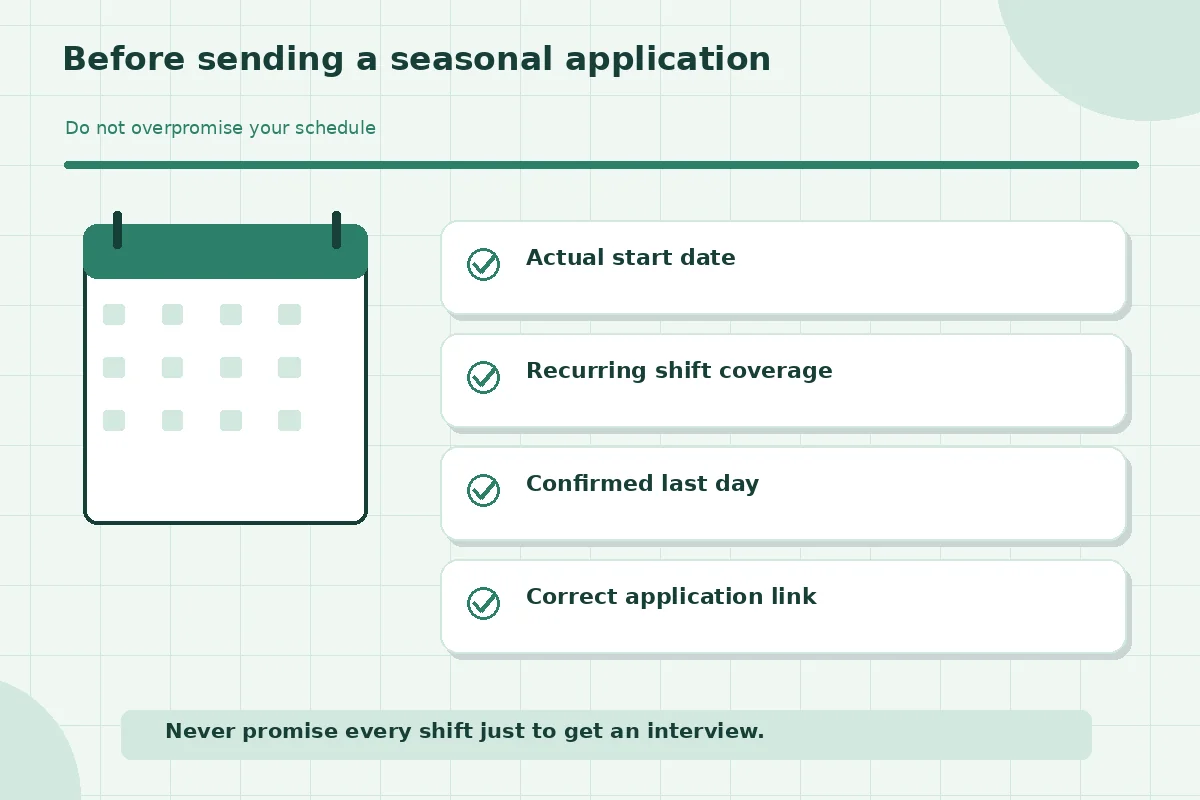
Prepare a simple four-part check: check opening date, list actual availability, confirm season end, follow submission route. If the posting lists a closing date or required documents, follow those directions. Do not include an unrequested government ID, bank account number, or private records. The FTC has documented scams in which people impersonate recruiters and ask for sensitive information before a legitimate hiring process. Verify the recipient through a known official channel rather than relying only on the address supplied in an unexpected message.
Read the seasonal posting before stating dates
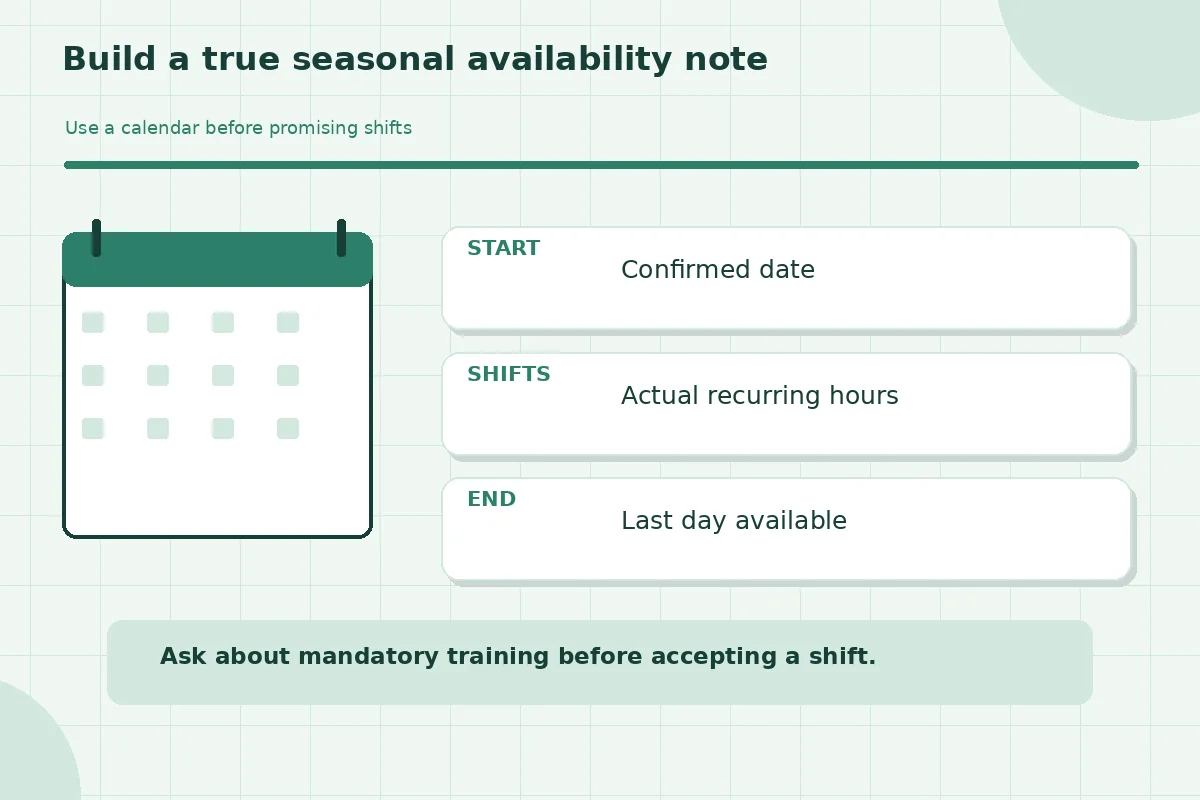
A seasonal opening is not automatically a casual or flexible arrangement. The announcement may identify a peak season, a required training week, weekends, holiday coverage, or a minimum period of work. Copy those requirements into a small calendar before composing the email. Circle a confirmed start date, the last day you can reliably work, and any recurring commitment that could affect a shift. If the employer uses a careers portal, submit there before emailing unless the posting explicitly directs applications to an inbox.
Separate what you know from what you need to ask. If the ad says the season ends in September but your school schedule changes in late August, say so. Do not promise September availability just to reach an interview. An employer may be able to offer a shorter assignment, but that decision belongs to the employer. A clear calendar protects you from sending contradictory dates in the email, resume, and application form.
Use one role-specific skill example instead of generic enthusiasm
The email needs evidence related to the advertised seasonal work. For a visitor-facing role, you might describe how you explained check-in instructions or organized a queue. For stock support, explain a verified count, label check, or safe handoff. If your closest example is volunteer or school work, label it accurately. A hiring manager needs to see how you will handle the tasks, not an unsupported claim that you are “hardworking and passionate about customer service.”
One short sentence can connect the example to the posting: “In a community event volunteer role, I checked guest registrations and referred exceptions to the coordinator.” Avoid made-up volume, satisfaction ratings, or certifications. Do not write that you can operate equipment, supervise minors, handle payments, or open a facility independently without the training and authorization that the employer requires.
Adapt a short email example without inventing experience
Here is an illustrative message to adapt, not a real applicant record. Subject: Application: Seasonal Guest Services — Summer Period. Hello Hiring Team, I am applying for the seasonal guest services opening listed on your careers page. I have experience answering visitor questions and keeping check-in records accurate during a volunteer program. I can begin June 10 and work Tuesday–Friday evenings and Saturdays through August 25. I understand the posting may require training before my first assigned shift. I have followed the application instructions and attached the requested resume. Thank you for considering my application. The example is deliberately modest: it identifies a role, gives one concrete contribution, and ends with a clear next step. Replace every date, title, skill and attachment statement with information you can defend. Never claim to have submitted a form unless you completed it.
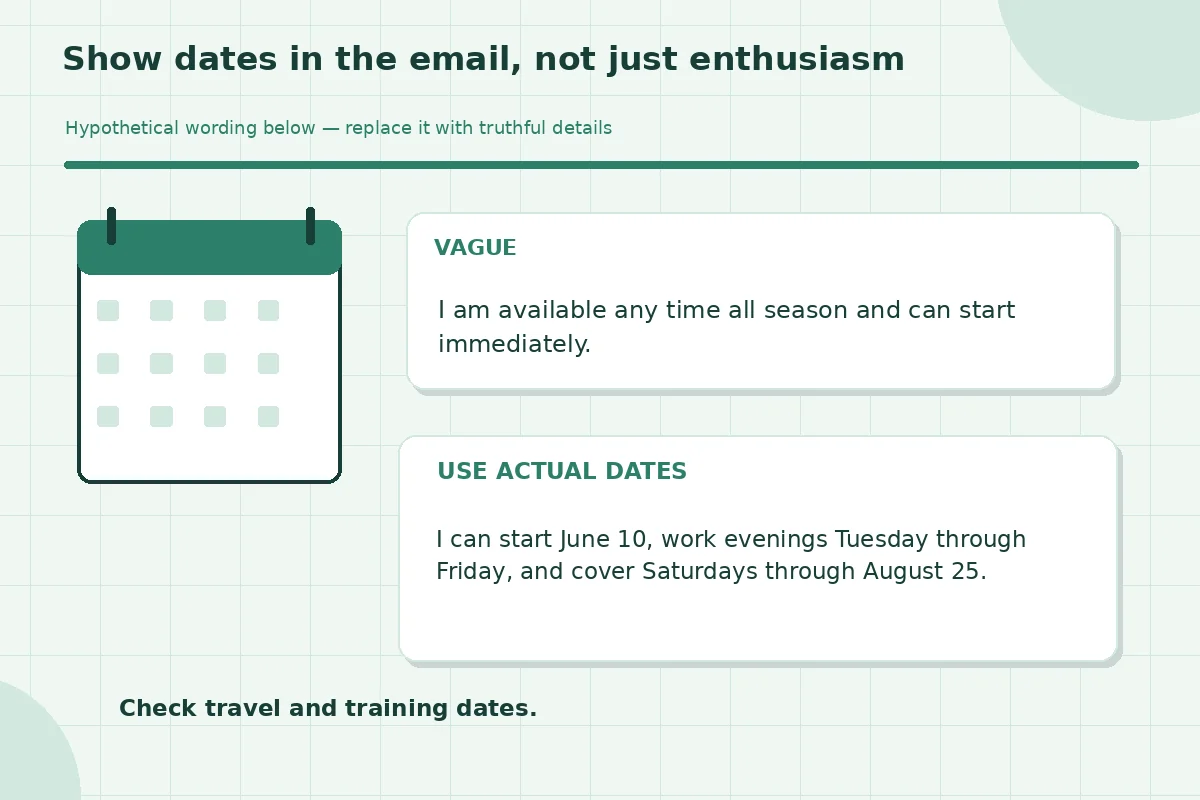
A useful quality test is to compare two sentences. Too broad: “I am available any time all season and can start immediately.” More accountable: “I can start June 10, work evenings Tuesday through Friday, and cover Saturdays through August 25.” The latter contains a detail a recruiter can check or ask about. If your own history differs, do not copy the stronger sentence literally. Use the same structure—specific circumstance, truthful action, realistic boundary—to describe what you have actually done.
Write an email that distinguishes fixed and negotiable shifts
A useful subject identifies the exact opening. In the first sentence, say where you saw the posting. In the second, name one relevant skill. Put availability in a separate concise sentence with a start date, recurring shift pattern, and end date. If certain hours are negotiable, use “I may be able to adjust Wednesday evenings with advance notice,” rather than suggesting all shifts are possible. Ask a single practical question only if the posting leaves an essential requirement unclear.
Hypothetical example: “I can begin June 10, work Tuesday–Friday evenings and Saturdays, and remain available through August 25.” Those illustrative dates must be replaced with your real dates. If the listing asks applicants to use a portal and not email, do not substitute this message for an application. You can save the same clear availability statement for the portal or for an approved recruiter reply.
| Message element | What to include | What to avoid |
|---|---|---|
| START DATE | Check opening date | Guessing the posting |
| SHIFT FIT | List actual availability | Promising a role |
| END DATE | Confirm season end | Invented credentials |
| APPLICATION | Follow submission route | Replacing required forms |
Check the practical commitments before pressing send
Seasonal workers may need transport at early or late hours, work at a temporary location, or complete orientation before regular shifts. Ask which worksite the job covers and whether training is scheduled during your stated availability. Do not confuse “seasonal” with a promise of a set number of weekly hours. The posting and offer, not your guess, determine the likely schedule and employment terms.
Verify the employer using its own website or a known official contact channel. The FTC cautions that scammers exploit holiday and seasonal job advertisements. Treat requests for payment, surprise financial details, or suspicious onboarding links as warning signs. Do not attach IDs, bank details, or payroll forms to an initial application email. Keep the job ID and a copy of the posting for later reference.
Finish with a calendar-and-attachment review
Read the email as though the recipient has never met you. Can they identify the role, the dates you actually offer, one relevant example, and what document is attached? Are the dates consistent with your resume and any online form? Did you use the correct role title and address? Put the recipient address into the draft last so that you can check everything before sending.
After submission, record the posting title, date, channel, and any confirmation number. If you receive an interview invitation, bring the same availability calendar and clarify changes immediately. If a season ends earlier or later than expected, ask for written confirmation instead of assuming an extension. The purpose of the email is not to sound endlessly flexible; it is to make staffing expectations clear enough for a real hiring discussion.
Make a final email check before sending
Read the subject line and message on a narrow screen, where long paragraphs are difficult to scan. Verify the exact title, the recipient, your dates, and the files you mention. A useful subject for this example is “Application: Seasonal Guest Services — Summer Period” only after replacing illustrative details with the real posting. Check that your signature uses contact information you are comfortable sharing. Add the recipient last to prevent an accidental early send.
If the employer’s instructions are incomplete, consider this narrow question: “Could you confirm the anticipated training dates and whether the position has a fixed end date?” Do not send multiple versions of the same question to several employees. Save the message and any official receipt separately from unrelated applications. The principle is simple: be easy to identify, honest about your contribution, and careful about which action has actually been completed. That makes the email useful to the reader and to the receiving hiring team without promises of an interview or an offer.
How We Research Job Application Emails
JobAsk compared this topic with the supplied WordPress title inventory and the project’s prior draft batches, then reviewed current public guidance from CareerOneStop, career centers, and relevant consumer agencies on November 7, 2026. Illustrative emails use fictional applicants, job titles, and requisition numbers. None is a live vacancy or proof of a hiring outcome. Employer-specific instructions always govern. Please review the affiliate disclosure for information about site relationships.
Source: cloudfront.careeronestop.org — CareerOneStop explains that an email body can serve as a cover letter when an employer specifically requests emailed application materials.
Source: consumer.ftc.gov — FTC warns about impersonated recruiters, requests for financial information before hiring, and other job-email scam signals.
Source: consumer.ftc.gov — FTC describes seasonal hiring scams and recommends checking employers independently before sharing sensitive information.
Source: www.career.berkeley.edu — Berkeley Career Engagement recommends brief, specific outreach that makes the purpose of the message clear.
Related Job Search Guides
Yes, when shift coverage and season dates matter to the advertised job. Give only dates and shifts you can actually work, and keep the statement short.
State the confirmed period honestly. Ask whether the employer considers shorter assignments; do not conceal a known end date.
You may apply if you meet the published requirements. Ask about mandatory training if its timing affects your ability to accept the job.
Follow the posting. If the employer requires its portal, use that route rather than replacing it with an unsolicited email.
Treat payment demands as a serious warning sign. Independently confirm the employer and review FTC job scam guidance before sharing sensitive information.