
Academic experience can strengthen a resume when you name the setting, your actual contribution, and the evidence a hiring manager can evaluate. A class project is not automatically paid employment; joining a research group is not necessarily authorship on a paper; and a student leadership role is different from a campus job. Use clear sections such as Projects, Research Experience, and Work Experience to distinguish them. Texas A&M’s career resources recommend presenting research and projects with a title, institution or course, dates, and action-focused bullets. The strongest entry explains work completed without inventing ownership or professional results.
Sort each activity before writing a bullet
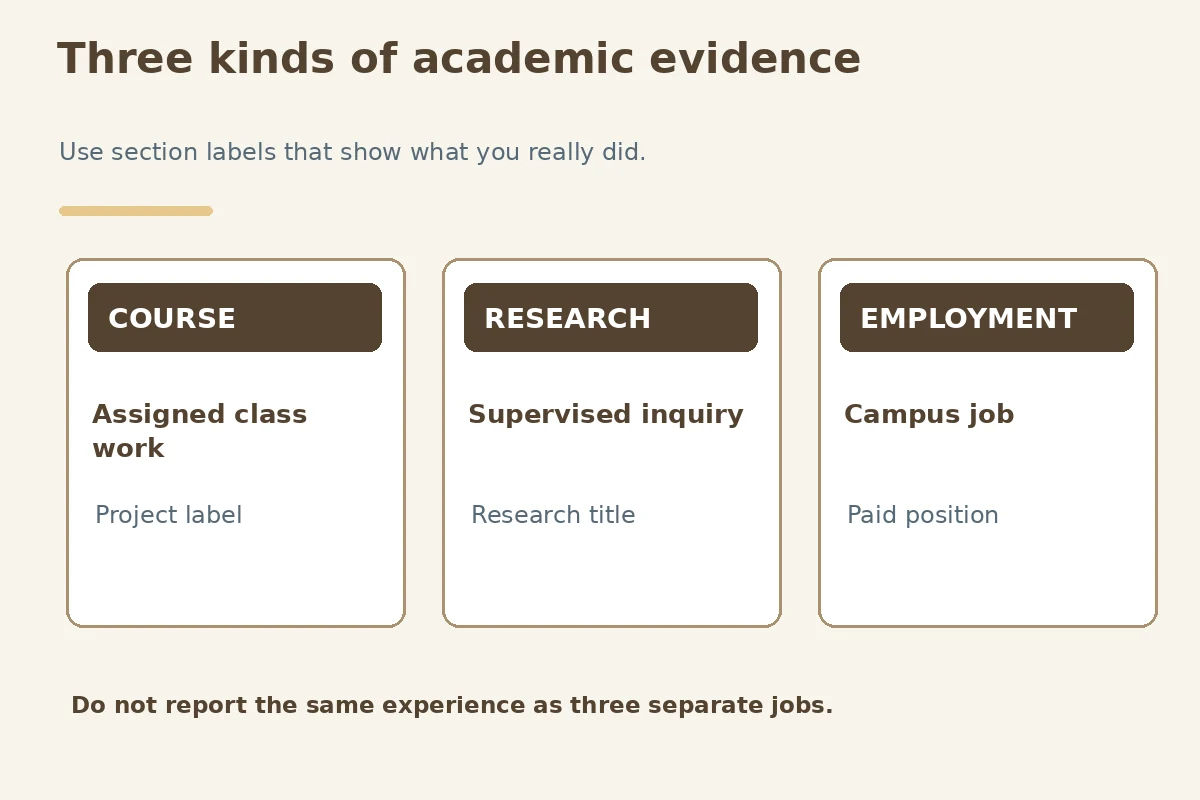
Build three groups from your academic history. The first is course projects: assigned work completed as part of a class, such as a design brief, code prototype, survey exercise, or lab report. The second is supervised research: assistantship work or research tasks done under a faculty member or lab, whether paid, volunteer, or for credit. The third is actual campus employment, such as a paid library assistant position with assigned shifts and a supervisor. These categories can overlap, but the label should reveal which relationship you had, not maximize how impressive it sounds.
A hypothetical example illustrates the difference. A marketing student built a fictional campaign proposal in a class, checked survey data for a professor’s approved study, and worked a paid shift at the campus information desk. The first belongs in Projects, the second in Research Experience, and the third in Employment. Claiming “Campaign Manager” for a course assignment or “Research Director” for data cleaning is misleading. If a project was done by a team, specify the part you actually created or reviewed rather than claiming collective results as your individual achievement.
Make a research entry specific and bounded
Useful research bullets identify the question, methods, data type, and quality control, while respecting the lab’s confidentiality and intellectual-property policies. “Prepared de-identified survey responses, checked missing entries, and flagged inconsistencies for the supervisor” may be appropriate if that is what you did. “Published a clinical study” is not acceptable unless a publication exists and your authorship is confirmed. Do not infer authority from having access to a lab workstation; you may have been permitted to enter records but not approve data releases or make scientific claims.
Write the lab, department, institution, location, dates, and truthful title. A student participant might use “Undergraduate Research Assistant” if that was their actual appointment, or “Independent Course Research Project” if they researched within coursework. Mention equipment only when training and authorized use can be substantiated. For public portfolios, use approved figures or a newly created demonstration with fictional data. Never attach raw participant records, undisclosed research results, or proprietary code to prove that the work was genuine. A supervisor can help confirm which high-level descriptions are shareable.
Show academic projects as evidence, not company outcomes
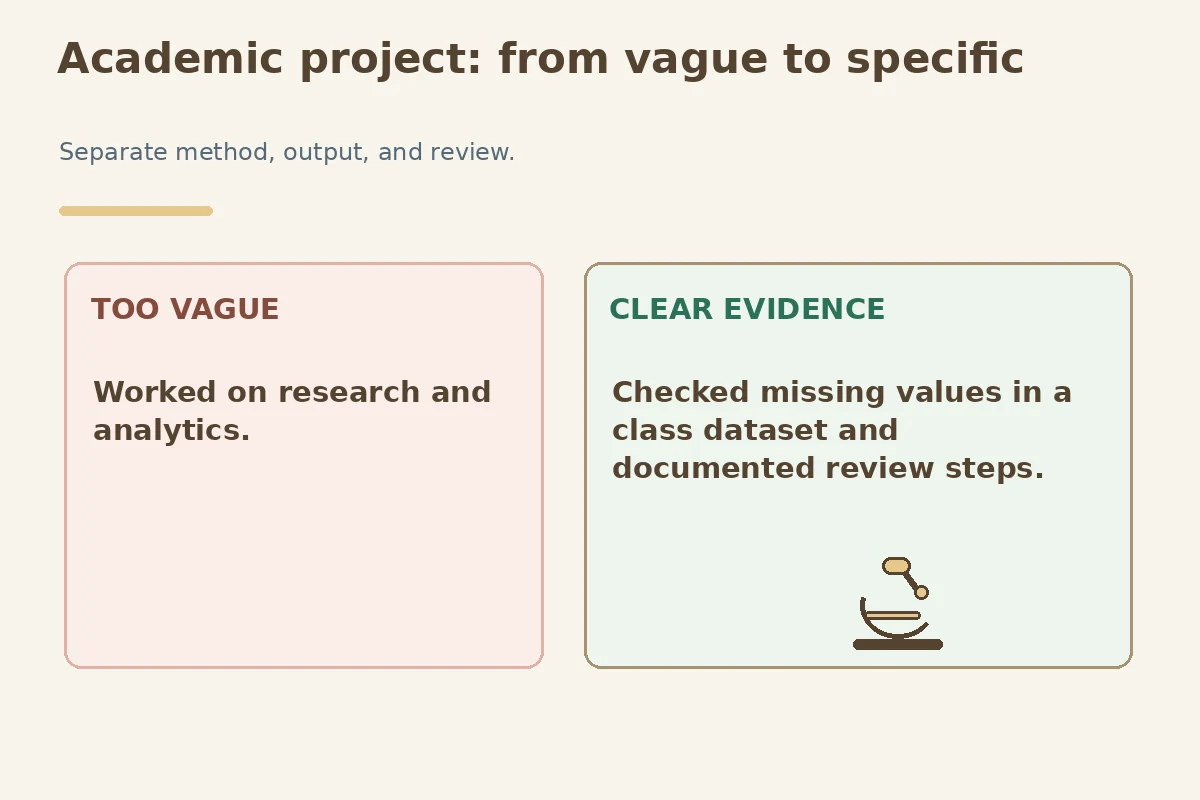
A course project is most compelling when it resembles a job problem and shows an actual deliverable. Instead of “Responsible for analytics,” say “Cleaned missing values in a provided sample dataset and documented three visualization choices for a class report,” if that accurately describes your work. Include the course or program, semester, and tools where relevant. State whether the inputs were hypothetical, public, or supplied for educational use. Do not claim that a simulation saved a business money or improved a real client process. An employer may value the analytical reasoning without being told a fictional result is commercial evidence.
Choose one or two projects for each target role rather than listing every class assignment. An entry-level UX role may benefit from a user-flow study conducted with consenting participants and documented design decisions; a laboratory role may benefit from a clearly supervised measurement process. If project feedback came from an instructor, describe your revision accurately but do not imply it was an external customer endorsement. Distinguish a proposal from a delivered solution. A project titled “inventory dashboard concept” is clearer than “deployed inventory system” when it was never implemented outside class.
Decide when academic experience deserves its own section
Recent graduates with limited employment history can place Projects or Research Experience near Education when those entries best answer the job posting. Experienced applicants may select just the most relevant research or project and put substantial paid experience first. Academic CVs are different from ordinary industry resumes: the University of Kansas describes CVs as broader records of academic preparation, research, teaching, and publications. An industry resume should be more selective and written for a specific vacancy. Avoid using a several-page academic CV template just because you have one student paper and two class projects.
If the application asks for a formal research CV, follow that document convention and list actual work, publication status, and dates in detail. If it asks for a one- or two-page resume, prioritize skills and results that align with the role. Group overlapping activities carefully so a project is not counted twice as both paid employment and coursework. Labels matter: “Course Project,” “Supervised Research,” or “Campus Employment” help a recruiter understand your level of responsibility. Use consistent date ranges and distinguish completed work from an ongoing experiment.
| Check | What to verify |
|---|---|
| Course project | Class assignment and deliverable |
| Research role | Supervision, method, permission |
| Campus employment | Real employer, shift, paid duties |
| Publication | Actual status and authorship |
Verify authorship, dates, and permissions before submitting
Cross-check the semester, research appointment, official position title, and what artifacts you can actually share. If your paper was submitted to a journal but not accepted, do not list it as published; use an accurate status if a scholarly CV calls for it. If you were one of several authors, do not imply sole credit. Get permission before naming a sponsor or describing internal data. Where school policy limits sharing, write a process-focused bullet and prepare to discuss your role in general terms. A thoughtful description can prove discipline without disclosing a confidential protocol.
For the final PDF, check that headings are readable and project names stay with their date and institution. Scan each bullet for claims such as led, owned, approved, or published; confirm those verbs fit your true work. A strong academic entry answers three questions: What was the setting? What did you actually do? What artifact or review shows it happened? That is enough to turn education into useful job evidence without dressing coursework up as a commercial career or assigning yourself authority the institution never gave you.

How We Research Resume Education Guidance
We compared U.S. career-center guidance on resume education and professional or government requirements relevant to this specific topic. Sources reviewed: Cos; Tamu; Ku; Princeton. Examples and institutions identified as illustrative are fictional; no candidate, school, employer decision, or hiring outcome is asserted. Always verify actual records and role-specific conditions before submitting an application. Review our affiliate disclosure. This article does not claim a paid referral or partnership.
More Resume and Cover Letter Guides
You can include it as relevant experience but should label it as a course project rather than paid employment.
No. Claim authorship only when the publication record and collaboration agreement support it.
Describe tasks and methods at a permitted level; use fictional or public data for demonstrations.
No. Select only activities that help answer the target job’s requirements.
Only if it really involved a client and the description is authorized; otherwise label it as a simulation or coursework.