
You may mention a certification in progress when the credential is relevant to the job and the resume makes its unearned status unmistakable. Write what you have actually done—training enrolled, exam scheduled, exam completed, result pending, or credential formally issued. Do not put letters after your name or list an active certification before the issuer has awarded it. If you have only decided to study someday, a speculative plan usually does not belong under Certifications. This distinction protects the hiring team from a mistaken qualification claim and gives you a clear update path.
Identify the exact stage of progress
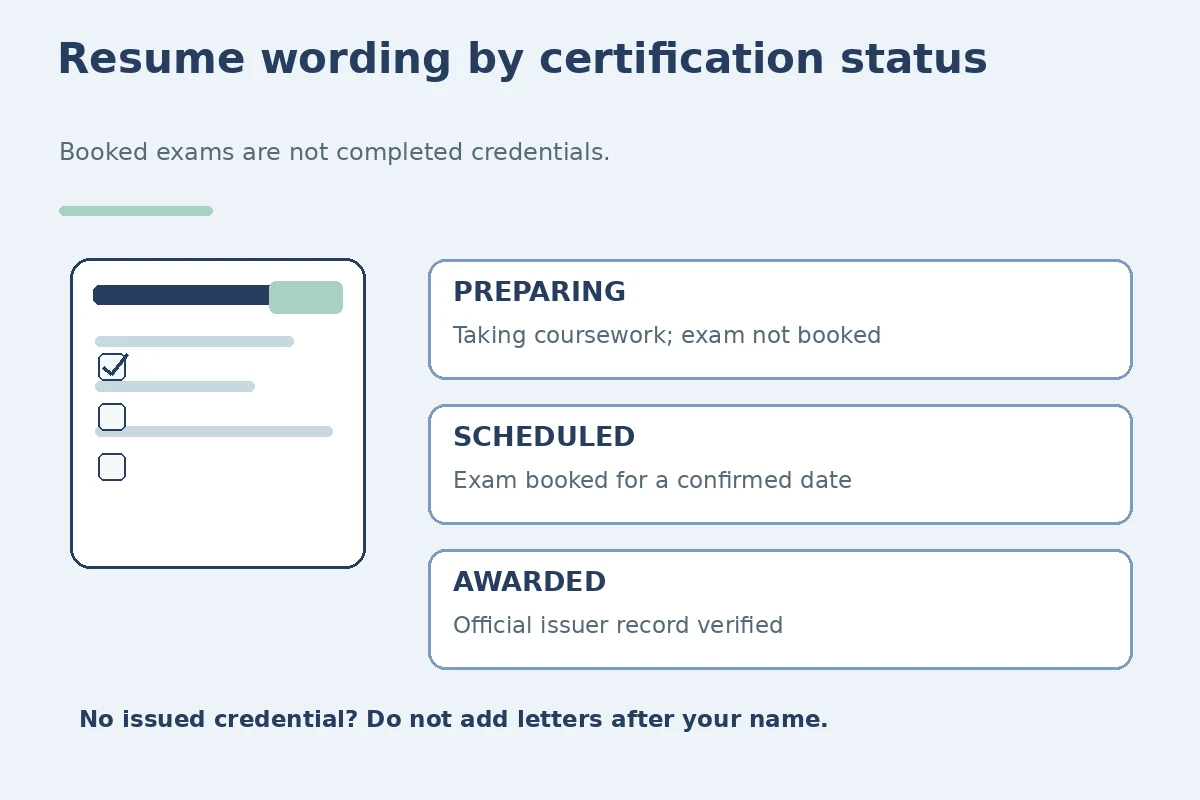
A preparation course, an exam booking, a passing score, and a credential award are not interchangeable. Start with proof: enrollment confirmation, exam registration receipt, results notice, or official credential registry entry. If you bought a textbook but have not enrolled or scheduled anything, that may be a personal goal rather than a meaningful resume qualification. Avoid a bare phrase such as “Certified Project Specialist (pending)” unless the issuer’s process actually provides that status. The word pending can mean different things; identify what is pending so the reader does not have to guess.
For example, “Network Security Credential — exam scheduled for March 2027” is clearer than “Network Security Certified” when you have registered but not tested. If you completed the exam and genuinely await results, say “Exam taken; results pending,” without asserting a pass. If you passed an exam but the issuer has not yet approved other requirements or issued the credential, state that limited fact accurately. The resume should be evidence-based, not optimized to sound as if eligibility hurdles have disappeared.

Decide which section belongs to the status
An earned credential with an issuing organization can go under Certifications. A training course that does not itself grant certification may belong under Professional Development, Education, or Training. For an ongoing university certificate, the Education section may better reflect the academic program. A candidate can also place an in-progress item under a clearly marked heading such as “Training and Exams in Progress.” This preserves scanability without implying that unfinished items and completed credentials have the same status. If the employer asks for active credentials specifically, do not count in-progress study as meeting the requirement.
Keep a short entry: official program or exam name, provider or awarding body, accurate stage, and a verified date if it helps. A hypothetical example is “Data Quality Specialist Exam — Registered; scheduled February 2027.” Do not invent the issuer or suggest it is a real industry standard; this is illustrative wording. An entry for completed coursework could instead say “Completed [actual course name], [provider], [month year]; certification exam not yet taken.” If the training has no independently recognized credential, name it as training rather than trying to turn it into a license.
Use dates only when you can defend them
Expected completion dates are useful when you have a real enrollment plan or an exam reservation, but they are not guarantees. Some providers have prerequisite experience hours, background checks, document reviews, practical assessments, or renewal obligations after a test. Passing the written exam may not be the last step. Before writing “expected certification May 2027,” check whether the issuing organization actually expects to confer it then, and whether your other requirements are met. If the award timing is uncertain, simply list the documented stage.
Update the entry whenever circumstances change. If an exam was rescheduled, remove the obsolete date promptly. If an attempt was unsuccessful, do not leave “results pending” indefinitely. If the credential is later awarded, replace the in-progress wording with the official credential and issue date, and add a verification link only if appropriate. If it expires or is suspended, do not continue to describe it as current. An outdated online profile is still a representation to employers, so keep resume and professional pages consistent.
Distinguish training skills from certification authority
You can describe skills acquired during training, but do not suggest that coursework authorizes restricted work. A candidate learning cybersecurity might safely discuss a home lab built on their own equipment, but should not describe themselves as licensed to perform regulated security audits. In healthcare, education about a procedure does not imply clinical authorization. In finance or engineering, an exam-preparation course cannot replace a required registration or license. Employers may assess the candidate’s demonstrated knowledge separately from formal credential eligibility; accurate labeling allows them to do so.
A practical evidence line might be: “Completed supervised practice in test-case documentation using a training environment; exam registration pending.” Specify the method and setting if true. Do not invent success rates or training hours. For a nonclinical software credential, a small, publicly shareable project can show what you understand, while the credential entry states what the issuer has confirmed. Keep real client details, proprietary test questions, and confidential course materials out of public samples. No matter how impressive a mock assessment feels, it is not the same as a credential award.
| Check | What to verify |
|---|---|
| Studying | Training only, no credential claim |
| Exam scheduled | Registration and date if real |
| Results pending | Exam completed; no pass assumed |
| Awarded | Use official name and issuer |
Review the application and interview language
Some application forms ask “Do you currently hold this license or certification?” If you do not, answer no even if you are close to passing, and use any comments or attachments to explain the stage. Never select a completed qualification to bypass a screening field. If a posting allows candidates who will be certified by a later date, state the exact status and ask the employer about evidence needed. Requirements differ by occupation and employer. A recruiter may appreciate that you have registered for an exam, but only the issuing body can confirm that the credential has been earned.
Finish with a four-point check: issuer, stage, verifiable date, and whether your wording implies permission you do not yet have. Read the entry aloud as if someone will verify it today. Would they find a completed course, an exam appointment, or an issued credential? If the wording could lead them to the wrong answer, rewrite it. List the actual learning you have done rather than attaching an unearned acronym to your name. Strong evidence combined with an honest timeline is more useful than an impressive-sounding but unverifiable claim.

How We Research Resume Education Guidance
We compared U.S. career-center guidance on resume education and professional or government requirements relevant to this specific topic. Sources reviewed: Cos; Princeton; Umass; American. Examples and institutions identified as illustrative are fictional; no candidate, school, employer decision, or hiring outcome is asserted. Always verify actual records and role-specific conditions before submitting an application. Review our affiliate disclosure. This article does not claim a paid referral or partnership.
More Resume and Cover Letter Guides
No. Use post-nominal letters only when the issuing organization has actually awarded the credential and permits that usage.
No. Label the scheduled exam and do not claim the credential.
It should mean you took the relevant assessment and are genuinely waiting for official results.
Only if the employer explicitly accepts that stage; do not assume it satisfies an active-credential requirement.
Whenever the exam date, results, award status, or validity changes.