
A medical receptionist offer should describe more than “front desk.” Confirm whether the role includes appointment scheduling, patient check-in, phone messages, records updates or payment intake, and learn who authorizes access to patient information. U.S. medical offices may fall under HIPAA privacy requirements, while the exact tools and workflows are employer-specific. Before accepting, ask for the real schedule, training plan and supervision route. The goal is a clear administrative role, not an implied promise that you may perform clinical duties.
Define Front-Desk Tasks and Their Clinical Boundary
BLS lists telephone messages, appointment calendars, check-in and records as common receptionist tasks. In a health setting, ask whether the position is primarily scheduling, intake, referrals, insurance coordination or a mix. Different offices give the same title very different duties. Administrative receptionists generally direct clinical questions to licensed or otherwise designated staff; do not accept a vague expectation to provide diagnosis, treatment advice or independent clinical triage.
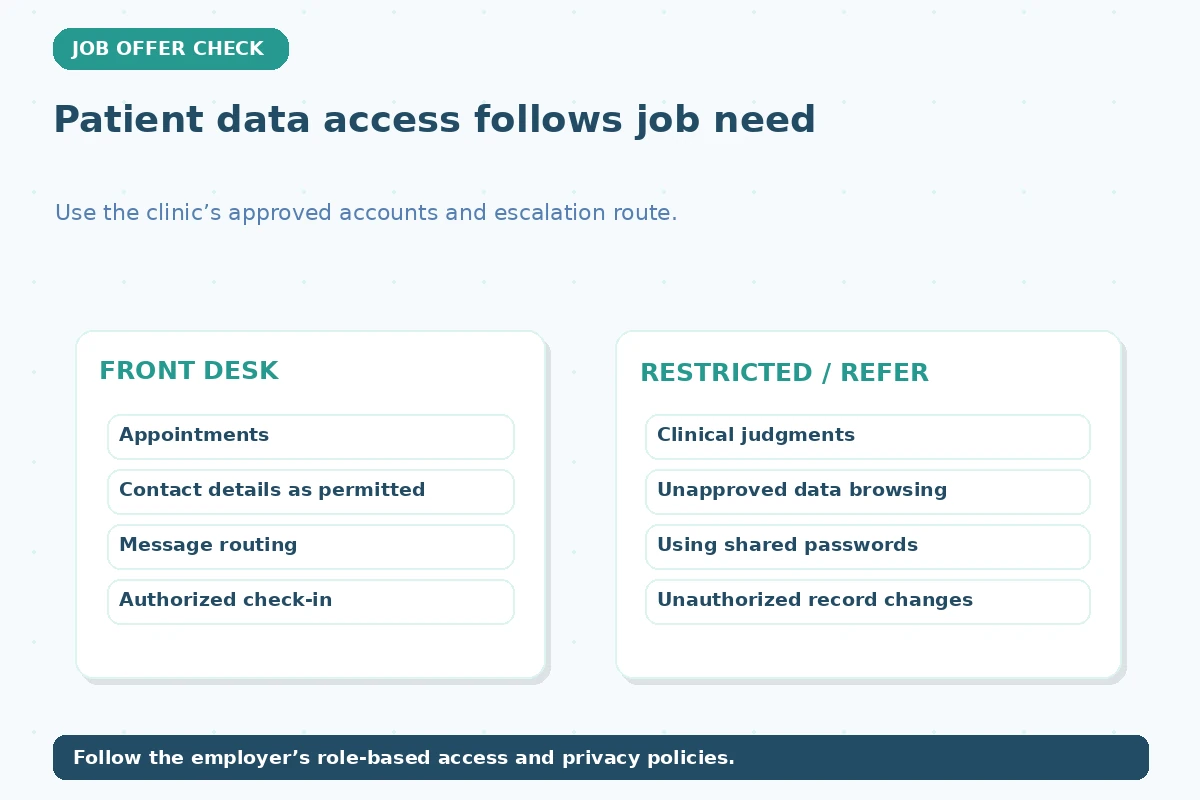
Get specific about what you can update in the practice system. “Enter demographic details from a form” is different from changing clinical findings or deciding which patients require urgent care. Ask who checks errors, where patients with unusual needs are referred and how confidential messages are passed on. Use the exact role description as your reference; do not assume that handling information makes you an authorized clinician.
Clarify Privacy Training and Appropriate System Access
The HHS HIPAA guidance explains that covered entities establish role-based access practices and reasonable limits on many uses of patient information; specific exceptions also apply. Before accepting a role, ask what privacy and security orientation is offered, which applications you will need, when accounts are issued and whom to contact about access mistakes. Do not request a coworker’s login or access more records than needed for assigned work. The practice, not the applicant, determines authorized access under applicable policies.
Patient names, appointment reasons, contact information and billing fields can be sensitive. Ask how the employer handles identity checks, callback messages, correction requests and accidental disclosure reports. Those are process questions, not invitations to discuss real patient cases with a recruiter. Never include patient examples, private screenshots or record numbers in a sample acceptance email. When uncertain, ask who owns the privacy-policy explanation and required training.

Check Clinic Coverage, Phone Volume and Escalation
A clinic may have multiple desks, specialties, telehealth scheduling or early and late coverage. Ask whether shifts are fixed, whether lunches require covering another desk and how schedule changes are communicated. Does the role involve answering incoming calls while checking patients in, or is that handled by a separate team? This affects practical workload and training. The employer can tell you its actual expectations; a generic salary or job-title description cannot.
Identify escalation routes for missed appointments, scheduling conflicts, upset visitors, equipment outages and urgent medical requests. A receptionist can document a concern and promptly refer it according to policy without making clinical decisions. Clarify the specific supervisor or team lead for scheduling corrections. If the clinic expects tasks outside the written role, request an updated description before you commit, especially when additional skills or credentials are involved.
| Offer dimension | Verify in writing | Question before accepting |
|---|---|---|
| Appointments | Scheduling and reminders | Who resolves conflicts? |
| Patient records | Authorized fields only | Who grants access? |
| Clinical requests | Referral to clinical staff | Who receives urgent concerns? |
| Shift coverage | Desk, phones and lunch relief | Who coordinates changes? |
Use a Role-Specific Acceptance Email
Hypothetical message: “Subject: Acceptance — Medical Receptionist Position. Hello [Hiring Contact], Thank you for offering me the Medical Receptionist position with [verified practice]. I am pleased to accept the written terms and the agreed [date] start. I look forward to learning the appointment and check-in workflows. Please share my reporting location, supervisor and the official steps for privacy training and account setup. Sincerely, [Name].” This example deliberately includes no patient information or invented software permissions.
If the letter includes a different job title or clinic address than the recruitment conversation, ask the contact to reconcile them first. You may confirm the compensation arrangement or schedule in writing once verified, but do not add assumptions about patient volume or system access. Use the employer’s official portal for identity, payroll and credential records. A simple acceptance email is not an appropriate place to attach patient records, security passwords or financial account data.
Prepare for the First Shift With a Limited-Access Checklist
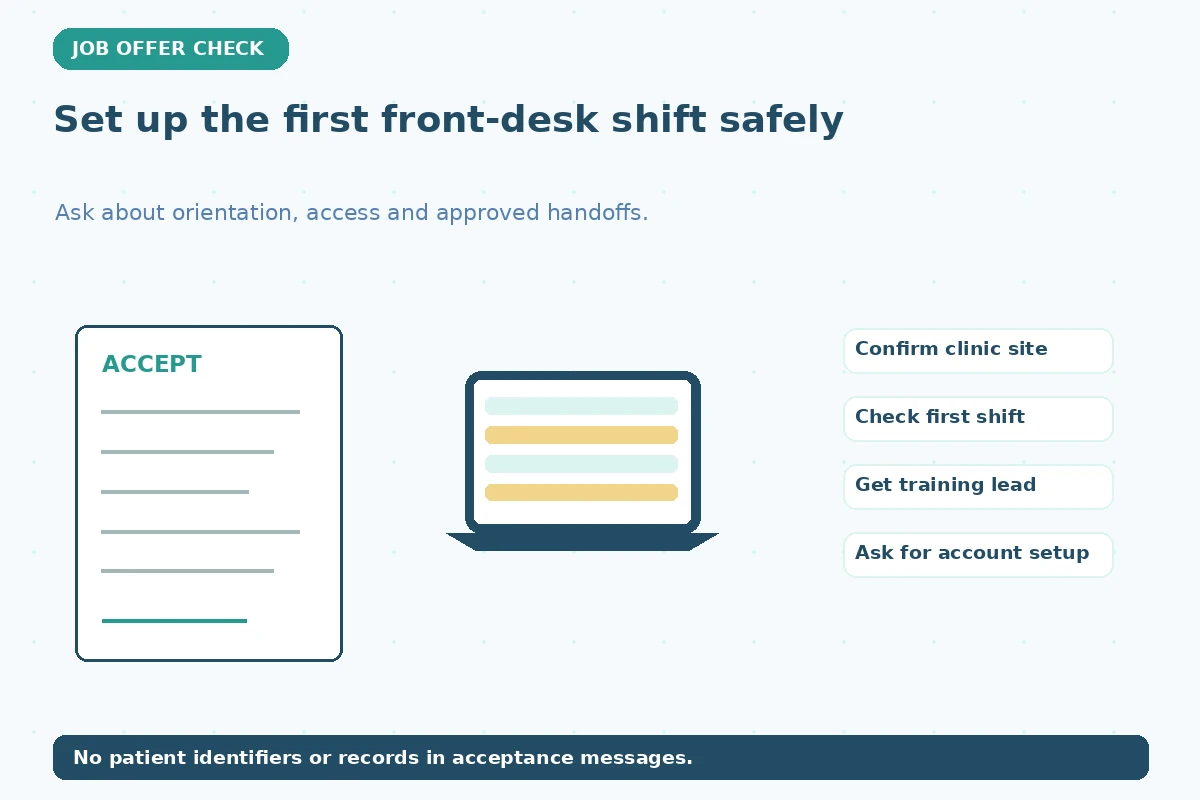
Before the start, identify the arrival time, building, team contact and how you will receive phone, calendar and record-system training. Make a list of the procedures that require verification: confirming appointments, checking intake forms, reporting privacy incidents and referring clinical questions. BLS describes the receptionist as a first contact for patients and visitors; consistency and privacy-conscious handoffs are more important than claiming expertise in software you have not yet learned.
Onboarding should distinguish observation, supervised practice and authorized independent work. A new hire may need access approvals for different appointment, billing and message modules. Asking how these approvals are granted is reasonable; claiming you already have access is not. If a job requires certification, insurance training or specific shift coverage, make sure that requirement is explicitly documented before the offer is final.
Evaluate Two Similar Medical Office Offers Fairly
A small specialty practice and a larger clinic may both hire receptionists, but their appointment systems, phone queues and approval pathways can differ. Compare the actual written schedule, your supervisor, training, expected tasks and access boundaries. An offer for “patient services” should not be treated as interchangeable with a clinical assistant role without a confirmed description. Never infer a better workplace solely from the employer’s size.
Send a consolidated set of questions before accepting if key details remain unanswered: which clinic site, what shift pattern, what systems, which role-based permissions, who handles clinical escalations and when orientation begins. Once the agreed facts are written, reply clearly, save the version you accepted and make a personal pre-start checklist that contains no patient data.
How We Research and Maintain This Guide
This U.S.-focused guide was checked against employer-neutral primary and university career sources on 2026-11-13: University of Maryland Career Center Cornell Career Network U.S. Bureau of Labor Statistics HHS HIPAA Guidance. Requirements differ by role, employer, location and applicable rules. All sample names, roles and emails are illustrative; confirm your own actual written offer before using a template. Read our affiliate disclosure. No hiring, credential or authorization outcome is promised.
Related Workplace Guides
No. Access should be provided through the employer’s approved role-based process and training.
Do not assume clinical authority. Follow the employer’s approved referral and escalation procedures for clinical concerns.
Only if actually relevant and verified; acceptance does not require pretending you already know or have access to a system.
No. Other applicable state laws and employer policies may apply; get workplace-specific training.
The agreed worksite, shift, supervisor, reporting instructions, privacy training and account setup process.