
Before accepting a rotating-shift job, ask for the actual rotation pattern rather than treating ‘full-time’ or ‘flexible’ as a complete schedule description. You need to know whether hours rotate weekly or monthly, how days off move, who publishes the roster, how much advance notice the employer normally provides, and how training and handoffs work. The goal is not to force every employer to promise an unchangeable schedule; it is to distinguish known rules from assumptions. Ask the hiring contact to confirm the schedule arrangement in writing with the other agreed terms before you commit.
Translate the offer into a real sample roster
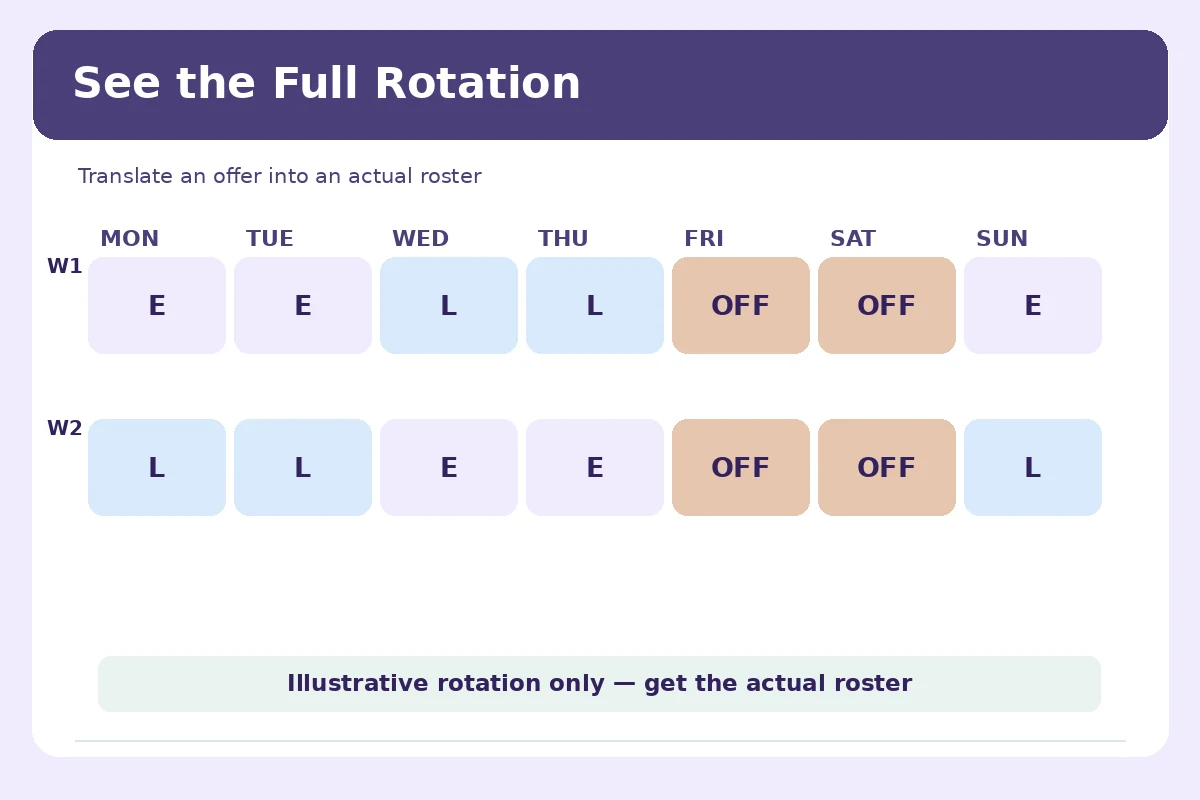
Ask the hiring manager for a representative two- or four-week schedule, including clock-in and clock-out times, consecutive days on, consecutive days off, and how the sequence repeats. A rotating shift can mean alternating early and late shifts, changing workdays, or coverage across several teams. These are materially different arrangements for commuting and family logistics. The words ‘rotating schedule’ are too broad to plan around without an example.
Draw a grid with calendar days across the top and each shift on its correct date. Add the commute and recovery time you realistically need. If the team uses a bid system or rotates holidays, note that separately. Do not mistake one illustrative roster for a permanent guarantee: ask which features are standard and which are subject to change.
Ask who can change the roster and how notice works
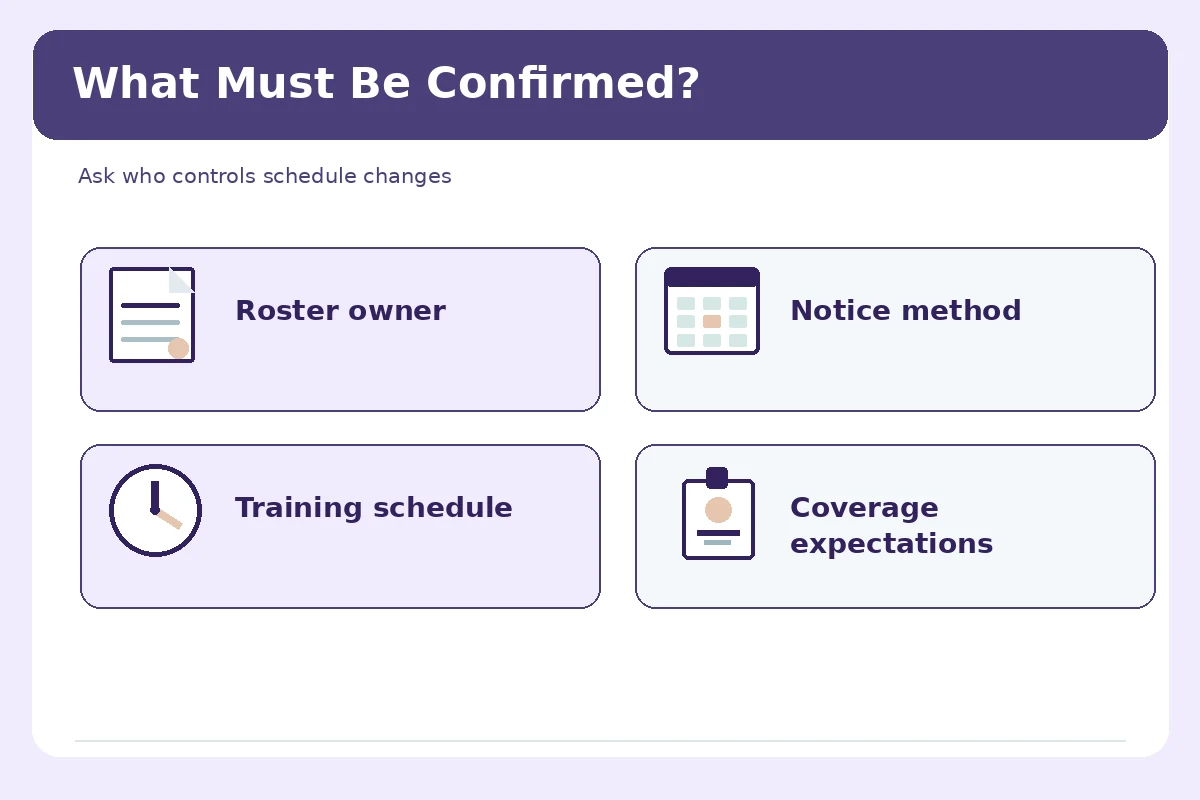
Clarify whether a supervisor, automated system or collective process sets the roster; when the next schedule is normally published; and how changes are communicated. Ask whether staff may swap shifts, how those swaps are approved and how unexpected absences are covered. Different worksites use different practices. A promised weekly work total does not tell you whether a weekday, weekend or start time will move.
Do not assume that a particular U.S. federal notice period applies to all adult workers. The Department of Labor explains that the FLSA generally does not regulate adult scheduling in the way many people expect; other applicable state or local rules, agreements and policies may matter. For your decision, obtain the employer’s actual written policy and check any applicable requirements rather than relying on a single nationwide rule.
Separate normal rotation from extra coverage requests
A standard rotating roster is one question; on-call duty, overtime, emergency callbacks and required last-minute coverage are others. Ask whether those are part of the position, who authorizes them and how employees are notified. If there are distinct on-call rules, request the actual policy. Do not call a position ‘no overtime’ simply because the recruiter described a typical week. Also ask whether reporting locations change between shifts.
An example follow-up: ‘Could you share the usual three-week rotation and clarify whether team members are also expected to cover unscheduled absences? I want to confirm that I understand the normal schedule separately from occasional extra shifts.’ That asks for two discrete facts without arguing about hypothetical emergencies.

Confirm orientation and shift-handoff responsibilities
Ask whether initial training takes place on a different schedule from the permanent rotation and whether the start date depends on completing that training. Some workplaces have a daytime orientation followed by alternating early and late shifts; others train directly alongside a designated coworker. If you must receive equipment, keys or system permissions, ask who authorizes them and when they are issued. Do not presume a new hire can independently approve sensitive work before qualification.
For a handoff, clarify what workers record, how unresolved tasks move to the next shift, and where urgent issues are escalated. The shift log should support continuity, not invite careless sharing of customer, patient or personnel information. If a safety-critical task requires a qualified supervisor, that requirement is separate from having the shift on your calendar. Ask whom to contact if a handoff occurs during training.
Use a roster-based decision instead of a vague yes
Consider a hypothetical offer described as ‘five shifts per week, rotating.’ After the employer supplies a sample schedule, you discover early shifts begin before your transit line operates and late shifts end after service stops. That is a practical feasibility issue to resolve before acceptance, not a performance problem to fix later. Conversely, a predictable rotation and confirmed commuting plan may make the role manageable even if the start times vary.
Check the schedule against real obligations without revealing more personal detail than needed. Decide what you can do, what requires confirmation and what you cannot commit to. You can ask whether a fixed start window, different site or alternate team is available, but do not imply that a request has been approved until the employer says it has.
Send a written acceptance that reflects agreed shifts
Illustrative acceptance after the schedule is clarified: ‘Thank you for offering me the Operations Associate role. I am pleased to accept. I understand the position follows the rotating schedule discussed, with rosters issued through the team’s scheduling system and initial training on the dates provided. My agreed start date is the date in the written offer. Please let me know the orientation location and who will confirm my first assigned shift.’ Use the real role and verified terms only.
If one important point remains unclear, reply with a question instead of an acceptance: ‘Before I confirm, can you clarify whether weekend changes are part of the regular rotation and how notice is given?’ If the employer revises the schedule materially, ask for the change in the written offer or a clear written confirmation from an authorized representative.
Prepare the first rotation without promising unlimited availability
Once you accept, put the official published shifts in your calendar and verify the first-day reporting location. Ask how to request time off or report that you cannot attend a shift, what to do if the scheduling system fails, and which contact handles emergencies. Use the actual attendance policy rather than an informal assurance from a coworker. Never enter a shift exchange as approved without the required confirmation.
Keep the offer, the sample roster and any written clarifications so that later conversations have a common starting point. Schedules sometimes change, and one document may not resolve a dispute; the immediate benefit is that you and the employer know which features were discussed before your start. That is a more responsible basis for accepting than guessing what ‘rotating’ means.
How We Research and Verify Offer Advice
This guide compares advice from official university career centers and relevant U.S. government or institution sources with the separate issues raised by accepting a rotating shift job offer. The cited policies are examples from their own organizations, not terms automatically governing your employer. Dates, benefits, work classification and legal requirements depend on the actual written offer, applicable rules and the responsible hiring contact. Hypothetical emails and scenarios are labeled as examples; no salary, hiring outcome, or future renewal is promised.
Research sources (checked November 10, 2026): www.dol.gov (Federal FLSA generally does not prescribe adult work schedules; other rules and agreements can apply.) www.dol.gov (Flexible scheduling arrangements vary by employer agreement and workplace policy.) careers.bu.edu (Written offers, supervisor and start-date details, and timing of a reply.) career.ucla.edu (Evaluating offers and confirming agreed terms in writing.). These are editorial references, not endorsements or a substitute for official employer paperwork. Read our affiliate disclosure; this article does not claim an affiliate arrangement.
Related Workplace Guides
No. A regular rotation describes planned shifts; on-call duty generally involves availability outside a normal assignment. Ask whether either or both apply and obtain the employer’s policy.
Scheduling rules depend on applicable law, any agreement and workplace policy. Federal FLSA rules do not supply a universal adult advance-notice requirement, so check the actual jurisdiction and written terms.
Yes. A representative roster can reveal recurring start times, days off and practical transportation challenges. Ask what is typical versus fixed, because a sample may not be a guarantee.
Confirm the rotation or roster process as actually described, along with the job title and start date. Do not invent a fixed schedule if the employer has not promised one.
Clarify both schedules, the expected transition and who approves completion of training. Your acceptance should not imply you are cleared for independent duties before the employer authorizes them.