
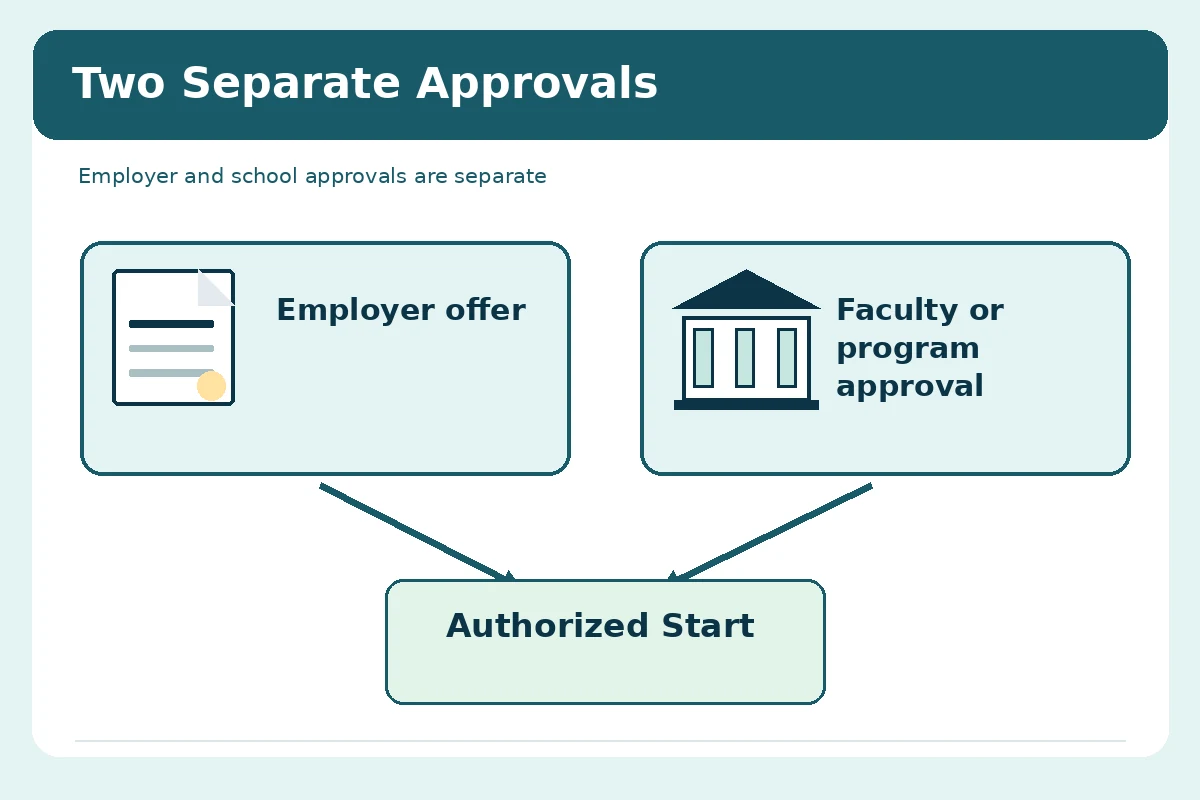
An internship offer does not automatically qualify for academic credit. Before replying ‘I accept,’ identify the actual employer, the supervisor who will guide your work, the proposed dates and hours, and the course or department that decides whether the experience can count toward your program. If credit is essential, ask the school about eligibility and approval before committing to a start date you may have to change. You can express enthusiasm immediately without implying that faculty approval has already been granted. The steps below separate a professional response to the employer from the university’s academic process.
Separate an internship offer from college-credit eligibility
An employer chooses whether to offer a placement; the university decides whether that placement satisfies the relevant course or program requirements. Neither decision automatically substitutes for the other. Some schools ask for an offer letter, a learning plan, supervisor contact details or an agreement signed by the host organization. Others handle credit through a faculty-sponsored independent study. Read the rules for your specific department and term, not a generic online checklist.
For example, the University of Virginia describes advance processing for some internship agreements, while Pasadena City College lists an offer letter and supervisor information among its own credit-request materials. Those are examples of institutional procedures, not a single nationwide rule. Ask your career center or course coordinator who can approve the placement and what must be done before you begin.
Verify supervisor, work scope, and learning objectives
Before accepting, request the supervisor’s name and role, where and when work occurs, expected hours, the type of projects you will assist with, and how feedback will be given. A learning-centered placement should provide an intelligible scope. For design work, this might mean supervised research and revision; for an operations internship, documented process observation and approved analysis. Avoid describing yourself as independently authorized to make decisions the host reserves for employees.
Compare the proposed duties against the course’s learning outcomes. A student may be able to perform legitimate support tasks without satisfying a course that requires specific supervision or assessment. Explain the difference to the employer courteously and ask whether the duties or review schedule can be documented. Do not suggest that the host change records retroactively or sign a form describing work you did not actually complete.
Build a calendar that meets both sets of deadlines
Create one calendar with the offer-response deadline, course enrollment deadline, agreement review, faculty approval, orientation date, placement start and expected end date. If signatures are needed, identify who prepares the forms and whether the school must approve the employer as a site. Leave time for administrative review; do not assume the coordinator can approve a request overnight or that a form will be backdated.
If the host needs an answer sooner than the school can decide, explain the specific dependency and request a brief extension or a conditional discussion. A useful sentence is: ‘I am excited about the placement. My program must confirm credit eligibility, and I expect to know the decision after its review. Could we agree on a reply deadline that allows that check?’ Do not call this a final acceptance if approval remains a deal-breaker.

Review the written terms before sending acceptance
Ask for the placement title, organization address or remote site arrangement, direct supervisor, dates, anticipated weekly hours, any compensation or reimbursement information, and required orientation. Verify whether course registration and the employer’s forms are separate tasks. A written offer can document the work arrangement, but it is not a guarantee that a faculty adviser will award academic credit. Where pay or unpaid status raises questions, seek school guidance rather than assuming that academic credit resolves employment rules.
If the institution asks for an academic agreement, route it through its published process. The student’s signature on an employer letter does not replace the school’s authorization. Keep copies of what was submitted and when it was approved. Do not send sensitive personal or banking information to an unverified contact; use the official host or school onboarding process once the placement is confirmed.
Use an acceptance email that distinguishes the two tracks
Illustrative example after both decisions are confirmed: ‘Thank you for offering me the Program Support Intern position. I am pleased to accept the placement starting on our agreed date. My academic-credit arrangements have been approved by my department. I understand that I will work with the named supervisor on the listed projects and follow the onboarding instructions you provide. Please let me know which documents I should complete before orientation.’ Replace every detail with the actual terms you have verified.
If approval is still pending, use an acknowledgment instead: ‘Thank you for the offer. I would like to move forward, but the placement must be approved for my credit course before I can confirm acceptance. May I update you by our agreed date?’ This is less exciting than writing ‘accepted’ immediately, but it avoids making two organizations rely on a commitment that has not been cleared.

Handle rejection or delayed credit approval honestly
If the department declines to award credit, tell the host as soon as you know. You might still be interested in the internship without academic credit, but only if the compensation, schedule, school requirements and your own goals make that arrangement workable. Ask whether the host would consider the modified terms rather than presuming the placement remains available. If the approval will merely be late, give a concrete update date and propose an amended start date for the employer to accept or reject.
Do not begin work on the assumption that a later signature will make it eligible for credit; school policies differ. Also avoid telling a faculty sponsor that a position is paid, supervised or already accepted unless those claims are accurate. Clear written notes protect both your academic record and the working relationship you are trying to start.
Keep a clean record of the final agreement
Save the employer’s actual offer, the accepted reply, the learning plan and the school approval in separate clearly labeled files. Keep a record of the exact dates, supervisor, site and any required evaluation milestones. If the supervisor changes, ask both parties whether a revised academic plan is needed. Never treat a job title alone as proof that the expected learning activities were authorized.
Before day one, confirm where to report, how to access the campus course site and who signs any required hour logs or evaluations. The goal is not more paperwork for its own sake; it is making sure the employer and your school understand the same placement. A successful acceptance contains a realistic start date and no claim that an unapproved internship is already credit-bearing.
How We Research and Verify Offer Advice
This guide compares advice from official university career centers and relevant U.S. government or institution sources with the separate issues raised by accept internship offer for college credit. The cited policies are examples from their own organizations, not terms automatically governing your employer. Dates, benefits, work classification and legal requirements depend on the actual written offer, applicable rules and the responsible hiring contact. Hypothetical emails and scenarios are labeled as examples; no salary, hiring outcome, or future renewal is promised.
Research sources (checked November 10, 2026): career.virginia.edu (Academic credit and university internship approval may require advance review or agreements.) pasadena.edu (Program-specific internship credit requirements, supervisor details and approval.) careers.bu.edu (Written offers, supervisor and start-date details, and timing of a reply.) careers.umd.edu (Reviewing an offer before accepting, obtaining written terms, timing and accurate acceptance.). These are editorial references, not endorsements or a substitute for official employer paperwork. Read our affiliate disclosure; this article does not claim an affiliate arrangement.
Related Workplace Guides
You can discuss or accept the employer arrangement, but that does not guarantee academic credit. If credit is essential, check your program rules and be clear with the employer about any condition before making a firm commitment.
It may, depending on the school and course. Paid status alone does not decide credit eligibility; required learning outcomes, approved supervision, coursework and documentation may matter.
Notify the employer promptly and discuss whether the opportunity is still workable without credit or with revised duties and dates. Do not promise the school will reverse its decision.
Follow your institution’s required submission route. Some agreements go directly between the school and host organization, while others require your faculty coordinator to review the paperwork first.
Confirm the actual role, supervisor or team, start date, appreciation and next steps. Mention academic-credit approval only if it is complete, and avoid copying hypothetical facts from a sample email.