
Before accepting a technical writer offer, verify what you will write and who confirms that it is technically correct. “Technical writer” can describe software help pages, hardware manuals, process guides, internal knowledge bases, release notes, or a combination. Request the written offer with an accurate title, start date, work arrangement, and manager. Then ask how drafts move through subject matter experts, editorial review, and publishing approval.
O*NET describes organizing technical materials, maintaining revision records, editing, and updating existing documentation as technical-writing activities. The Bureau of Labor Statistics also describes writers working with technical staff to clarify complex information. Neither source tells you how a particular employer divides writing, engineering review, and final sign-off. The practical risk is accepting a role where responsibility for accuracy is implied but reviewers, documentation access, or publishing permissions are unspecified.
Check the Exact Role Described in the Offer
Ask which documents are the immediate priority and who the intended reader is. A help-center update for customers requires different approvals from an internal maintenance guide. Find out whether you inherit a mature style guide or build one, whether you own new documentation or only revise existing material, and whether screenshots, diagrams, or product walkthroughs are part of the deliverable. A job title alone does not define the workflow.
Separate writing accountability from technical sign-off. You may propose clearer instructions and maintain version history without being authorized to certify that a product procedure is safe or correct. Ask who approves factual assertions, test steps, release status, and public publication. When the answer is “everyone reviews it,” request a named final decision-maker and a way to document unresolved comments. This distinction protects both the product users and your editorial work.
| Offer item | Ask before accepting | Record the answer |
|---|---|---|
| Assignment | Documentation ownership and technical review | Exact responsibilities and location |
| Authority | Who reviews exceptions or changes? | Named approver and escalation contact |
| Coverage | Which shifts or deadlines apply? | Normal schedule and any rotations |
| Training | Which systems and tasks are taught? | Trainer, access route, and first-day plan |

Confirm Schedules, Location, and Daily Handoffs
Clarify whether the role is onsite with engineers, hybrid, or remote, and how much overlap is required for live reviews. Ask whether releases or product launches create evening or weekend documentation work and how those requests are planned. A remote-friendly editing system does not automatically mean a fully remote job. Similarly, a “flexible” schedule may still have standing meetings with a product team in another time zone.
Find out how deadlines are set when a product feature changes late in a release cycle. Who tells you a specification has changed? Who prioritizes conflicting document requests? A writer may be asked to maintain a help center and a developer portal, but without a clear review queue those tasks can compete. Ask whether the team has revision tickets, change logs, and a publication calendar, and who negotiates the scope when time is limited.

Ask About Systems, Training, and Role Boundaries
Ask which authoring tools and repositories will be provided: structured help authoring, a content management system, version control, document templates, or an internal wiki. Tools vary, so mention software you have actually used and ask about the specific training plan. Clarify how access to unreleased product information is granted and how screenshots or test environments are approved. Never request confidential product credentials through an unofficial recruiter email.
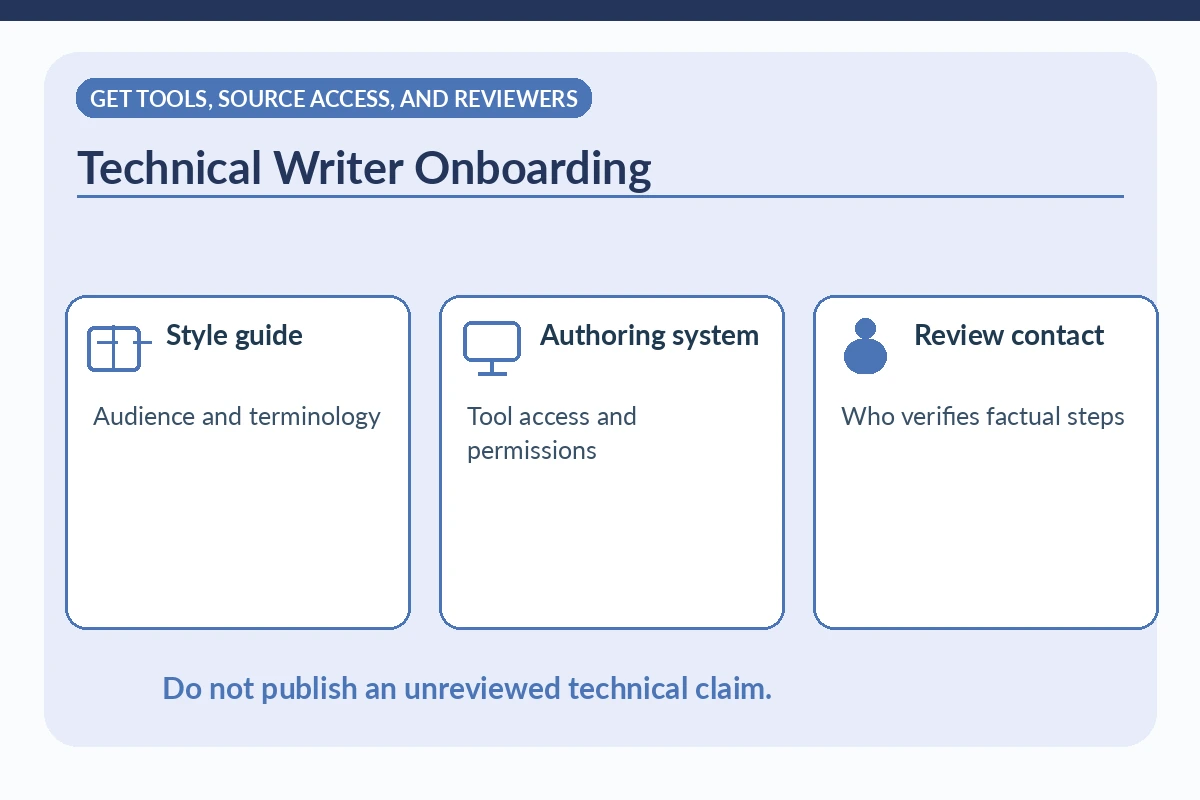
A reasonable onboarding sequence might be reading the style guide, observing a subject matter review, editing a low-risk page, and submitting a revision for approval. That is a suggested sequence, not a universal promise. Confirm who will review your first change and where you record a disputed instruction. It is better to acknowledge gaps in the source material than to publish a confident but unverified technical claim.
Use a Short, Accurate Acceptance Email
Illustrative email, not a real correspondence: Subject: Acceptance – Technical Writer Role. Dear [Hiring Contact], thank you for offering me the Technical Writer position on [team]. I am pleased to accept the terms of the written offer, including the agreed start date of [date]. I look forward to working with the documentation and product teams on clear, accurate guidance. Please let me know the official onboarding steps and who will introduce the documentation tools and review workflow. Kind regards, [Your Name].
Avoid promising a release schedule you cannot yet validate, or claiming ownership of technical sign-off not granted to writers. If the offer says “own all documentation” but no reviewer is available, ask what that phrase means operationally. A good clarification might be: “Who approves technical accuracy before customer-facing content is published?” Keep the question separate from your formal acceptance until answered.
Keep the Offer and Onboarding Record Clear
Save the offer, the stated documentation scope, accepted work arrangement, reporting contact, and agreed start date. Keep private product specifications or proprietary writing samples off personal accounts unless you have authorization. If a contact wants you to buy work equipment or transfer money to obtain editor access, verify that request through the official employer website or known HR contact before responding.
Before day one, confirm where orientation happens, whether there is a style guide, and which team will issue authoring access. Do not assume you must supply your own licensed software unless the written offer expressly says so. Ask whether a mentor or editor can walk through the review process. Taking notes on who creates drafts, who verifies facts, and who approves publishing is more useful than memorizing a tool list.
Complete a Role-Specific Before-Reply Audit
Verify the audience, core document types, revision ownership, reviewers, publish permissions, and release cadence. If interviewers described a team of subject matter experts but the offer assumes that the writer independently validates engineering procedures, request clarification. A strong technical writer is accountable for clarity and editorial process, but that does not replace a qualified product expert’s review of domain-specific instructions.
Once terms and workflow expectations are clear, accept promptly in the format requested. Your acceptance should acknowledge the role and agreed details, not invent authority over engineering releases or access to unpublished content. Keep your first-week questions for the official onboarding channel. The essential principle is simple: ask who writes, who checks technical claims, and who publishes.
How We Research Role-Specific Job Offers
Sources checked on 2026-11-15: O*NET Technical Writers explains relevant work tasks; Harvard Career Services advises acknowledging offers, examining written terms, and confirming deadlines; UW–Madison SuccessWorks recommends confirming details in a formal acceptance. We use occupational profiles only as comparisons, not as proof of what this employer promises. All emails and workplace situations here are hypothetical. For job-offer impersonation and payment warnings, we also consulted FTC Consumer Advice. We do not have a relationship with a hiring employer. For site disclosures, see Affiliate Disclosure.
Related Workplace Guides
Ask who is responsible for technical validation and final publishing approval. Writers can improve clarity and manage revisions without personally certifying every product claim.
Clarify whether creating one is part of the assignment, what audience the documentation serves, and who approves terminology and structure before large changes.
No. Ask about required meeting overlap, review turnaround, product release deadlines, and work-location terms rather than inferring schedule freedom.
Follow the stated job requirements. If the platform is new to you, explain your transferable experience and ask about official onboarding and access.
Confirm the actual role, terms, and start date, express appreciation, and request official onboarding details. Do not claim authority to approve engineering content.