
A technical writer resume should show that the candidate can transform complicated information into clear instructions for a defined audience. That claim is stronger when it names a document type, the subject being explained, the checks used, and an authorized writing sample. Technical writing can involve user guides, internal procedures, release notes, reference pages or help articles; these require different types of judgment. Read the exact posting before naming a dozen software products. An applicant to a developer-documentation role should not present product marketing copy as API reference work unless they actually completed an API documentation task.
O*NET describes technical writers as people who organize technical materials, maintain revision records and edit information against standards. It also notes collaboration with technical specialists and the use of drawings or other sources to understand products. These are helpful occupational categories, not a checklist every applicant has done. Start from work you can show: a lab instruction set, an authorized product how-to, a public developer guide or a university project. Label student and personal documents honestly rather than describing them as published employer manuals.
Name the Documents and Their Intended Readers
Sort your skills into document craft, verification, and tools. Document craft might include procedure writing, content structuring, plain-language editing and terminology consistency. Verification might include checking a sequence against a working product, requesting subject-matter review or tracing a changed step to a new version. Tools might include Markdown, a wiki, a content-management system or version control, but only if the candidate used them directly. A tool name alone does not demonstrate that the person can create accurate reference material.
A before-and-after bullet illustrates this. The vague version is “Created technical documentation.” A better hypothetical version is “Drafted a setup guide for a student application, verified each step in a fresh environment and incorporated instructor feedback before submission.” This shows scope, checking and review without inventing deployment or traffic metrics. If the applicant only assisted with screenshots, they should say so. An engineer’s approval, a teacher’s grade and a product release each describe different outcomes; use the one that actually occurred.

Track Authoring, Technical Review, and Approval
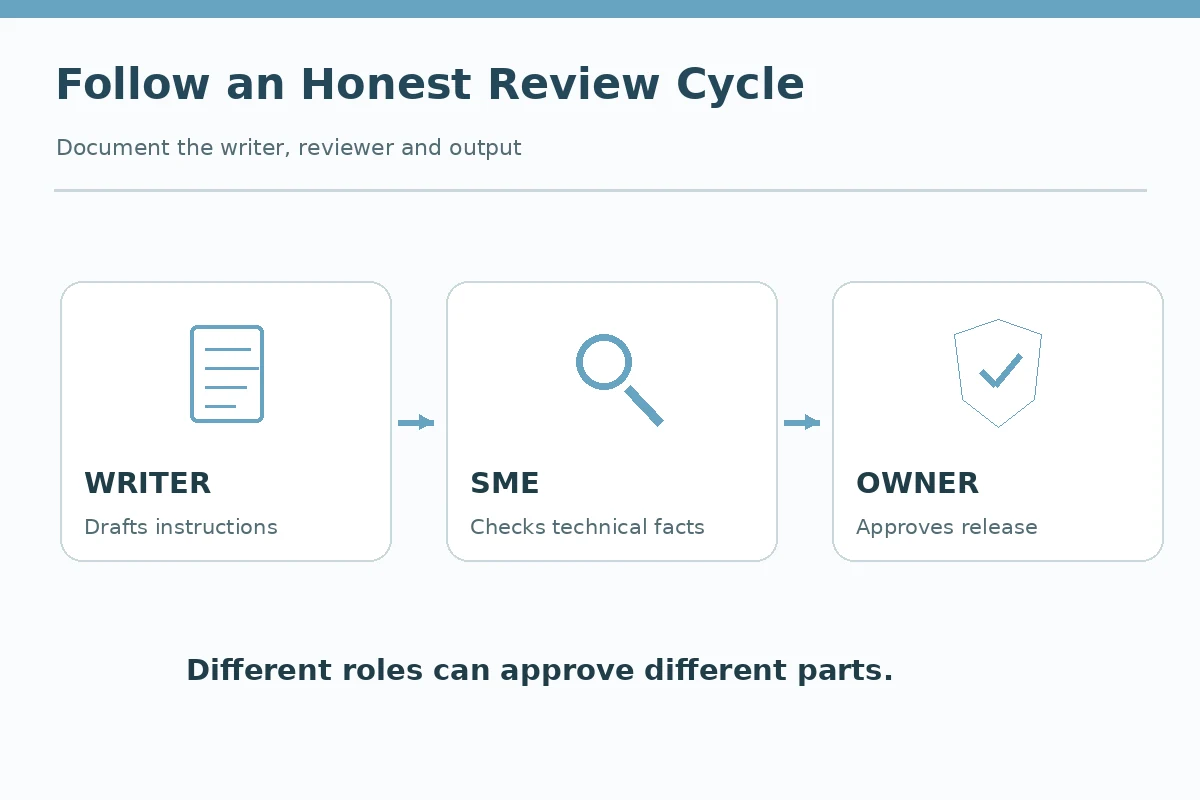
Distinguish the author from the technical reviewer. Writers often create a draft after interviewing a subject-matter expert; the expert may validate engineering facts and an editor or product owner may control publication. An applicant who requested an SME review cannot claim to have certified a safety-critical procedure. A useful work-history bullet says what the candidate documented, which ambiguity they raised and how review was resolved. If access to the actual document is restricted, explain the process in general terms without quoting confidential procedures or diagrams.
Organize the skills section for the employer’s reader. For a product user-guide position, highlight task writing, information hierarchy, screenshots, accessibility-aware headings and release maintenance, where true. For a developer-documentation position, a genuine sample may show code-block formatting, command-line examples, endpoint parameter descriptions or controlled review of changes. Do not claim API testing, SDK development or ownership of security documentation solely because those phrases appear in a job advertisement. Tool proficiency and technical domain expertise require different evidence.
Connect Software Claims to Real Outputs
Your samples should be safe, easy to inspect and correctly labeled. Remove proprietary screenshots, authentication tokens, customer details, internal repository addresses and unpublished designs. Provide a public link only when you have permission, or create an original tutorial using a neutral toy project. A portfolio caption can say “Personal guide; wrote steps, tested examples and revised headings after peer review.” That is more transparent than a polished page presented as a commercial product release when it never was one.
Review cycles provide evidence of judgment. A writer may collect confusing user questions, reproduce the issue in a safe test environment, edit a step, ask an expert to confirm the change, and publish through the appropriate owner. The resume should name the stages actually performed. A candidate might maintain a change log but not have permission to publish; “tracked approved revisions” is then correct while “owned documentation releases” is not. Describing the right boundary avoids exaggeration and also signals professionalism.
| Evidence you have | Accurate resume treatment | Do not claim |
|---|---|---|
| You wrote a procedure | Name reader, document and verification | You approved the engineering content |
| An SME reviewed the draft | Explain what was checked and revised | You personally certified the procedure |
| You practiced with a documentation tool | Label the exercise accurately | You maintained a production documentation system |
Protect Restricted Documents and Code
Quantification is useful when it is recorded, not when it is guessed. If you have verifiable counts of revised topics, supported product versions or review rounds, you can include them with clear context. Do not invent ticket-deflection rates or reduced support calls. A portfolio link is not a substitute for describing a technical task in plain English, and a number is not proof that the instructions were accurate. A short but credible explanation of how you tested the procedure often matters more than a large unverified outcome.

Before sending, compare each listed skill to a real project. For every tool, identify what you created. For every document type, identify the intended reader and the information source. For every “collaboration” claim, identify who reviewed which fact. If one entry cannot pass that check, replace it with a skill you genuinely exercised. A technical writer’s resume is itself a sample of clear communication: consistent headings, concrete definitions and no unexplained acronyms help the reader see the standard you bring to documentation.
Test the Resume as a Writing Sample
Finally, open the final exported PDF, test sample links and read the most technical sentence as if you were a new user. Watch for broken bullet alignment, irrelevant tool names and contradictory statements about review ownership. Technical writers gain credibility by making complex work understandable while preserving the distinction between writing, validating and publishing. The skills section should invite verification rather than promise competence no sample can demonstrate.
If you mention accessibility, distinguish what you implemented from what you tested. Writing descriptive headings and meaningful links may be within your contribution; declaring that a document passed a formal accessibility audit requires evidence of that audit. Similarly, an edited code example is not proof that you owned a production codebase. Assign credit to the author, technical reviewer and publication owner appropriately.
When a role requests a portfolio, place the strongest relevant example first and add a short note on how it was verified. A setup guide is useful when its steps can be reproduced safely; a style guide is useful when its conventions are explained. Do not expose private endpoints, credentials, unreleased UI or colleagues’ internal comments. Treat the portfolio as a carefully reviewed product, not an accidental export of your employer’s document system.
How We Research and Check Sources
We checked the following authoritative references on 2026-11-14 for the specific occupational, assessment or resume-writing points described here: www.onetonline.org — O*NET identifies organizing technical materials, maintaining revisions and editing specialized documents as technical writer tasks. www.onetonline.org — O*NET task details include working with technical experts, source materials, help documentation and revision records. careercenter.umich.edu — The University of Michigan Career Center emphasizes tailoring resume bullets to actual tasks and outcomes. Examples in this guide are hypothetical, not actual candidate test scores, qualifications, credentials, endorsements or employer decisions. Verify the current job posting and any institution-specific requirements before submitting. Read our affiliate disclosure for editorial transparency.
More Resume and Cover Letter Guides
No. Include only role-relevant tools that you can demonstrate through real work or clearly labeled practice.
Yes when it is your own work, accurately labeled, technically checked and safe to share.
A subject-matter expert reviews domain-specific facts; it does not mean the writer personally authorized release.
Only if the count is real and meaningful. Explain the document type, accuracy checks and audience as well.
Not without permission. Use an original public example or describe your workflow without exposing restricted material.