
Quick answer: If this is your first paid job, ask what a normal shift includes, how training works, who checks your work, and what the schedule really requires. Two thoughtful questions about learning the job are often more useful than a memorized list of impressive-sounding lines. Interview questions are a tool for judging the actual job, not a script that proves you will receive an offer.
Choose questions based on what is still unknown after the job description and the conversation. The examples below are hypothetical; employer responses, team structures, rules, and training arrangements vary. Avoid treating sample wording as a promise from any real employer.
Start With the Real Responsibilities of This Role
Career Services at the University of Pennsylvania specifically recommends asking about daily duties, important skills, onboarding, and growth in a first-job interview. The goal is to make a responsible decision, not to perform confidence that you have not yet earned.
The important distinction is between an occupation profile and the actual work offered to you. Before the meeting, mark the responsibilities stated in the posting and write down what they do not explain: who owns a decision, how errors are corrected, which tools are used, and where a new employee seeks support. Bring the short list to the interview. If the interviewer already answers a question, acknowledge the answer and move to a more useful one.
Five Questions That Reveal How the Work Operates
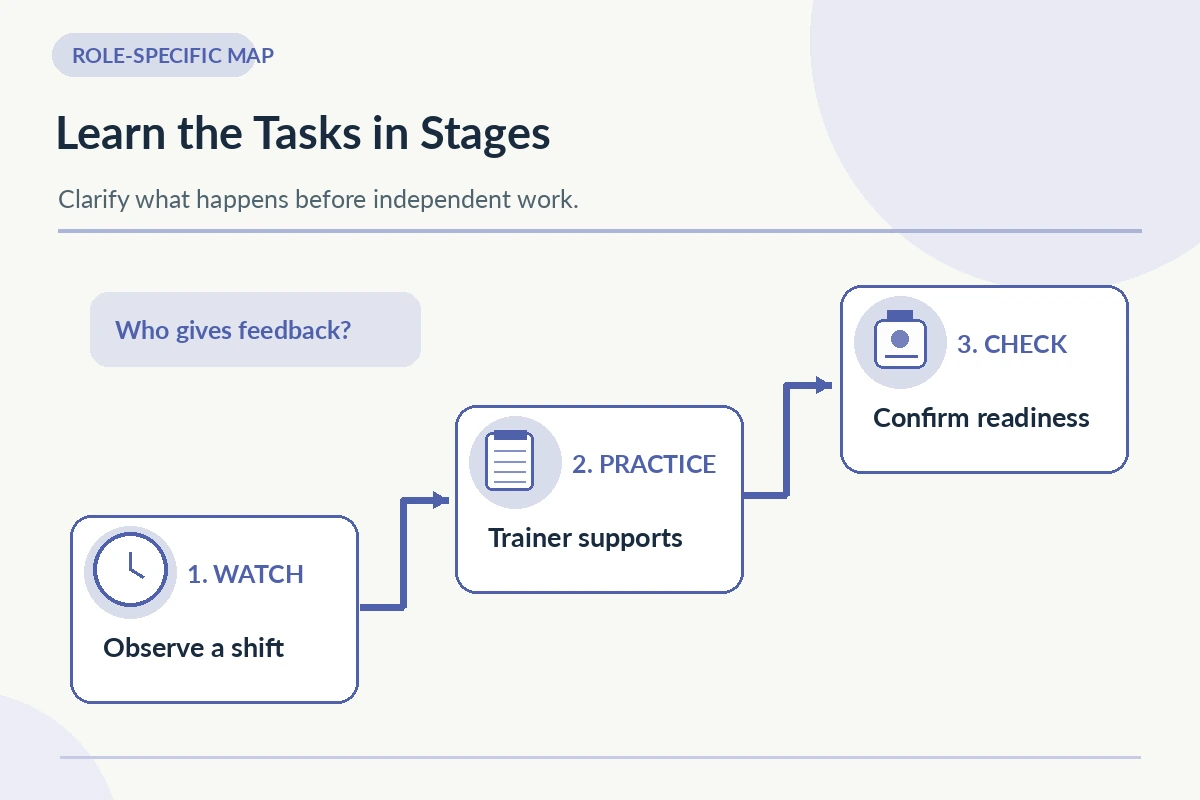
1. “What tasks would I handle during a typical first shift?” This reveals whether the work is customer-facing, inventory-based, administrative, or something else, and prevents guessing from a broad job title. Useful follow-up: “Which tasks would I practice first, and which require someone to check my work?” Listen for concrete examples of tasks appropriate for a beginner.
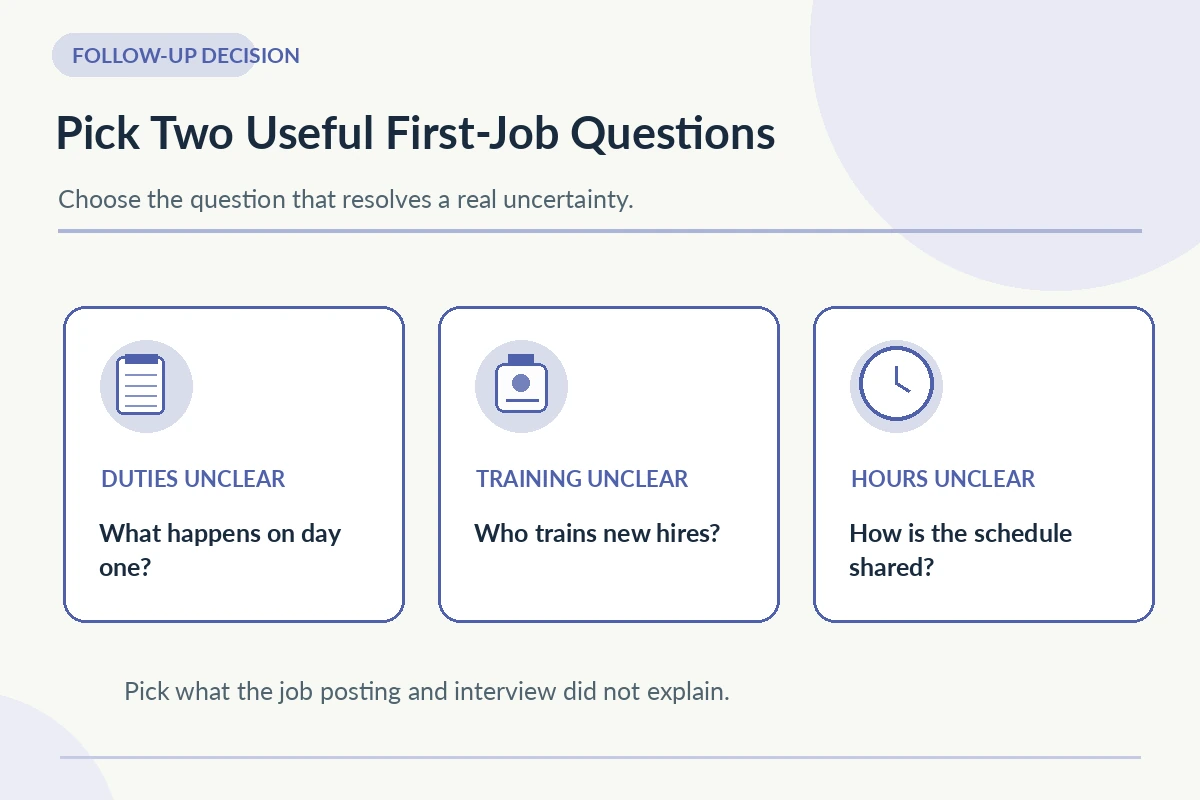
2. “Who trains new employees, and what does that training include?” A named trainer and a clear plan can make a new role easier to evaluate, particularly when tools, safety rules, or customer records are involved. Useful follow-up: “How do new hires ask questions when that trainer is not on shift?” Look for a route to help, not a promise that no one ever needs help.
3. “How would the team know I am ready to work more independently?” This distinguishes learning milestones from arbitrary pressure to speed up before you understand the task. Useful follow-up: “What feedback would I receive during the first few shifts?” Good specifics include observed tasks, a check-in, or an established supervisor.
4. “What hours and shift changes should I be able to cover?” Do not commit to availability you cannot actually maintain around school, transportation, or family obligations. Useful follow-up: “How far ahead is the schedule usually shared?” The response may vary by role; confirm mandatory availability in the offer or schedule policy.
5. “What are the most common mistakes beginners should learn to avoid?” This asks for realistic preparation without implying that every mistake is acceptable or risk-free. Useful follow-up: “What is the right way to flag an error quickly?” A clear reporting route helps you protect customers, coworkers, and accurate records.
Do not ask all five mechanically. The strongest question is the one that closes an information gap that matters to your decision. If the employer explains a process while answering an earlier question, move to the next unresolved issue rather than asking it again just because it is on your list.

Match Each Question to the Right Interviewer
A recruiter may answer about hours and the application timeline. A store, office, or shift supervisor should know how tasks are assigned and reviewed. A prospective teammate can describe how new hires ask questions. Choose the person who is likely to know the answer. If someone says the schedule changes often, ask for a typical notice period rather than assuming either flexibility or unpredictability.
You can introduce a question by referencing something genuine from the posting or conversation: “You mentioned that this position will support the new workflow. Could you explain who handles the initial review?” This wording invites specific information while respecting the interviewer’s expertise. Do not pretend you researched an initiative unless you actually found it in a credible source.
Practice One Realistic Question and Follow-Up
Hypothetical exchange: Candidate: “Who would show me the register process?” Supervisor: “A shift lead trains new employees.” Follow-up: “If an order or transaction does not look right, should I stop and call that lead before completing it?” The candidate demonstrates willingness to learn without claiming prior register experience.
The hypothetical exchange shows the difference between merely listing questions and listening to the response. A strong follow-up uses an actual word from the answer—such as review, orientation, training, or escalation—and asks what that means in practice. If your interviewer cannot provide an answer, ask when and from whom you could obtain that information before deciding on an offer.
Check Risk, Authority, and Missing Information
Be careful with promises such as “you will pick it up instantly” when the job involves safety-sensitive equipment, confidential records, or money. Ask which activities require training and a designated supervisor. Do not assume an entry-level title grants permission to perform licensed tasks. If the interviewer cannot explain how training works, treat that as a question to resolve before agreeing to the role.
Keep a private decision note with three columns: what the employer stated, what remains unclear, and what document or person could confirm it. This protects you from turning a pleasant conversation into assumptions about duties, pay, training, or working conditions. It also helps you draft a concise follow-up if a serious question was not answerable during the interview.
Adjust the Shortlist for Your Experience Level
If you are a student, make a realistic list of hours you could work during classes and exams before the interview. If this is your first job after volunteering, cite the actual tasks you did rather than calling volunteer work paid employment. If the employer expects you to lift, drive, handle personal information, or use equipment, ask about training, minimum qualifications, and who supervises those activities. Job titles do not override stated qualifications.
For a first conversation, prioritize role duties and the immediate support structure. For a later interview, ask about details that remain material to your decision, such as review processes, assignment boundaries, and the next stage. If time is short, choose two questions that lead to different information rather than two variations on the same concern.
Use the Answers to Decide Your Next Step
After the meeting, separate statements of fact from your interpretation. A thoughtful interviewer may be unable to speak for another department; that is different from proof that no process exists. Summarize any answer that affects your decision, note who supplied it, and identify one unresolved item. If necessary, send a short follow-up asking who can clarify the issue. Do not send a long questionnaire that repeats everything you discussed.
The CareerOneStop preparation guide suggests researching the organization and preparing questions related to the position. Harvard career services similarly recommends discussing challenges and expectations; Penn Career Services emphasizes tailoring questions to your interviewer. The goal is informed judgment, not a magic question guaranteed to impress.
How We Research These Interview Questions
This guide uses published interview preparation recommendations and role descriptions rather than invented employer policies. Its role-specific discussion is checked against the first-job career guide, and its interview approach against the three university and federal career resources linked above. All scenarios are explicitly hypothetical. We do not have inside information about any particular employer’s practices, hiring results, or current job openings. For editorial and commercial transparency, read the JobAsk affiliate disclosure; this article does not endorse an affiliate product.
More Interview Preparation Guides
- Job Interview in English: Practice Clear Answers Without Hiding Your Accent
- Questions to Ask in an Accounting Interview: Close, Controls, and Review
- Questions to Ask a CEO in an Interview: Strategy and Your Role
- Questions to Ask in a Nursing Interview: Unit Support and Escalation
- Questions to Ask in a Final Interview: Resolve What Is Still Unknown
No. Asking how to learn the role responsibly is useful, especially when you are new to paid work.
Ask which tasks take priority in the first week or how success is checked, instead of rereading the posting.
Yes. Give truthful availability and ask about the expected shifts and notice for changes.
Ask the most important unresolved question, often how new hires are trained or what work is expected first.
Yes, describe its real scope and separate it from paid-job responsibilities.