
Accounts payable resume accomplishments should show the exact record you handled and what happened when something did not match. Distinguish coding or entering invoices from comparing invoices with purchase records, identifying exceptions, contacting vendors, posting entries, and approving payments. Those steps may belong to different people. Use a verifiable deliverable—accurate records, an exception log, or a complete review packet—when confidential totals and personal performance metrics cannot be disclosed. The examples below are hypothetical and should be adapted only to duties you performed.
Map the invoice workflow before choosing verbs
BLS and O*NET describe bookkeeping and accounting clerical activities such as entering transactions, checking codes, matching records, reconciling differences, and preparing reports. However, “accounts payable” covers a range of jobs: some staff key invoice data, others investigate mismatches or prepare payment batches, and designated personnel approve transactions. A good resume preserves those distinctions rather than borrowing the largest-sounding responsibility.
Create a personal task map with six separate boxes: received invoice, checked vendor and document fields, matched supporting records, logged an exception, sent for review, and recorded approved next steps. Circle only the boxes you actually handled. That produces a credible statement of scope and helps avoid implying that you authorized expenditure or released funds.
Describe matching without claiming financial approval
A hypothetical beginner bullet: “Compared invoice details with purchase-order records and flagged missing receiving documentation for review.” If you performed a three-document comparison, you may mention the invoice, purchase order, and receipt or receiving report—but do not assume your workplace used the same process. Some organizations use different approvals and records. Your bullet must match your employer’s actual workflow.
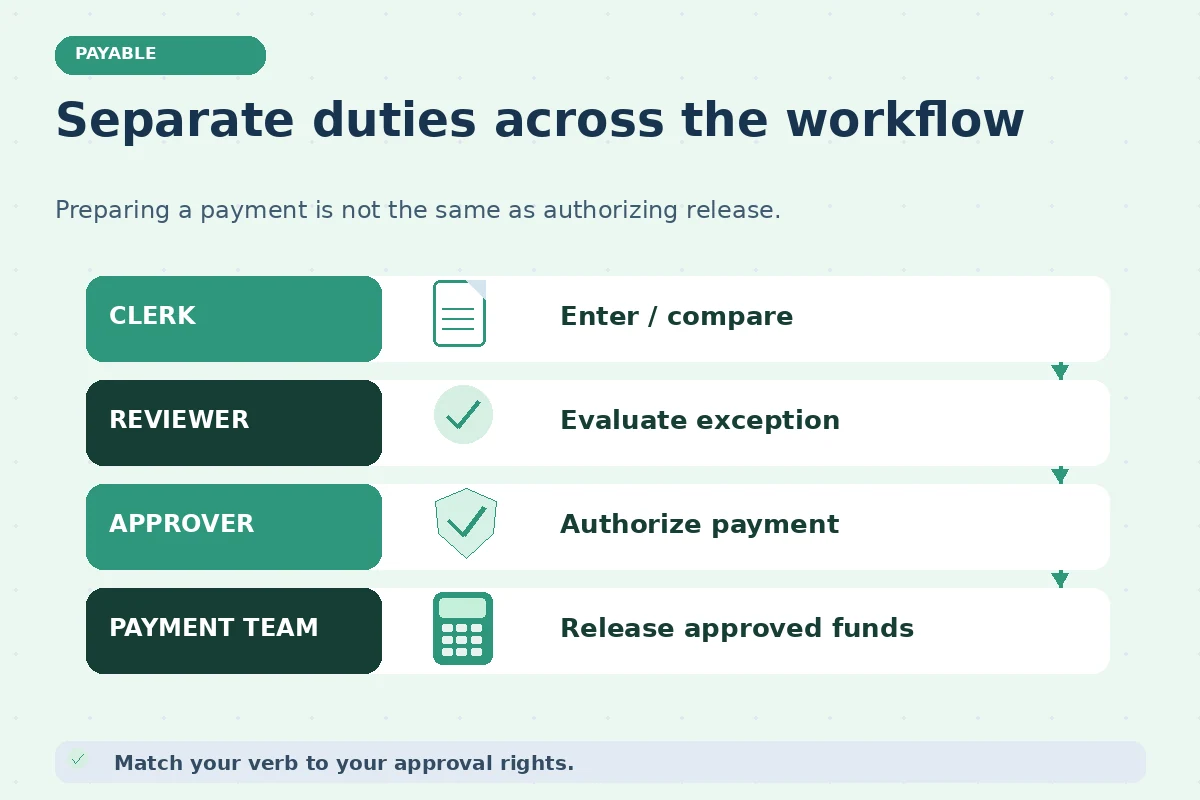
Words such as “validated,” “checked,” “reconciled,” and “approved” are not interchangeable. A clerk may identify a mismatch and record it without authority to accept a price change. Write “prepared discrepancy notes for controller review” when you prepared information rather than making the decision. The qualification is a strength because it shows that you understand separation of duties.

Make exception handling visible and specific
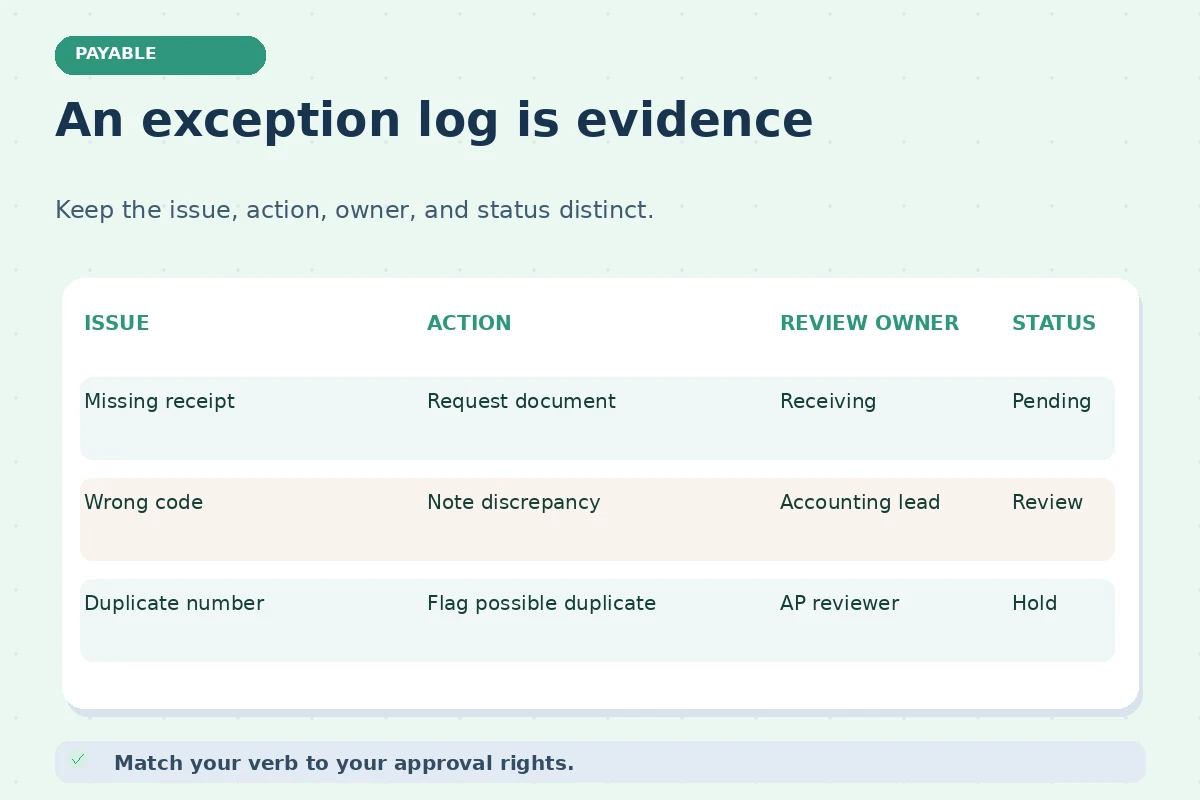
Exceptions may involve missing purchase references, duplicate invoice numbers, inconsistent quantities, unconfirmed receipts, or incomplete tax information. Do not imply that every mismatch is fraudulent or that a discrepancy was actually resolved by you. A precise example is “Logged vendor invoice exceptions and requested missing documentation through the assigned approval route.” A more experienced role might say “Researched recurring coding differences and summarized possible causes for supervisor review.”
An exception log can be useful evidence without revealing dollar amounts: issue category, date, source document, follow-up owner, status, and next decision. In an interview, describe the generic fields and your workflow rather than showing actual invoices. Avoid proprietary vendor names and invoice images. Public resume claims should be understandable without disclosing controlled financial records.
Distinguish entering, reconciling, and reporting
Entering an invoice into accounting software is different from reconciling a vendor statement or generating an aging report. Use the specific object: “Entered approved invoice data with assigned account codes,” “Compared vendor statement balances with payable records,” or “Compiled open-invoice status reports for the accounting lead.” Each is a hypothetical example requiring actual experience and authorization.
If you resolved a difference, identify what you did: requested an updated invoice, corrected an entry under procedure, or passed documentation to someone with adjustment authority. “Eliminated accounting errors” is too broad unless you have defensible evidence of that outcome. A completed correction log is a stronger, safer proof item than a claimed improvement you cannot measure.
Represent vendor communication and internal handoffs accurately
Accounts payable staff may answer vendor status questions, request documentation, or coordinate with purchasing and receiving. Your bullet can show communication without revealing payment terms: “Requested missing packing confirmations from internal receiving contacts and updated invoice status notes.” For vendor work, distinguish asking for a corrected invoice from negotiating terms; these are different responsibilities.
If the job required sensitive account verification, keep it general. Do not place vendor bank numbers, invoice details, employee credentials, or unusual payment instructions in examples. Where approval separation is relevant, “sent verified documents for payment authorization” is usually more accurate than “approved payments” for a clerk who does not approve them.
Find acceptable evidence when the numbers are confidential
Metrics such as invoices processed per period, exception rates, late-payment changes, or dollar totals should appear only when accurate, comparable, and permitted to disclose. A personal count might be available, but reporting volume alone says little about complexity or control. If the count cannot be substantiated, use workflow evidence: types of invoices, matching checks, exception documentation, software actually used, and handoff responsibilities.
Do not attribute company-wide savings or faster closing to yourself unless a credible documented connection exists. The resume can still demonstrate careful work: “Maintained an organized queue of invoice exceptions and documented review status for the accounting team.” An employer can assess your process knowledge without private financial data.
Apply an approval-boundary check to every bullet
Ask who could create the record, modify an accounting entry, accept a discrepancy, authorize a payment, and release funds. If those rights belonged to different workers, the resume should show which steps belonged to you. Replacing “approved” with “prepared for approval” can prevent a major inaccuracy while making the internal control clearer.
At final edit, select the bullets that match the new role’s emphasis: invoice entry accuracy, matching, exception research, vendor inquiries, or reporting. Keep dates and software experience truthful. Review the exported document for readable descriptions and remove identifiable invoice details from any attached portfolio material. An accomplishment is a specific defensible contribution, not necessarily a financial percentage.
How We Research Resume Examples and Role Boundaries
We use U.S. career-center guidance for writing truthful accomplishment statements and role-specific public occupational references where available. We compare tasks listed by official occupational sources with what an individual applicant may or may not have done. An occupation description is not proof of a particular person’s skills, assignments, performance, certification, or authority. Every example in this article is hypothetical and must be adjusted to documented personal experience. We do not promise hiring outcomes, approval by automated resume tools, or a measurable result without evidence.
Sources checked November 13, 2026: onetonline.org — O*NET lists accounting clerk tasks including verifying figures and codes, matching orders to invoices, posting information, and noting discrepancies., bls.gov — BLS describes data entry, financial record checks, reconciliation and accounts payable tasks as possible clerical responsibilities., careerdevelopment.princeton.edu — Princeton career guidance explains action, context, and end result as a framework for accomplishment statements..
This article provides general U.S. resume-writing information, not individualized legal, privacy, employment, or professional advice. See the JobAsk affiliate disclosure. Links to our resume category are informational; no paid partnership is claimed here.
No. Matching compares supporting records; approval is an authorization step. Name the exact action you performed.
Only when the count and period are accurate, relevant, and appropriate to disclose. Never estimate a large number to make the job sound bigger.
State what you checked, how you recorded the difference, and whether you corrected it under procedure or referred it for review.
Describe the documents, required fields, codes, and verification steps you actually completed. Accurate entry is legitimate work.
Usually avoid real vendor details and financial documents without authorization. Use generic process descriptions or fabricated demonstration data explicitly labeled hypothetical.