
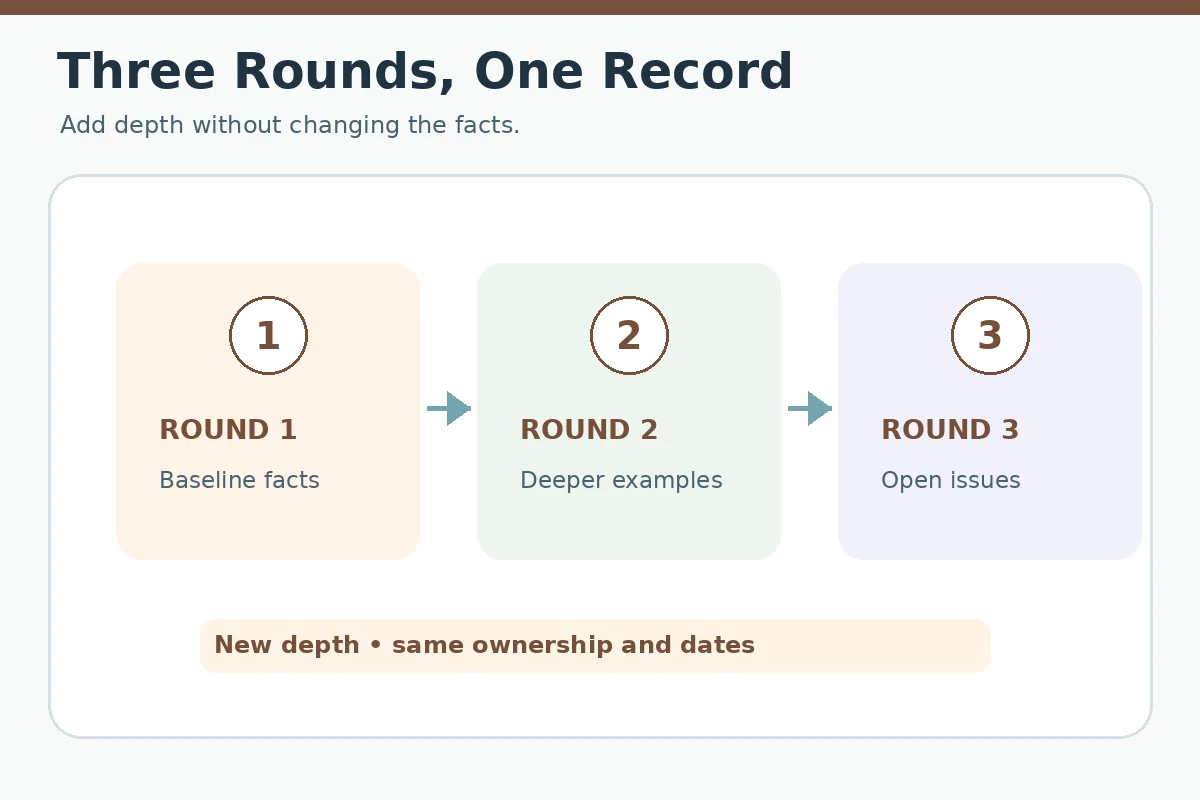
A third interview after two rounds is an opportunity to address the questions still open about your ability to do the job. Review your earlier answers, keep factual details consistent, and add clearer evidence rather than inventing a new success story. You may meet a new interviewer, revisit a work example, or discuss role expectations. None of those possibilities confirms an offer; ask what the upcoming session will cover instead of reading the invitation as a decision.
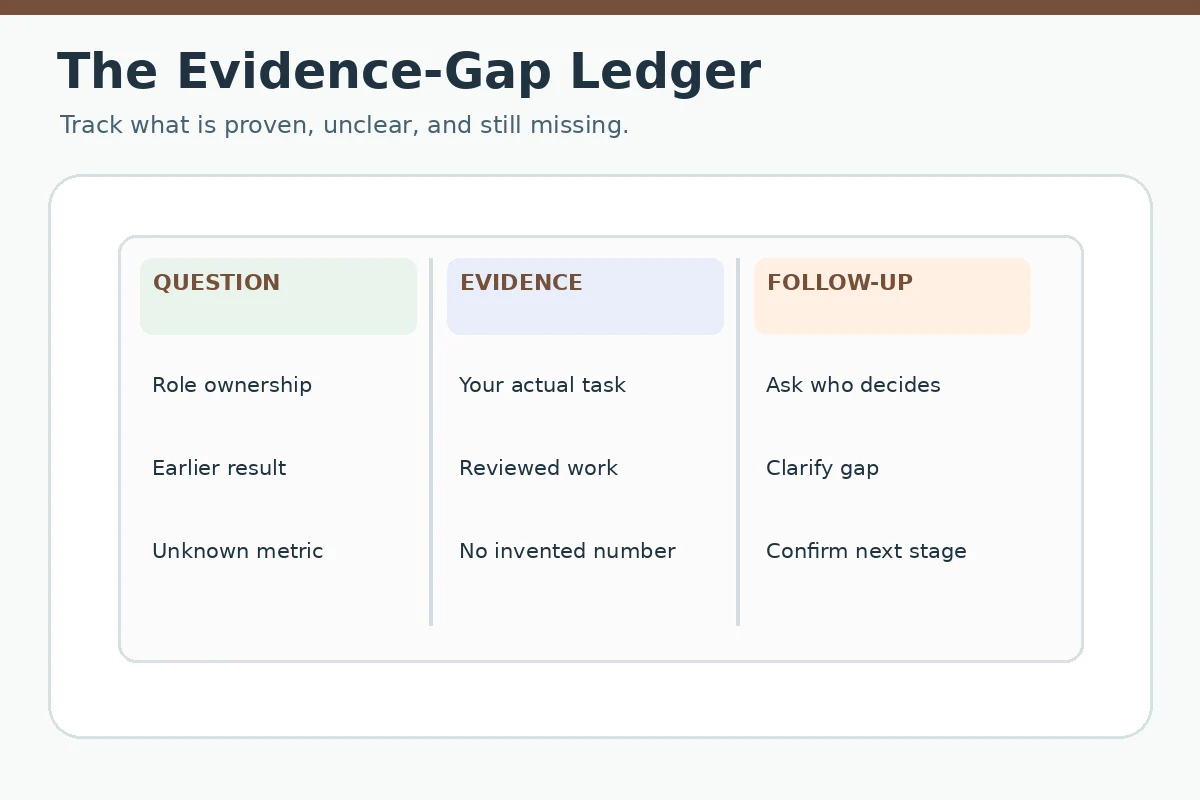
Create a short evidence-gap list before the meeting: a claim you can support more precisely, a skill the employer has not explored, and a role requirement you still need to clarify. Verify interviewer names or functions through the recruiting contact. If another exercise or reference request is planned, ask about scope, timing and authorized materials rather than assuming every employer uses the same third-round format.
Build a Record From the First Two Rounds
Write down only facts you actually remember: who discussed the role, which requirements came up, what you said about your responsibilities, and which questions were left unresolved. If you do not have notes, rebuild a simple outline without claiming a verbatim transcript. Mark unknowns as unknown. A reliable record keeps dates, titles and numbers aligned with your application.
Identify one important example that needs a better explanation. Perhaps you described a delivery problem but omitted the review step or the way responsibility was assigned. The third interview lets you add those details. It does not justify changing “I assisted” to “I led” or turning a team outcome into a solo result.
Add Evidence Rather Than Repeating a Script
For each likely follow-up, prepare context, your action, the relevant check, and the result that you can substantiate. OPM’s advice on structured questions uses a situation, action and result approach; it is a useful rehearsal method even if the organization does not use a standardized interview. Keep a shorter and a longer version of a story so you can answer without rushing or rambling.
A hypothetical example: the employer asks how you handled competing service requests. A stronger third-round response names the priority rule used, the information checked, what was escalated, and how you closed the handoff. Do not supply fabricated customer names, rates or employer policies. When you lack evidence, explain your decision process and its limit.
| Still unknown after two rounds | Third-round preparation | Guardrail |
|---|---|---|
| Whether a skill was demonstrated | One real example with scope, check and result | Keep original dates and ownership consistent |
| Who decides a risky exception | Explain a decision boundary and escalation | Never invent approval authority |
| What the new role actually owns | Ask a role-specific question and record the answer | Do not treat a verbal possibility as final terms |
Introduce Your Story to New Interviewers
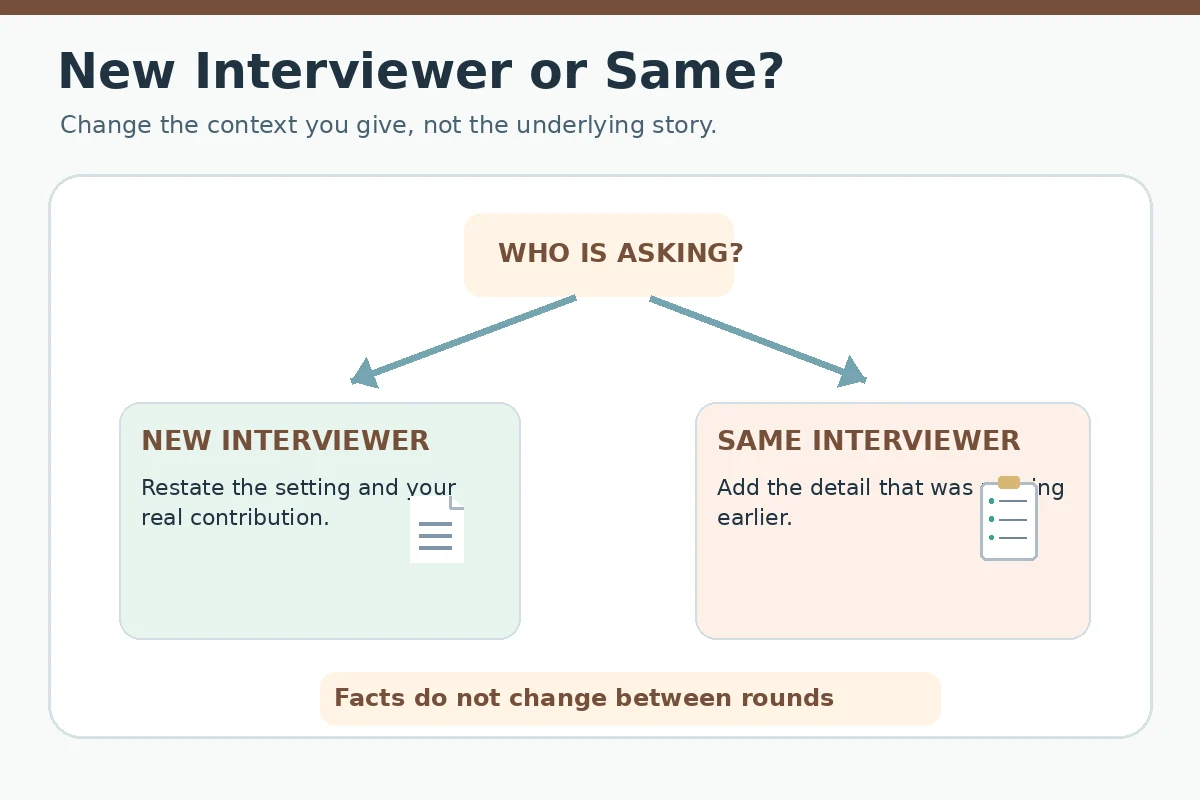
If a new leader or peer attends, begin with enough background for someone who was not in earlier rounds. “In my previous support role, I owned the daily queue review” gives useful context; “as I said last time” does not. You can restate a verified story and then add the detail the new person needs. Consistency means facts stay the same, not that every sentence must be identical.
If the same interviewer is present, connect the new detail to their earlier question: “You asked how we checked the fix. I can explain the review step.” Do not imply the interviewer remembers every note. Ask for clarification when a hypothetical prompt is ambiguous, then state which assumptions you are making.
Prepare for Unresolved Risk and Role Boundaries
Late-stage discussions sometimes probe exceptions: what you do when two deadlines collide, when information is missing, or when a requested action is outside your authority. Use a decision rule: verify the objective, check the policy or job scope, identify who can approve, act within permission, and document the handoff. A claim that you personally solved every issue is less convincing than sound boundaries.
If the employer introduces a new responsibility, ask whether it is a core duty, occasional support, or a later development area. Do not agree to a required license, credential or work arrangement you cannot honestly meet. If the role appears materially different from the posting, request an accurate revised description before relying on the new terms.
Ask What Remains to Be Decided
Use two questions: one about the work and one about the decision process. “Which first-month task will show whether the new hire is on track?” is more focused than a generic request for a company overview. “Are there any remaining job-related areas you would like me to explain more clearly?” gives the interviewer a fair chance to raise a concern.
For logistics, use the recruiter: ask whether additional interviews, references or a formal offer review remain and how they communicate updates. Do not assume the third round is always the final round. Avoid speculative questions about other candidates, hidden ratings or why a particular person was invited to interview you.
Follow Up Without Overstating a Signal
After the meeting, save a brief record of new facts, confirmed expectations, and what you agreed to provide. Send any approved follow-up material through the stated channel. Do not attach restricted work samples, disclose third-party information, or present an unapproved solution as an employer-endorsed recommendation.
A positive conversation can still end without an offer. Thank the interviewers, note one relevant topic, and wait for the employer’s stated decision process. If an offer arrives, review its written terms; if the process continues, prepare for the stated next stage. Your strongest asset is a stable, truthful account of what you can do.
How We Research Interview Guidance
We reviewed the linked career and public-interest guidance on 2026-11-14: U.S. Office of Personnel Management (The U.S. Office of Personnel Management explains that structured interviews assess job-related competencies through behavior and hypothetical situations.); OPM interview question guidance (OPM recommends job-relevant, open-ended questions and a situation, action and result structure.); Indeed third-interview guide (Indeed career advice describes third-round interview preparation and deeper situational questions.). We also compared candidate topics with the WordPress title inventory supplied by the site owner, the preceding local package and the original JobAsk content plan. Interview formats and employer procedures differ; all sample scenarios here are hypothetical, not verified employment histories, interview transcripts, promises of hiring outcomes or a substitute for employer policy. For transparency, see the JobAsk affiliate disclosure; this article does not claim an endorsement or paid partnership.
No. It shows the employer scheduled another assessment or conversation, not that an offer is guaranteed.
Yes when relevant, especially for new interviewers. Keep facts consistent and add useful missing details.
Clarify the underlying facts, acknowledge a real correction, and avoid changing dates or exaggerating personal ownership.
Yes. Hiring processes vary; ask the recruiter what stages remain and how updates will be sent.
Thank the interviewer, mention one actual job topic discussed, and provide only accurate information requested through the verified channel.